

Amazon Translate AI
Use Amazon Translate AI as the anchor for a real shortlist.
Instead of returning to a broad directory, jump straight into the strongest adjacent matchups for pricing, workflow fit, and differentiation.
Overview
Overview
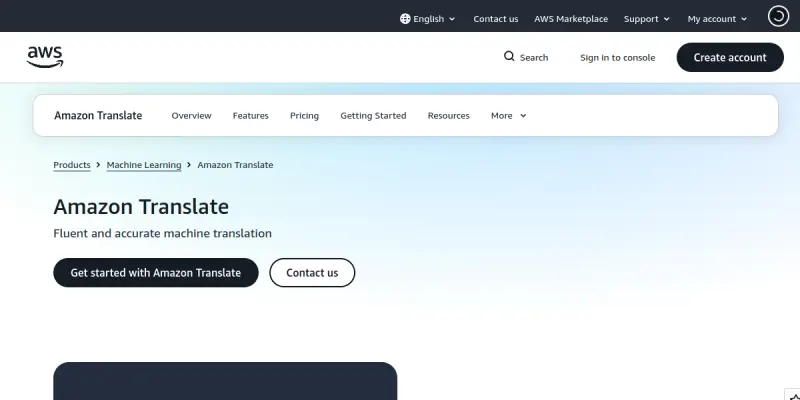
Amazon Translate is a fully managed neural machine translation service from Amazon Web Services (AWS). It uses deep learning models to deliver fluent, natural-sounding translations across a wide range of languages. Unlike traditional statistical or rule-based methods, Amazon Translate learns from massive corpora to handle context, idioms, and domain-specific terminology more effectively. It supports both real-time and batch translation, making it suitable for everything from live chat to document localization.
Key Features
- Real-time Translation: Translate text in milliseconds via the API, ideal for customer support chats, live dashboards, and dynamic content.
- Batch Translation: Process large volumes of text (documents, PDFs, HTML) in one job, with support for input/output in Amazon S3.
- Custom Terminology: Upload custom glossaries to enforce specific translations for brand names, technical terms, or acronyms.
- Active Custom Translation: Train custom models on your parallel texts to improve translation quality for your domain (e.g., legal, medical, financial).
- Language Detection: Automatically identifies source languages, reducing manual setup work.
- Integration with AWS Services: Seamlessly works with Amazon S3, Amazon Comprehend, Amazon Polly, and AWS Lambda for end-to-end AI pipelines.
- Automatic Updates: The underlying models are continuously improved by AWS, so translations get better over time without user intervention.
Use Cases
Multilingual Customer Support
Enterprises can use Amazon Translate to convert customer inquiries and knowledge base articles in real time, enabling support teams to assist users in their preferred language without hiring multilingual staff.
Content Localization
Global businesses can batch-translate marketing materials, user guides, and product descriptions stored in Amazon S3. Custom terminology ensures brand consistency, while Active Custom Translation improves fluency for niche industries.
Social Media Monitoring
Analytics platforms can integrate Amazon Translate to detect sentiment and trends across multiple languages, helping organizations understand global audience reactions.
E-commerce Product Listing Translation
Online retailers can translate product titles, descriptions, and reviews automatically, allowing them to launch stores in new regions rapidly while maintaining accuracy on product-specific terms.
Internal Collaboration
Multinational teams can use the API to translate internal communications, meeting notes, or project documentation, reducing barriers between offices that speak different languages.
Pricing & Plans
Amazon Translate uses a pay-as-you-go pricing model based on the number of characters processed. There is a free tier of 2 million characters per month for the first 12 months (limited to specific features). After that, standard rates apply: $15 per million characters for real-time translation. Batch translation and Active Custom Translation have additional costs. Enterprise customers can negotiate custom pricing or reserved capacity. All plans require an AWS account.
Integrations & Compatibility
Amazon Translate integrates natively with Amazon S3, Amazon Comprehend (for NLP), Amazon Polly (for text-to-speech), AWS Lambda (for serverless workflows), and Amazon CloudWatch (for monitoring). It supports more than 75 languages and variant pairs. The service is accessible via the AWS Management Console, CLI, and SDKs for Python, Java, .NET, and JavaScript. It also supports HIPAA eligibility and PCI DSS compliance for regulated industries.
Who Is It For?
Amazon Translate is designed for developers, data engineers, and DevOps teams who build and maintain multilingual applications. It is also suitable for content managers, localization specialists, and enterprises that need scalable, cost-effective translation without managing infrastructure. Beginners in AI or cloud may need some familiarity with AWS to use the service effectively.
Limitations
- Requires AWS Ecosystem: To get the most out of the service, users typically need other AWS products, which can create vendor lock-in.
- No Free Real-Time Tier: The free tier only covers batch translation; real-time use incurs charges from the start.
- Internet Dependency: The service is cloud-based; offline operation is not supported.
- Niche Language Support: While broad, less common languages may have lower translation quality compared to major language pairs.
Final Verdict
Amazon Translate is a robust, production-grade translation service that excels when combined with other AWS tools. Its deep learning approach and customisation options (terminology, active training) give it an edge for enterprises needing high-volume, consistent translation. However, teams outside the AWS ecosystem or seeking a zero-cost entry point may find alternatives more accessible. For existing AWS customers, the seamless integration and scalability make it a compelling choice.
Tool Facts
Screenshots & Interface
Pros
- ✓ Seamlessly integrates with AWS services like S3, Lambda, and Comprehend for automated translation pipelines.
- ✓ Custom terminology and active custom training allow businesses to enforce brand-specific or domain-accurate translations.
- ✓ Pay-as-you-go pricing model scales from small projects to enterprise-grade throughput without upfront costs.
- ✓ Supports real-time and batch translation across over 75 languages, covering most global business needs.
Cons
- × Vendor lock-in: optimal usage requires deep integration with the AWS ecosystem, making migration to other platforms difficult.
- × Real-time translation incurs costs from the start; there is no free tier for real-time use.
- × Translation quality for less common languages may be lower than for major pairs like English-Spanish or English-French.
- × Active custom translation training can add additional complexity and cost for users unfamiliar with machine learning workflows.
How to Use Amazon Translate AI in Your Workflow
Integrating Amazon Translate AI into your professional toolkit enhances efficiency by automating manual steps. By configuring it to suit your specific project requirements, you can optimize output quality and reduce project cycle times. Standard workflows involve testing the tool on simple tasks before scaling its use to complex operations.
Frequently Asked Questions
What is Amazon Translate AI used for?
Amazon Translate is a neural machine translation service from AWS that uses deep learning to convert text across languages. It supports batch and real-time translation for enterprises and developers. A key differentiator is its tight integration with other Amazon Web Services for scalable workflows.
What is the pricing model for Amazon Translate AI?
Amazon Translate AI uses a Paid pricing model.
What are the main advantages of Amazon Translate AI?
The key benefits of Amazon Translate AI include: Seamlessly integrates with AWS services like S3, Lambda, and Comprehend for automated translation pipelines., Custom terminology and active custom training allow businesses to enforce brand-specific or domain-accurate translations., Pay-as-you-go pricing model scales from small projects to enterprise-grade throughput without upfront costs., Supports real-time and batch translation across over 75 languages, covering most global business needs..
What are the main limitations of Amazon Translate AI?
Some limitations or cons of Amazon Translate AI are: Vendor lock-in: optimal usage requires deep integration with the AWS ecosystem, making migration to other platforms difficult., Real-time translation incurs costs from the start; there is no free tier for real-time use., Translation quality for less common languages may be lower than for major pairs like English-Spanish or English-French., Active custom translation training can add additional complexity and cost for users unfamiliar with machine learning workflows..
Alternative AI Tools

Checksub AI
Checksub AI is an automated subtitling, translation, and dubbing platform for video creators and businesses. It uses voice cloning and lip-syncing technology to localize content in over 180 languages, helping users expand their audience reach.

AutoCap AI
AutoCap AI automates video subtitling with AI translation. It helps content creators and businesses quickly generate multilingual captions.

DeepL
Explore our AI suite and get more done: Translate speech, text, and media, or integrate the DeepL API.
Rating Details
Based on 0 ratings
Related Tools
More AI tools from the same workflow, industry, or category.
fablepilot
FablePilot is a free AI story generator that turns a single prompt into a complete story — no sign-up required. Add illustrations or generate a plot outline.
Ghosts.app
Ghosts is an AI ghostwriter for agencies, creators, and law firms. It produces researched, cited drafts in a specific voice without requiring prompts. Users brief a specialist agent and approve a finished draft.
GrowthBar
GrowthBar is an AI tool for content generation, designed to boost productivity and streamline workflows for writers and content creators, with features like editing and tone adjustment.
GetGenie AI
GetGenie AI is an AI-powered writing and SEO assistant that helps content creators and marketers generate optimized content quickly. It includes built-in keyword research and SERP analysis to improve organic search performance.
Reviews
No reviews submitted yet. Be the first to share your experience.
Write a Review
Share Your Experience
Join the community to write reviews, submit ratings, and bookmark your favorite AI tools.