

Lunit AI
Use Lunit AI as the anchor for a real shortlist.
Instead of returning to a broad directory, jump straight into the strongest adjacent matchups for pricing, workflow fit, and differentiation.
Overview
Overview
Lunit AI is a medical artificial intelligence company that provides software solutions for radiology. The platform utilizes deep learning algorithms to analyze medical images, specifically chest X-rays and breast scans, to assist radiologists in detecting abnormalities. The primary goal is to enhance the accuracy and efficiency of cancer screening and diagnosis, offering decision support tools that integrate into existing clinical workflows.
Key Features
- AI-Powered Image Analysis: Leverages deep learning to detect lung nodules and breast cancerous tissues in medical scans.
- Clinical Decision Support: Provides radiologists with objective second opinions to reduce diagnostic errors.
- Workflow Integration: Seamlessly integrates with Picture Archiving and Communication Systems (PACS) and Radiology Information Systems (RIS).
- Multi-Modality Support: Capable of analyzing various imaging modalities to support comprehensive care.
- Precision Oncology: Helps in characterizing tumors and staging cancers more accurately.
- Regulatory Compliance: Solutions are developed in compliance with global regulatory standards like FDA and CE marking.
Use Cases
Lung Cancer Screening
Lunit AI is widely used in lung cancer screening programs. By analyzing chest X-rays, the AI identifies potential lung nodules that might be missed by the human eye, significantly aiding in the early detection of lung cancer, which is often asymptomatic in early stages.
Breast Cancer Detection
The tool extends its capabilities to breast imaging. It assists radiologists in detecting subtle signs of malignancy in mammograms, helping to standardize interpretations and improve the consistency of breast cancer diagnoses across different institutions.
Radiology Workflow Optimization
Hospitals utilize Lunit AI to streamline their radiology departments. By automating the initial analysis of images, it reduces the workload on radiologists, allowing them to focus on complex cases and patient care.
Medical Research & Clinical Trials
Research institutions use the technology to accelerate clinical trials by identifying eligible patients more efficiently through image analysis.
Pricing & Plans
Lunit offers its solutions through various licensing models. While the tool is accessible, enterprise-grade solutions typically require custom pricing based on the volume of scans and the specific needs of the healthcare facility. There is generally a free tier or evaluation period available for testing the core functionalities before committing to a full enterprise contract.
Integrations & Compatibility
Lunit AI is designed to be compatible with standard medical infrastructure. It integrates natively with major PACS and RIS systems, allowing the AI analysis to appear directly in the radiologist's workstation. This ensures that the insights are available at the point of care without disrupting existing clinical routines.
Who Is It For?
This tool is specifically designed for radiologists, oncologists, and medical professionals involved in diagnostic imaging. It is also suitable for healthcare administrators looking to improve diagnostic efficiency and reduce operational costs through automation.
Limitations
- Specialized Hardware: The system may require specific hardware configurations or software integration to function optimally within a hospital network.
- Niche Focus: While highly effective for specific cancers like lung and breast, it is not a general-purpose tool for all types of radiological diagnostics.
- Interpretation Dependency: While it supports decision-making, the AI outputs should always be reviewed by a qualified medical professional and is not a substitute for human expertise.
Final Verdict
Lunit AI represents a significant advancement in medical imaging technology. By combining deep learning with clinical workflows, it offers tangible benefits in terms of early cancer detection and diagnostic support. While it requires integration effort, the potential to save lives through improved accuracy makes it a valuable asset for modern radiology departments.
Tool Facts
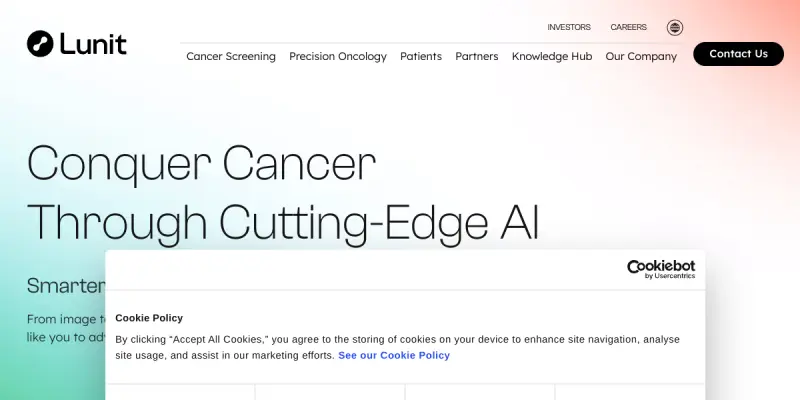
Screenshots & Interface
Pros
- ✓ Improves diagnostic accuracy for lung and breast cancer screening
- ✓ Streamlines radiology workflows by automating image analysis
- ✓ Provides actionable insights to support clinical decision-making
Cons
- × Requires integration with specific medical imaging hardware
- × Focuses primarily on specific cancer types (lung, breast) rather than general radiology
- × May require specialized training to interpret AI-generated reports
How to Use Lunit AI in Your Workflow
Integrating Lunit AI into your professional toolkit enhances efficiency by automating manual steps. By configuring it to suit your specific project requirements, you can optimize output quality and reduce project cycle times. Standard workflows involve testing the tool on simple tasks before scaling its use to complex operations.
Frequently Asked Questions
What is Lunit AI used for?
Lunit AI analyzes medical images to support early cancer detection and precision oncology in radiology.
What is the pricing model for Lunit AI?
Lunit AI uses a Free pricing model.
What are the main advantages of Lunit AI?
The key benefits of Lunit AI include: Improves diagnostic accuracy for lung and breast cancer screening, Streamlines radiology workflows by automating image analysis, Provides actionable insights to support clinical decision-making.
What are the main limitations of Lunit AI?
Some limitations or cons of Lunit AI are: Requires integration with specific medical imaging hardware, Focuses primarily on specific cancer types (lung, breast) rather than general radiology, May require specialized training to interpret AI-generated reports.
Alternative AI Tools

Lemonaid AI
Lemonaid AI generates unique melodies and chords using AI trained by Grammy-winning producers. Create compositions in MIDI or Audio format for music production.
Viz.ai
Viz.ai is an AI care coordination platform that automates disease detection and alerts. It streamlines workflows for radiologists and clinicians in over 1,700 hospitals.

Philips AI
Philips AI provides AI-powered medical imaging and diagnostic tools for healthcare professionals. The platform helps improve diagnostic accuracy and workflow efficiency in clinical settings. It offers both free and paid tiers to accommodate different facility sizes.
Rating Details
Based on 0 ratings
Quick Comparisons
Related Tools
More AI tools from the same workflow, industry, or category.
fr3n
fr3n is a creator platform that combines a link-in-bio page, digital storefront, community spaces, and newsletters into one hub. It helps creators sell digital products, run memberships, and build an audience with first-party data.
Aveva AI
Aveva AI optimizes industrial processes and predictive maintenance by leveraging AI models to detect anomalies and support risk-based decision-making in manufacturing.
Paddle AI
Paddle AI streamlines billing, tax compliance, and revenue management for digital businesses. This SaaS platform automates financial operations, supporting global revenue generation for apps like n8n and AdGuard. It integrates essential payment processing tools into a single interface.
Honeywell Forge AI
Honeywell Forge is an industrial IoT platform that combines digital twin technology with AI to optimize facility operations. It is designed for industrial manufacturers seeking predictive maintenance and operational efficiency.
Reviews
No reviews submitted yet. Be the first to share your experience.
Write a Review
Share Your Experience
Join the community to write reviews, submit ratings, and bookmark your favorite AI tools.