

Semantic Scholar AI
Use Semantic Scholar AI as the anchor for a real shortlist.
Instead of returning to a broad directory, jump straight into the strongest adjacent matchups for pricing, workflow fit, and differentiation.
Overview
Overview
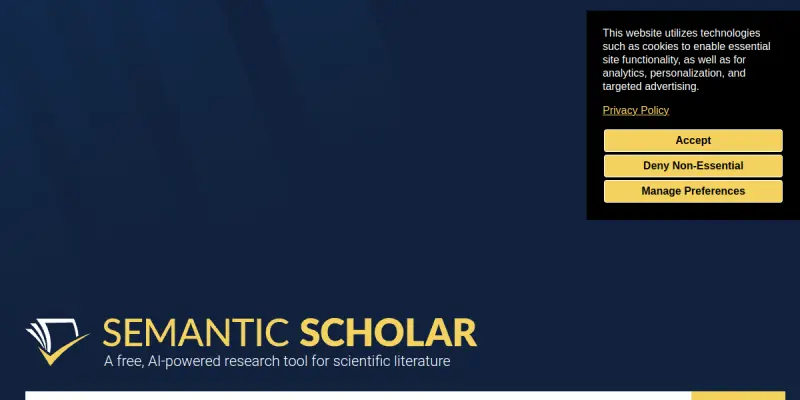
Semantic Scholar is a free, AI-powered academic search engine developed by the Allen Institute for Artificial Intelligence (AI2). It indexes over 200 million scholarly papers across all scientific disciplines, using natural language processing to understand the meaning and context of research. Unlike traditional keyword-based search tools, Semantic Scholar analyzes the semantics of scientific texts to surface the most relevant papers, authors, and citations. It is designed for researchers, students, librarians, and anyone engaged in scientific literature discovery.
Key Features
- Semantic Search: Uses AI to understand the meaning behind search queries, delivering more relevant and context-aware results compared to keyword matching.
- Citation Graphs: Visualizes citation networks for any paper, showing how research has been built upon over time and identifying influential works.
- Paper Recommendations: Learns from your reading history and library to suggest new papers you may find relevant.
- Research Feeds: Create custom alerts for specific topics, authors, or journals to receive notifications when new papers are published.
- TL;DR Summaries: Provides brief, AI-generated summaries of paper abstracts to help you quickly assess relevance.
- API Access: Offers a free API for developers to programmatically query the corpus and integrate paper data into their own applications.
Use Cases
Literature Review for Graduate Students
Graduate students can use Semantic Scholar to quickly find core papers in their field, explore related work through citation graphs, and stay up to date with new publications relevant to their thesis or dissertation.
Keeping Current for Busy Researchers
Researchers can set up research feeds for their specific topics of interest. The platform will automatically deliver new paper recommendations, saving hours of manual searching each week.
Bibliometric Analysis for Librarians
Librarians and information specialists can use the citation graph and API to analyze research impact, track emerging trends, and answer complex bibliometric questions for their institutions.
Pricing & Plans
Semantic Scholar is completely free for all users. There are no paid tiers or subscription plans. The platform is supported by the Allen Institute for Artificial Intelligence, a nonprofit research organization.
Integrations & Compatibility
Semantic Scholar offers a free REST API that allows developers to search papers, retrieve citation graphs, and access metadata. The web interface works on all modern browsers and mobile devices. There is no native desktop application.
Who Is It For?
Semantic Scholar is intended for academics, researchers, graduate and undergraduate students, science writers, librarians, and anyone who needs to find and explore scientific literature. It is especially valuable for those working in computer science, neuroscience, biomedical research, and other STEM fields where the corpus is large and fast-growing.
Limitations
- Discipline Coverage: While strong in computer science and biomedicine, coverage in some humanities and social sciences may be less comprehensive.
- No Full-Text Access: Semantic Scholar indexes metadata and abstracts but does not host full papers; you may need institutional access or open-access versions to read the full text.
- API Rate Limits: The free API has rate limits that may affect large-scale or high-frequency integration projects.
Final Verdict
Semantic Scholar is an indispensable tool for anyone involved in scientific research. Its AI-powered search and recommendation features significantly reduce the time spent on literature discovery. The platform's free access, robust API, and visual citation graphs make it a top-tier resource for academics and researchers. While it does not replace full-text databases, it excels at helping users find and navigate the vast landscape of scientific publications.
Tool Facts
Screenshots & Interface
Pros
- ✓ Semantic search understands meaning behind queries, delivering more relevant results than keyword-based search.
- ✓ Citation graph feature visualizes how research builds over time and identifies influential papers.
- ✓ Custom research feeds send new paper alerts automatically, saving hours of manual searching.
- ✓ Free API enables developers to integrate search and citation data into their own applications.
- ✓ TL;DR summaries help users quickly assess a paper's relevance before reading the full abstract.
Cons
- × Coverage in humanities and social sciences is less comprehensive than in STEM fields.
- × The tool indexes metadata only, so full-text access still requires institutional subscriptions or open-access sources.
- × API rate limits may restrict large-scale or high-frequency data retrieval projects.
How to Use Semantic Scholar AI in Your Workflow
Integrating Semantic Scholar AI into your professional toolkit enhances efficiency by automating manual steps. By configuring it to suit your specific project requirements, you can optimize output quality and reduce project cycle times. Standard workflows involve testing the tool on simple tasks before scaling its use to complex operations.
Frequently Asked Questions
What is Semantic Scholar AI used for?
Semantic Scholar is an AI-powered research assistant that helps scholars and researchers discover scientific literature by analyzing semantic relationships. It provides citation graphs, paper recommendations, and alert features for staying current with new publications.
What is the pricing model for Semantic Scholar AI?
Semantic Scholar AI uses a Paid pricing model.
What are the main advantages of Semantic Scholar AI?
The key benefits of Semantic Scholar AI include: Semantic search understands meaning behind queries, delivering more relevant results than keyword-based search., Citation graph feature visualizes how research builds over time and identifies influential papers., Custom research feeds send new paper alerts automatically, saving hours of manual searching., Free API enables developers to integrate search and citation data into their own applications., TL;DR summaries help users quickly assess a paper's relevance before reading the full abstract..
What are the main limitations of Semantic Scholar AI?
Some limitations or cons of Semantic Scholar AI are: Coverage in humanities and social sciences is less comprehensive than in STEM fields., The tool indexes metadata only, so full-text access still requires institutional subscriptions or open-access sources., API rate limits may restrict large-scale or high-frequency data retrieval projects..
Alternative AI Tools

Readwise AI
Readwise AI is a knowledge retention tool that resurfaces your best book highlights via daily email. It imports highlights from Kindle, Instapaper, and iBooks. It helps readers and lifelong learners remember and apply what they read without manual effort.

Kosmik AI
Kosmik AI is a knowledge management tool that helps users collect, organize, and connect information across multiple formats. It functions as a digital workspace for creatives and researchers to build a personal knowledge base. Its key differentiator is the ability to save any web content, file, or note as a visual card for flexible linking.

Heptabase AI
Heptabase is a visual knowledge base that helps students, researchers, and lifelong learners organize and connect complex information. It combines note-taking with a digital whiteboard to map ideas and build a second brain. Its key differentiator is the use of visual cards and whiteboard-style thinking for deeper understanding.
Rating Details
Based on 0 ratings
Related Tools
More AI tools from the same workflow, industry, or category.
Mailbutler AI
Mailbutler AI is an email extension that integrates AI-powered writing, scheduling, and tracking features directly into your existing inbox. It helps professionals and teams streamline email workflows and save time on routine communication tasks.
Lucidspark AI
Lucidspark AI is a virtual whiteboard tool that helps teams brainstorm, organize ideas, and move from concept to execution. It is designed for remote and hybrid teams seeking a structured yet flexible collaboration space. Its integration with Lucidchart sets it apart for end-to-end visual workflow planning.
SignNow AI
SignNow AI automates document signing and workflow management for businesses. It uses AI to extract fields, send documents for signature, and track completion. Ideal for HR, legal, and sales teams.
ProtonMail AI
ProtonMail AI is an integrated writing assistant for secure email, leveraging Swiss privacy standards to draft, summarize, and translate messages within the Proton Mail interface.
Reviews
No reviews submitted yet. Be the first to share your experience.
Write a Review
Share Your Experience
Join the community to write reviews, submit ratings, and bookmark your favorite AI tools.