

Spatial AI
Use Spatial AI as the anchor for a real shortlist.
Instead of returning to a broad directory, jump straight into the strongest adjacent matchups for pricing, workflow fit, and differentiation.
Overview
Overview
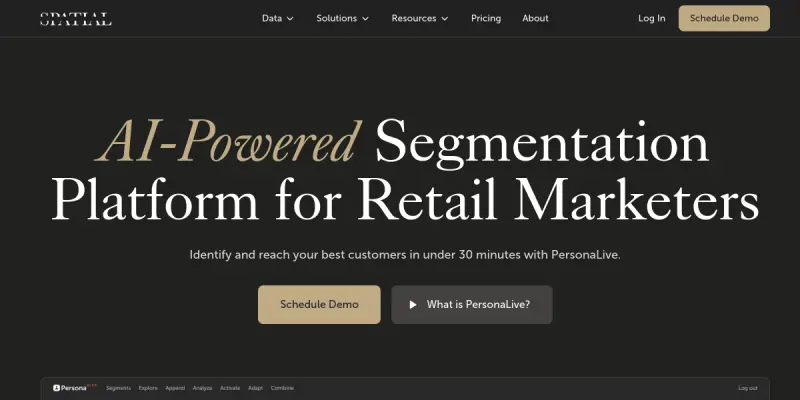
Spatial AI is a geospatial audience intelligence platform that enables retail marketers to identify and reach their ideal customers within 60 minutes. By merging location data with machine learning, it provides actionable audience segments for targeted marketing campaigns. The tool is designed for businesses seeking to optimize their marketing spend through data-driven customer discovery.
Key Features
- Geospatial Audience Segmentation: Analyze and segment audiences based on location intelligence to find high-value customer groups.
- Fast Campaign Activation: Generate audience segments in under 60 minutes, enabling rapid deployment of targeted marketing campaigns.
- Machine Learning Models: Leverage advanced ML algorithms to predict customer behaviors and preferences from location patterns.
- Location Data Integration: Combine first-party data with proprietary geospatial datasets for richer audience profiles.
- Visual Heatmaps: Explore customer concentration areas through interactive heatmaps on the platform’s dashboard.
- API Access: Integrate spatial audience insights directly into existing marketing tools and workflows via a REST API.
- Retail-Focused Dashboards: View customer segmentation and campaign performance metrics tailored for retail marketing teams.
Use Cases
Retail Marketing Optimization
Retail brands can use Spatial AI to identify high-potential store locations or neighborhoods for targeted advertising, reducing wasted ad spend.
Event Campaigns
Marketers planning events can segment audiences by geographic behavior, inviting only those likely to attend based on proximity and past visitation patterns.
Product Launch Targeting
When launching a new product in specific regions, Spatial AI helps create custom audience segments for localized marketing pushes.
Competitive Analysis
Retailers can analyze foot traffic patterns around competitor stores to fine-tune their own outreach strategies.
Pricing & Plans
Spatial AI operates on a freemium model. The free tier provides limited access to audience segmentation and basic heatmaps. Paid tiers offer advanced features such as higher API rate limits, custom data exports, and dedicated support. Specific pricing for paid plans is not publicly disclosed and requires contacting the sales team.
Integrations & Compatibility
- API Integration: RESTful API for connecting with CRM, DMP, and ad platforms such as Facebook Ads and Google Ads.
- Data Export: Export audience segments as CSV or JSON files for use in external tools.
- Browser-Based: Fully web-based SaaS platform, accessible from any modern browser.
- No Native Mobile App: No dedicated mobile application is available.
Who Is It For?
Spatial AI is aimed at retail marketers, brand managers, and data analysts working in omnichannel retail. It is also suitable for agencies that need fast, location-driven audience insights for client campaigns.
Limitations
- Internet Dependency: Requires a stable internet connection to access the platform and process data.
- Limited Free Tier: The free tier has significant usage caps, and advanced features require a paid subscription.
- Focus on Retail: Primarily optimized for retail marketing use cases; may not be suitable for industries like healthcare or finance without customization.
Final Verdict
Spatial AI delivers a powerful solution for retail marketers seeking rapid geospatial audience segmentation. Its fast activation time and intuitive interface make it a strong choice for data-driven campaigns. However, the limited free tier and lack of public pricing may be barriers for smaller teams. Overall, it is a valuable tool for retail-focused audience intelligence.
Tool Facts
Screenshots & Interface
Pros
- ✓ Generates audience segments in under 60 minutes, enabling rapid campaign activation.
- ✓ Combines location data with machine learning for precise geospatial audience insights.
- ✓ Offers a free tier to test core segmentation features before committing to a paid plan.
Cons
- × The free tier has limited features, requiring a paid subscription for full utilization.
- × Pricing for paid plans is not publicly disclosed, making cost evaluation difficult.
- × Platform is optimized for retail marketing and may not suit non-retail industries.
How to Use Spatial AI in Your Workflow
Integrating Spatial AI into your professional toolkit enhances efficiency by automating manual steps. By configuring it to suit your specific project requirements, you can optimize output quality and reduce project cycle times. Standard workflows involve testing the tool on simple tasks before scaling its use to complex operations.
Frequently Asked Questions
What is Spatial AI used for?
Spatial AI uses AI-powered geospatial segmentation to help retail marketers and brands identify and reach their best customers within 60 minutes. It combines location data with machine learning for actionable audience insights.
What is the pricing model for Spatial AI?
Spatial AI uses a Freemium pricing model.
What are the main advantages of Spatial AI?
The key benefits of Spatial AI include: Generates audience segments in under 60 minutes, enabling rapid campaign activation., Combines location data with machine learning for precise geospatial audience insights., Offers a free tier to test core segmentation features before committing to a paid plan..
What are the main limitations of Spatial AI?
Some limitations or cons of Spatial AI are: The free tier has limited features, requiring a paid subscription for full utilization., Pricing for paid plans is not publicly disclosed, making cost evaluation difficult., Platform is optimized for retail marketing and may not suit non-retail industries..
Alternative AI Tools

Inworld AI
Inworld AI is a character engine providing real-time voice synthesis and conversational agents for interactive experiences. It features low-latency TTS and voice cloning capabilities designed for scalable applications.

GameBench AI
GameBench AI is an automated testing framework for video games, designed for developers and QA teams. It uses AI-driven bots to simulate player behaviors and detect bugs, performance issues, and balance problems. Its key differentiator is the integration of reinforcement learning for adaptive test generation.

PlaytestCloud AI
PlaytestCloud AI helps game developers collect player feedback through video recordings and surveys. It supports PC, mobile, browser, and Steam games. Its key differentiator is using AI to analyze play sessions and deliver actionable insights quickly.
Rating Details
Based on 0 ratings
Quick Comparisons
Related Tools
More AI tools from the same workflow, industry, or category.
fr3n
fr3n is a creator platform that combines a link-in-bio page, digital storefront, community spaces, and newsletters into one hub. It helps creators sell digital products, run memberships, and build an audience with first-party data.
Aveva AI
Aveva AI optimizes industrial processes and predictive maintenance by leveraging AI models to detect anomalies and support risk-based decision-making in manufacturing.
Paddle AI
Paddle AI streamlines billing, tax compliance, and revenue management for digital businesses. This SaaS platform automates financial operations, supporting global revenue generation for apps like n8n and AdGuard. It integrates essential payment processing tools into a single interface.
Honeywell Forge AI
Honeywell Forge is an industrial IoT platform that combines digital twin technology with AI to optimize facility operations. It is designed for industrial manufacturers seeking predictive maintenance and operational efficiency.
Reviews
No reviews submitted yet. Be the first to share your experience.
Write a Review
Share Your Experience
Join the community to write reviews, submit ratings, and bookmark your favorite AI tools.