

Turbine AI
Use Turbine AI as the anchor for a real shortlist.
Instead of returning to a broad directory, jump straight into the strongest adjacent matchups for pricing, workflow fit, and differentiation.
Overview
Overview
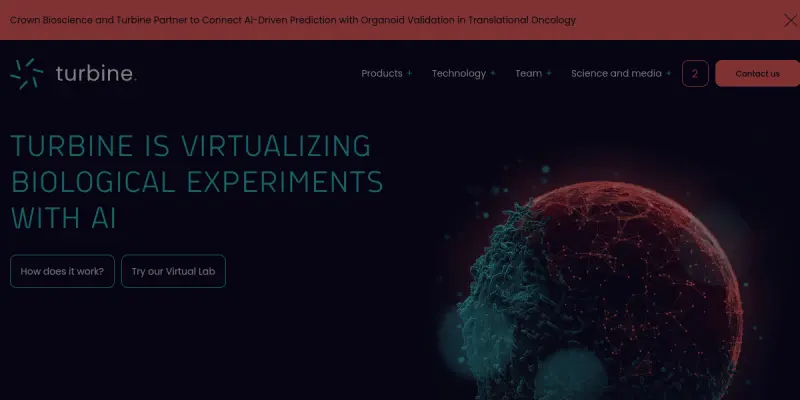
Turbine AI is a platform that leverages artificial intelligence to simulate biological experiments, enabling pharmaceutical researchers to predict how drugs will behave in human biology before physical trials begin. By modeling cellular processes and drug interactions computationally, Turbine aims to reduce the high failure rate of drug candidates in clinical phases and shorten the overall discovery timeline.
Key Features
- Simulated Biology Engine: Uses proprietary AI models to replicate complex biological pathways and predict drug effects in virtual cell systems.
- High-Throughput Screening: Tests thousands of compounds in silico, prioritizing the most promising candidates for lab validation.
- Clinical Translatability Prediction: Estimates the likelihood that a drug candidate will succeed in human trials based on simulated patient data.
- Mechanism of Action Discovery: Identifies how a drug interacts with cellular targets, uncovering potential off-target effects early.
- Data Integration API: Connects with existing lab data systems and public biological databases to enrich simulations.
- Collaboration Workspace: Allows cross-functional teams (biologists, chemists, data scientists) to share models, results, and annotations.
- Automated Reporting: Generates detailed reports on simulation outcomes, including graphs and confidence scores.
- Pre-built Disease Models: Offers library of validated models for major therapeutic areas such as oncology, neurology, and inflammation.
Use Cases
Preclinical Drug Screening
Researchers can run virtual assays on thousands of compounds to filter out toxic or ineffective candidates before committing to animal studies. This reduces the number of physical experiments needed and accelerates the hit-to-lead phase.
Target Validation
When a novel biological target is identified, Turbine can simulate the target's role in disease pathways and predict the effect of modulating it, helping teams decide whether to pursue the target.
Clinical Trial Design
By modeling expected patient responses, Turbine can assist in selecting the right patient populations and biomarkers for Phase I/II trials, thereby improving the chances of a positive outcome.
Drug Repurposing
Pharmaceutical companies can input existing approved drugs into Turbine's simulations to discover new therapeutic uses, bypassing early-stage safety testing.
Academic Research Collaboration
University labs can use Turbine to investigate basic biology questions, such as how a particular mutation leads to cancer growth, without the need for wet-lab resources.
Pricing & Plans
Turbine operates on a freemium model. The free tier provides limited simulation runs and access to pre-built disease models. Paid plans (Starter, Professional, and Enterprise) unlock higher simulation volumes, advanced analytics, priority support, and custom model creation. Specific pricing is not publicly disclosed and is custom-quoted for enterprise clients based on usage and team size.
Integrations & Compatibility
Turbine offers a RESTful API for integrating with laboratory information management systems (LIMS) and data warehouses. It also supports import from common data formats (CSV, JSON, SDF) and exports results in PDF and HTML. The platform is web-based and works on all major browsers (Chrome, Firefox, Edge). No native mobile app is currently available.
Who Is It For?
Turbine is designed for pharmaceutical R&D teams, computational biologists, contract research organizations (CROs), and academic researchers involved in drug discovery. It is especially valuable for organizations looking to reduce the costs and time associated with early-stage drug development.
Limitations
- Simulation Fidelity: Virtual models may not fully capture all biological complexities, potentially missing rare side effects or non-linear interactions.
- Data Dependency: The accuracy of predictions relies heavily on the quality and completeness of input data; poor data leads to unreliable outputs.
- Learning Curve: Users need a basic understanding of bioinformatics and pharmacology to interpret simulation results effectively.
- Limited Disease Coverage: While the library includes many models, rare diseases may not be represented, requiring custom model development.
Final Verdict
Turbine AI presents a promising step forward for reducing the inefficiency of traditional drug discovery. Its simulated biology engine and clinical translatability predictions offer tangible value for researchers seeking to de-risk early-stage programs. However, the platform's reliance on high-quality input data and the inherent limitations of computational modeling mean that it should be used as a complement to, not a replacement for, physical experiments. With continued validation and expansion of disease models, Turbine could become an essential tool in the pharmaceutical R&D toolkit.
Tool Facts
Screenshots & Interface
Pros
- ✓ Simulates thousands of experiments in silico, reducing the need for costly wet-lab work.
- ✓ Provides clinical translatability predictions that help de-risk drug candidates before human trials.
- ✓ Offers a freemium tier that allows researchers to test the platform without upfront investment.
- ✓ Includes pre-built disease models for major therapeutic areas, accelerating initial simulations.
Cons
- × Simulation accuracy is limited by the quality and completeness of input biological data.
- × Rare or novel diseases may not be covered by the existing library of pre-built models.
- × Pricing for paid plans is not publicly listed, making cost evaluation difficult for potential customers.
- × The platform currently lacks native mobile support and may not integrate with all legacy lab systems.
How to Use Turbine AI in Your Workflow
Integrating Turbine AI into your professional toolkit enhances efficiency by automating manual steps. By configuring it to suit your specific project requirements, you can optimize output quality and reduce project cycle times. Standard workflows involve testing the tool on simple tasks before scaling its use to complex operations.
Frequently Asked Questions
What is Turbine AI used for?
Turbine AI simulates biological experiments to speed up drug discovery. It helps researchers predict drug responses and improve clinical success rates. The platform targets pharmaceutical R&D teams seeking to reduce costly lab failures.
What is the pricing model for Turbine AI?
Turbine AI uses a Freemium pricing model.
What are the main advantages of Turbine AI?
The key benefits of Turbine AI include: Simulates thousands of experiments in silico, reducing the need for costly wet-lab work., Provides clinical translatability predictions that help de-risk drug candidates before human trials., Offers a freemium tier that allows researchers to test the platform without upfront investment., Includes pre-built disease models for major therapeutic areas, accelerating initial simulations..
What are the main limitations of Turbine AI?
Some limitations or cons of Turbine AI are: Simulation accuracy is limited by the quality and completeness of input biological data., Rare or novel diseases may not be covered by the existing library of pre-built models., Pricing for paid plans is not publicly listed, making cost evaluation difficult for potential customers., The platform currently lacks native mobile support and may not integrate with all legacy lab systems..
Alternative AI Tools

Freeletics AI
Freeletics AI is a fitness application that generates personalized workout plans tailored to each user's fitness level and goals. Designed for individuals seeking efficient home or gym sessions, it adapts workouts based on user feedback and performance. The tool combines AI-driven programming with high-intensity interval training (HIIT) principles.

BetterHelp AI
BetterHelp AI matches users with licensed therapists via online counseling. It features over 32,000 professionals for accessible mental health support.

Insilico Medicine
Insilico Medicine uses generative AI to accelerate drug discovery and clinical research. It provides tools for target identification, molecule generation, and clinical trial prediction. Designed for pharmaceutical researchers, it combines deep learning with biomedical data.
Rating Details
Based on 0 ratings
Related Tools
More AI tools from the same workflow, industry, or category.
fr3n
fr3n is a creator platform that combines a link-in-bio page, digital storefront, community spaces, and newsletters into one hub. It helps creators sell digital products, run memberships, and build an audience with first-party data.
Aveva AI
Aveva AI optimizes industrial processes and predictive maintenance by leveraging AI models to detect anomalies and support risk-based decision-making in manufacturing.
Paddle AI
Paddle AI streamlines billing, tax compliance, and revenue management for digital businesses. This SaaS platform automates financial operations, supporting global revenue generation for apps like n8n and AdGuard. It integrates essential payment processing tools into a single interface.
Honeywell Forge AI
Honeywell Forge is an industrial IoT platform that combines digital twin technology with AI to optimize facility operations. It is designed for industrial manufacturers seeking predictive maintenance and operational efficiency.
Reviews
No reviews submitted yet. Be the first to share your experience.
Write a Review
Share Your Experience
Join the community to write reviews, submit ratings, and bookmark your favorite AI tools.