

AssemblyAI
Use AssemblyAI as the anchor for a real shortlist.
Instead of returning to a broad directory, jump straight into the strongest adjacent matchups for pricing, workflow fit, and differentiation.
Overview
Overview
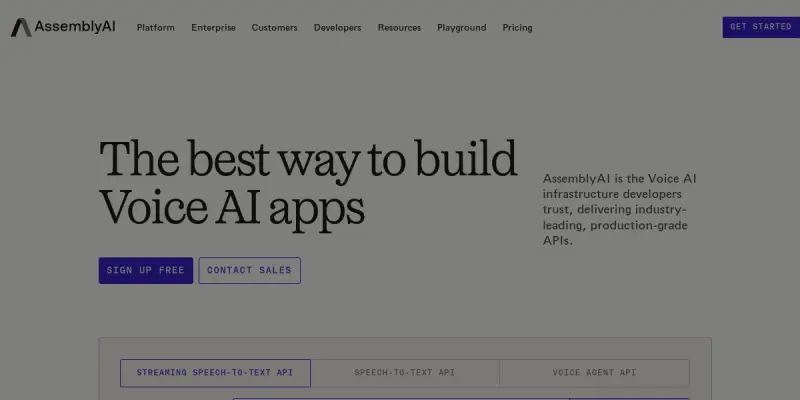
AssemblyAI is a deep learning-powered speech-to-text API that provides accurate transcription, speaker identification, and audio intelligence features. It supports multiple languages, real-time streaming, and batch processing, making it suitable for applications ranging from meeting notes to customer call analytics.
Key Features
- Speech-to-Text: High-accuracy transcription using advanced deep learning models, supporting various audio formats and languages.
- Speaker Diarization: Automatically distinguishes between different speakers in an audio file, labeling each segment.
- Sentiment Analysis: Detects positive, negative, or neutral sentiment for each spoken phrase.
- Content Moderation: Identifies profanity, hate speech, and sensitive content in transcriptions.
- Custom Vocabulary: Allows users to add domain-specific terms to improve recognition accuracy.
- Real-time Streaming: Offers low-latency transcription for live audio streams and voice interfaces.
- Audio Intelligence: Generates summaries, chapters, and key phrases extracted from the audio content.
- Automatic Language Detection: Detects the language spoken and applies the appropriate model.
Use Cases
Customer Support Analytics
Businesses can transcribe customer support calls and analyze sentiment to detect satisfaction issues, escalate complaints, and improve agent training.
Meeting Transcription
Teams can record meetings and generate searchable transcripts with speaker labels, making it easy to revisit decisions and action items.
Media & Content Creation
Podcasters and video editors use AssemblyAI to generate captions, show notes, and searchable archives of their content.
Voice Assistants & Bots
Developers integrate real-time transcription to power voice-driven applications, such as voice-controlled dashboards and interactive voice response systems.
Pricing & Plans
AssemblyAI offers usage-based pricing with pay-as-you-go rates per audio hour. Free tier provides limited usage (up to 3 hours per month). Paid plans start at $0.01 per minute for batch transcription and vary for real-time processing. Enterprise plans with custom SLAs and volume discounts are available upon request.
Integrations & Compatibility
The platform provides REST APIs, WebSocket support, and client libraries for Python, Node.js, Java, and Go. It integrates with popular tools like Zapier, Voxa, and various cloud platforms. Output formats include JSON, SRT, VTT, and plain text.
Who Is It For?
Developers building voice-enabled applications, data analysts processing call recordings, media professionals automating transcription workflows, and enterprises requiring scalable audio intelligence.
Limitations
- Requires internet connectivity for all API calls; offline usage is not supported.
- Accuracy may decrease with heavy accents, background noise, or overlapping speech.
- Custom model training is not available; users rely on pre-trained models.
- High-volume usage can become expensive without an enterprise contract.
Final Verdict
AssemblyAI is a robust and developer-friendly speech-to-text API with strong accuracy and useful audio intelligence features. It is well-suited for scalable transcription needs, though its cost structure may be a consideration for high-volume users. The platform's real-time capabilities and custom vocabulary support give it an edge over some competitors.
Tool Facts
Screenshots & Interface
Pros
- ✓ High transcription accuracy for clear, clean audio.
- ✓ Real-time streaming support enables live transcription use cases.
- ✓ Custom vocabulary option improves recognition of niche terminology.
- ✓ Supports multiple output formats like SRT, VTT, and JSON.
- ✓ SDKs available for Python, Node.js, Java, and Go reduce integration effort.
Cons
- × No offline support requires constant internet connectivity.
- × Free tier is limited to 3 hours per month, which may be restrictive for testing.
- × Accuracy drops significantly with heavy accents or noisy recordings.
- × Pricing can become high for large-scale usage without an enterprise contract.
How to Use AssemblyAI in Your Workflow
Integrating AssemblyAI into your professional toolkit enhances efficiency by automating manual steps. By configuring it to suit your specific project requirements, you can optimize output quality and reduce project cycle times. Standard workflows involve testing the tool on simple tasks before scaling its use to complex operations.
Frequently Asked Questions
What is AssemblyAI used for?
AssemblyAI is a speech-to-text API that converts audio and video files into accurate transcriptions using deep learning models. It is designed for developers and businesses who need scalable, real-time voice data processing. The platform offers features like speaker diarization, sentiment analysis, and content moderation.
What is the pricing model for AssemblyAI?
AssemblyAI uses a Paid pricing model.
What are the main advantages of AssemblyAI?
The key benefits of AssemblyAI include: High transcription accuracy for clear, clean audio., Real-time streaming support enables live transcription use cases., Custom vocabulary option improves recognition of niche terminology., Supports multiple output formats like SRT, VTT, and JSON., SDKs available for Python, Node.js, Java, and Go reduce integration effort..
What are the main limitations of AssemblyAI?
Some limitations or cons of AssemblyAI are: No offline support requires constant internet connectivity., Free tier is limited to 3 hours per month, which may be restrictive for testing., Accuracy drops significantly with heavy accents or noisy recordings., Pricing can become high for large-scale usage without an enterprise contract..
Alternative AI Tools

Speechify
Speechify AI is a text-to-speech platform that converts written content into natural-sounding audio. It uses advanced voice synthesis to help users listen to documents, articles, and web pages. The tool is designed for productivity and accessibility, offering customizable voices and playback speeds.
Soundraw
Soundraw generates original, royalty-free music using AI. It allows content creators to customize tracks by adjusting tempo, genre, and mood. The tool is designed for video producers, podcasters, and musicians seeking unique background music without licensing concerns.
Lalals
Lalals is an AI-powered tool that generates music from text prompts and voice inputs. It is designed for musicians, content creators, and producers who want to quickly produce royalty-free tracks. Its key differentiator is support for multiple music genres and vocal styles.
Rating Details
Based on 0 ratings
Quick Comparisons
Related Tools
More AI tools from the same workflow, industry, or category.
ClipTrend.ai
ClipTrend.ai is an AI image-to-video workspace for creators, marketers, and short-form video teams.
SongR
SongR is a text-to-song app that generates custom music tracks from a few keywords. It is designed for content creators and social media users who need quick, royalty-free songs in genres like pop, rock, hip-hop, and chant. Its key differentiator is instant generation without requiring musical expertise.
Quantum Capture
Quantum Capture generates AI-powered talking head videos from text input. It is designed for content creators and marketers who need quick, studio-quality video clips without expensive equipment. The platform specializes in creating realistic avatars with consistent lip-sync and facial expressions.
Kaltura AI
Kaltura is an enterprise video platform that combines cloud hosting with AI tools for content creation, marketing, and learning management. It helps businesses create branded video experiences for webinars, social media, and internal training.
Reviews
No reviews submitted yet. Be the first to share your experience.
Write a Review
Share Your Experience
Join the community to write reviews, submit ratings, and bookmark your favorite AI tools.