

Jukebox (OpenAI)
Use Jukebox (OpenAI) as the anchor for a real shortlist.
Instead of returning to a broad directory, jump straight into the strongest adjacent matchups for pricing, workflow fit, and differentiation.
Overview
Overview
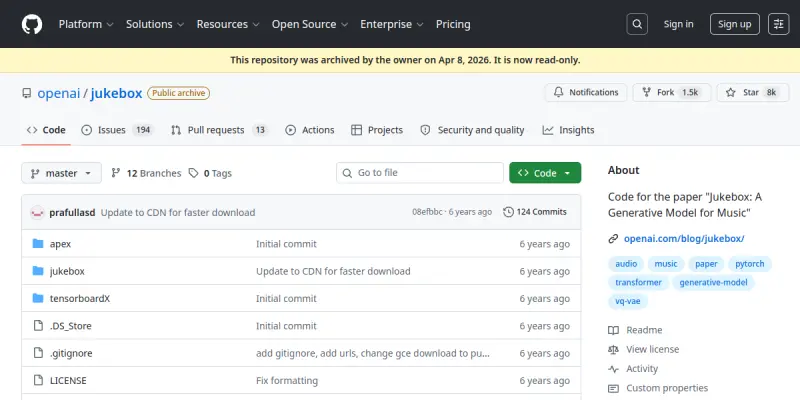
Jukebox is an open-source generative music model developed by OpenAI. It is a deep generative model capable of generating entire songs with vocals and accompaniment, conditioned on text descriptions. Unlike standard music tools, Jukebox attempts to model the hierarchical structure of music, including lyrics, creating a unique approach to neural audio synthesis.
Key Features
- Text-to-Music Generation: Generates high-fidelity songs from natural language prompts.
- Open Source: Available on GitHub under the MIT license for customization.
- Genre Diversity: Capable of generating music across various genres like pop, rock, and classical.
- Hierarchical VAEs: Utilizes a hierarchical variational autoencoder architecture.
- Lyric Generation: Can generate lyrics in multiple languages conditioned on text.
- Long-Range Context: Models long-range dependencies within musical pieces.
Use Cases
AI Research and Development
Researchers and data scientists use Jukebox to study neural representations of music and audio generation techniques. It serves as a benchmark for state-of-the-art generative models and provides a playground for experimenting with deep learning architectures.
Content Creation and Prototyping
While not a consumer tool, creators and developers can use the codebase to generate unique soundtracks, background music, or experimental audio clips for projects, leveraging the raw generative power of the model.
Education and Learning
It is an excellent resource for students and educators learning about deep learning, generative AI, and audio processing. The code provides insight into how large language models are applied to non-text modalities.
Pricing & Plans
Jukebox is completely free and open source. There are no paid tiers, subscriptions, or enterprise plans required to use the code. Users are responsible for their own computational costs.
Integrations & Compatibility
Jukebox is a Python library built on PyTorch. It requires a compatible Python environment and is typically deployed on GPU clusters or powerful local machines to handle the heavy computation involved in inference.
Who Is It For?
This tool is specifically designed for Machine Learning Researchers, Data Scientists, and Python Developers who want to experiment with generative audio models. It is not intended for casual users seeking a drag-and-drop music maker.
Limitations
- High Resource Requirements: Running the model locally requires significant GPU memory and processing power.
- Lack of User Interface: It is a code library, not a SaaS, requiring technical knowledge to operate.
- Long Generation Times: Due to its size, generating audio samples can be time-consuming.
- Latency: The model has high latency, making it unsuitable for real-time applications.
Final Verdict
Jukebox is a powerful research tool for the open-source community. While it lacks the ease of use of commercial SaaS tools, its ability to generate complex musical structures from text makes it a significant milestone in generative AI.
Tool Facts
Screenshots & Interface
Pros
- ✓ Generates high-fidelity audio and lyrics conditioned on text prompts
- ✓ Open-source availability enables customization and local deployment
- ✓ Supports diverse genres and long-form song structures
Cons
- × Extremely high computational requirements for local inference
- × Lacks a user-friendly interface for non-coders
- × Long generation times due to model size and complexity
How to Use Jukebox (OpenAI) in Your Workflow
Integrating Jukebox (OpenAI) into your professional toolkit enhances efficiency by automating manual steps. By configuring it to suit your specific project requirements, you can optimize output quality and reduce project cycle times. Standard workflows involve testing the tool on simple tasks before scaling its use to complex operations.
Frequently Asked Questions
What is Jukebox (OpenAI) used for?
Open-source generative music model from OpenAI that creates full songs from text prompts. Designed for researchers and developers to explore neural audio generation.
What is the pricing model for Jukebox (OpenAI)?
Jukebox (OpenAI) uses a Free / Open Source pricing model.
What are the main advantages of Jukebox (OpenAI)?
The key benefits of Jukebox (OpenAI) include: Generates high-fidelity audio and lyrics conditioned on text prompts, Open-source availability enables customization and local deployment, Supports diverse genres and long-form song structures.
What are the main limitations of Jukebox (OpenAI)?
Some limitations or cons of Jukebox (OpenAI) are: Extremely high computational requirements for local inference, Lacks a user-friendly interface for non-coders, Long generation times due to model size and complexity.
Alternative AI Tools
Soundraw
Soundraw generates original, royalty-free music using AI. It allows content creators to customize tracks by adjusting tempo, genre, and mood. The tool is designed for video producers, podcasters, and musicians seeking unique background music without licensing concerns.

Beatoven.ai
Beatoven.ai is an AI-powered music generation tool that helps content creators produce royalty-free background music. It is designed for video producers, podcasters, and game developers who need original, mood-based soundtracks. A key differentiator is its ability to generate music that adapts in length and style to match the user's content.

Riffusion
Riffusion is an open-source generative AI tool that creates audio spectrograms from text prompts. It is designed for musicians and developers exploring experimental sound generation.
Rating Details
Based on 0 ratings
Related Tools
More AI tools from the same workflow, industry, or category.
ClipTrend.ai
ClipTrend.ai is an AI image-to-video workspace for creators, marketers, and short-form video teams.
SongR
SongR is a text-to-song app that generates custom music tracks from a few keywords. It is designed for content creators and social media users who need quick, royalty-free songs in genres like pop, rock, hip-hop, and chant. Its key differentiator is instant generation without requiring musical expertise.
Quantum Capture
Quantum Capture generates AI-powered talking head videos from text input. It is designed for content creators and marketers who need quick, studio-quality video clips without expensive equipment. The platform specializes in creating realistic avatars with consistent lip-sync and facial expressions.
Kaltura AI
Kaltura is an enterprise video platform that combines cloud hosting with AI tools for content creation, marketing, and learning management. It helps businesses create branded video experiences for webinars, social media, and internal training.
Reviews
No reviews submitted yet. Be the first to share your experience.
Write a Review
Share Your Experience
Join the community to write reviews, submit ratings, and bookmark your favorite AI tools.