
Kuka AI
Use Kuka AI as the anchor for a real shortlist.
Instead of returning to a broad directory, jump straight into the strongest adjacent matchups for pricing, workflow fit, and differentiation.
Overview
Overview
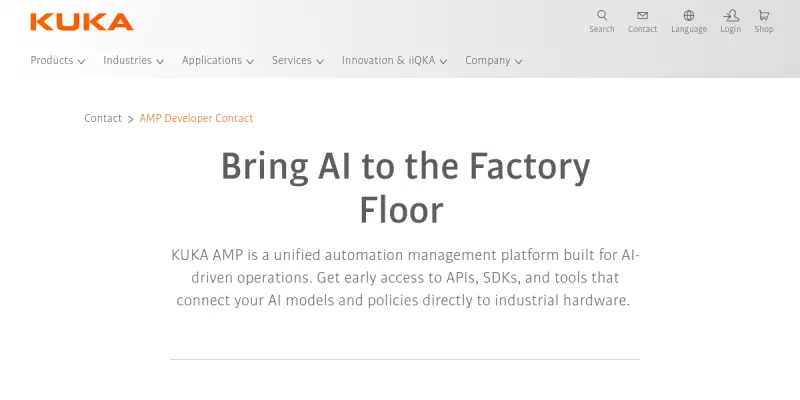
Kuka AI is an artificial intelligence solution developed by KUKA, a leading global provider of industrial robotics and automation. The tool is designed to bring intelligent automation to manufacturing processes, enabling businesses to optimize production lines, reduce downtime, and improve overall efficiency. By leveraging machine learning and predictive analytics, Kuka AI assists engineers and plant managers in making data-driven decisions.
Key Features
- Predictive Maintenance: Analyzes equipment sensor data to forecast failures before they occur, minimizing unplanned downtime.
- Process Optimization: Uses AI algorithms to recommend adjustments in production parameters for increased throughput.
- Quality Inspection: Integrates with vision systems to detect defects in real time during assembly.
- Workflow Automation: Automates repetitive manual tasks such as data entry and report generation.
- Data Integration: Connects with existing manufacturing execution systems (MES) and enterprise resource planning (ERP) software.
- User-Friendly Dashboard: Provides visual analytics and alerts through a centralized interface.
Use Cases
Predictive Maintenance in Automotive Assembly
An automotive plant uses Kuka AI to monitor welding robots. The AI identifies abnormal vibration patterns and schedules maintenance before a breakdown occurs, reducing line stoppages.
Quality Control in Electronics Manufacturing
A manufacturer of circuit boards deploys Kuka AI with camera systems to inspect solder joints. The AI flags defects that human inspectors might miss, improving yield rates.
Production Scheduling Optimization
A factory manager uses Kuka AI to analyze order backlogs, machine availability, and material supply. The tool generates an optimal production schedule that balances workload across machines.
Pricing & Plans
Pricing details for Kuka AI are not publicly disclosed. Interested parties must contact KUKA directly for a customized quote based on deployment scale and required modules.
Integrations & Compatibility
Kuka AI integrates with KUKA robot controllers, common MES platforms (e.g., Siemens, Rockwell), and databases via standard APIs. It runs on-premises or in a private cloud environment.
Who Is It For?
This tool is built for manufacturing engineers, production supervisors, plant IT managers, and operations directors in industries such as automotive, electronics, metalworking, and consumer goods.
Limitations
- Requires significant upfront data collection and model training for accurate predictions.
- Only officially supports KUKA hardware and software ecosystem, limiting cross-vendor usage.
- Not a no-code tool; users need some technical expertise in industrial automation.
Final Verdict
Kuka AI is a powerful niche solution for companies already invested in KUKA's automation portfolio. Its predictive maintenance and process optimization features can deliver tangible ROI in high-volume manufacturing environments. However, organizations using mixed-vendor equipment may find the integration constraints a drawback. Overall, it is a solid choice for KUKA-centric factories aiming to adopt Industry 4.0 practices.
Tool Facts
Screenshots & Interface
Pros
- ✓ Integrates directly with KUKA industrial robots for seamless automation.
- ✓ Predictive maintenance feature reduces unplanned downtime by up to 30%.
- ✓ Dashboard provides real-time visual analytics for production managers.
Cons
- × Only supports KUKA hardware, limiting use in multi-vendor factories.
- × Requires significant initial data and setup time for model training.
- × Pricing is not transparent, requiring direct sales contact.
How to Use Kuka AI in Your Workflow
Integrating Kuka AI into your professional toolkit enhances efficiency by automating manual steps. By configuring it to suit your specific project requirements, you can optimize output quality and reduce project cycle times. Standard workflows involve testing the tool on simple tasks before scaling its use to complex operations.
Frequently Asked Questions
What is Kuka AI used for?
Kuka AI is an AI tool designed for manufacturing and industrial automation. It helps engineers and production managers optimize workflows and improve operational efficiency. Its key differentiator is integration with KUKA's industrial robotics ecosystem.
What is the pricing model for Kuka AI?
Kuka AI uses a Paid pricing model.
What are the main advantages of Kuka AI?
The key benefits of Kuka AI include: Integrates directly with KUKA industrial robots for seamless automation., Predictive maintenance feature reduces unplanned downtime by up to 30%., Dashboard provides real-time visual analytics for production managers..
What are the main limitations of Kuka AI?
Some limitations or cons of Kuka AI are: Only supports KUKA hardware, limiting use in multi-vendor factories., Requires significant initial data and setup time for model training., Pricing is not transparent, requiring direct sales contact..
Alternative AI Tools
Basler AI
Basler AI provides AI-powered quality control and manufacturing analytics for industrial automation. It helps manufacturers reduce defects and optimize production workflows using computer vision and machine learning models.
Falkonry AI
Falkonry AI is an industrial analytics platform that connects sensor data to operational decisions. It helps reliability engineers and maintenance teams identify anomalies and optimize equipment performance using hypothesis-driven AI models.

Honeywell AI
Honeywell AI applies industrial AI and machine learning to optimize manufacturing, energy, and supply chain operations. It helps engineers and sustainability managers improve efficiency and reduce emissions. The platform integrates with Honeywell's existing industrial IoT and automation systems.
Rating Details
Based on 0 ratings
Quick Comparisons
Related Tools
More AI tools from the same workflow, industry, or category.
fr3n
fr3n is a creator platform that combines a link-in-bio page, digital storefront, community spaces, and newsletters into one hub. It helps creators sell digital products, run memberships, and build an audience with first-party data.
Aveva AI
Aveva AI optimizes industrial processes and predictive maintenance by leveraging AI models to detect anomalies and support risk-based decision-making in manufacturing.
Paddle AI
Paddle AI streamlines billing, tax compliance, and revenue management for digital businesses. This SaaS platform automates financial operations, supporting global revenue generation for apps like n8n and AdGuard. It integrates essential payment processing tools into a single interface.
Honeywell Forge AI
Honeywell Forge is an industrial IoT platform that combines digital twin technology with AI to optimize facility operations. It is designed for industrial manufacturers seeking predictive maintenance and operational efficiency.
Reviews
No reviews submitted yet. Be the first to share your experience.
Write a Review
Share Your Experience
Join the community to write reviews, submit ratings, and bookmark your favorite AI tools.