

National Instruments AI
Use National Instruments AI as the anchor for a real shortlist.
Instead of returning to a broad directory, jump straight into the strongest adjacent matchups for pricing, workflow fit, and differentiation.
Overview
Overview
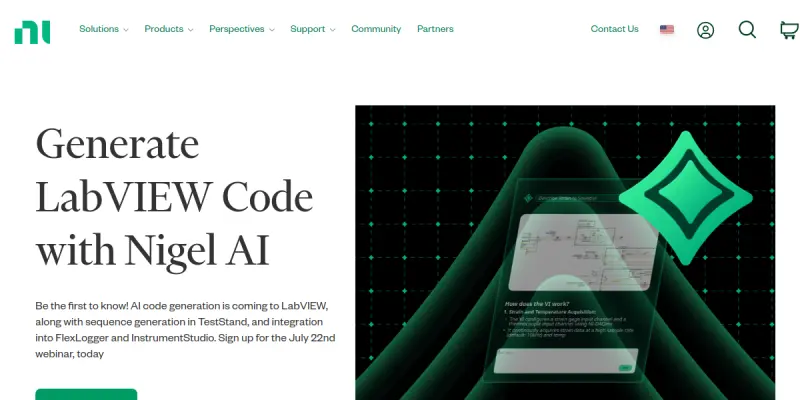
National Instruments AI brings artificial intelligence capabilities to the automated test and measurement systems from National Instruments. Designed for engineers in manufacturing, aerospace, automotive, and electronics industries, it helps streamline test processes, detect anomalies, and predict maintenance needs. By combining NI’s hardware ecosystem with AI-driven analytics, users can achieve faster time-to-market and higher product quality.
Key Features
- AI-Powered Anomaly Detection: Automatically identifies defects and unusual patterns in test data, reducing manual inspection time.
- Predictive Maintenance: Analyzes historical data to forecast equipment failures, minimizing unplanned downtime.
- Test Automation Optimization: Suggests optimal test sequences and parameters to improve efficiency.
- Real-Time Data Analysis: Provides live insights during test runs, enabling immediate adjustments.
- Integration with NI Hardware: Seamlessly works with NI’s PXI, cDAQ, and other modular instruments.
- Customizable Dashboards: Offers visualizations tailored to specific test metrics and KPIs.
- API Access: Allows developers to embed AI capabilities into existing workflows.
- Scalable Deployment: Supports single-lab setups through enterprise-wide rollouts.
Use Cases
Manufacturing Quality Control
Engineers use National Instruments AI to monitor production lines in real time. The system flags deviations in measurements, helping teams catch defects early and reduce scrap rates.
Aerospace Component Testing
In aerospace, components must meet strict reliability standards. The AI tool analyzes vibration, thermal, and stress test data to validate performance and predict lifespan.
Automotive Electronics Validation
Automotive engineers rely on the tool to test ECUs, sensors, and infotainment systems. AI-driven analysis speeds up regression testing and ensures compliance with industry standards.
Industrial Equipment Maintenance
Facility maintenance teams deploy predictive models to anticipate failures in motors, pumps, and conveyors. This reduces costly breakdowns and extends equipment life.
Research & Development Prototyping
R&D teams use the platform to rapidly test prototypes, gaining insights from AI-generated reports that highlight performance bottlenecks.
Pricing & Plans
National Instruments typically offers its software and hardware on a per-license or subscription basis. Detailed pricing for the AI module is not publicly disclosed; interested customers must contact NI sales for a custom quote. Some basic test automation features may be included with hardware purchases, while advanced AI analytics require a separate license.
Integrations & Compatibility
- Hardware: Works with NI PXI, CompactDAQ, CompactRIO, and third-party instruments via GPIB, USB, and Ethernet.
- Software: Integrates with NI LabVIEW, TestStand, and DIAdem. Also supports Python, MATLAB, and .NET for custom scripting.
- Data Sources: Accepts data from CSV, TDMS, and other standard file formats.
- Cloud: Optional cloud connector for remote monitoring and data aggregation.
Who Is It For?
This tool is built for test engineers, quality assurance teams, and R&D professionals in manufacturing, aerospace, automotive, electronics, and industrial automation. It suits organizations that already use NI hardware or are looking for an integrated test-and-AI platform.
Limitations
- Requires NI Ecosystem: The AI features are optimized for NI hardware; users without NI instruments may find limited value.
- Steep Learning Curve: Mastering the AI tools alongside LabVIEW or TestStand demands training.
- Pricing Opacity: Custom quotes and lack of public pricing make it hard to budget upfront.
- Internet Dependency: Cloud features need a stable connection; offline capabilities are restricted.
Final Verdict
National Instruments AI brings machine learning into the test and measurement domain, offering practical benefits for quality control and predictive maintenance. Its tight integration with NI hardware is both a strength and a limitation, as it ties users closely to the NI ecosystem. Teams already invested in NI platforms will find it adds valuable intelligence, while new users may face a steeper adoption curve. Overall, it is a solid choice for manufacturers seeking to automate and enhance their testing processes.
Tool Facts
Screenshots & Interface
Pros
- ✓ Integrates AI anomaly detection directly into existing NI test workflows
- ✓ Helps reduce product defects through real-time data analysis
- ✓ Enables predictive maintenance to minimize unplanned downtime
- ✓ Scalable from lab to enterprise deployment with flexible licensing
Cons
- × AI features are tightly coupled with NI hardware, limiting use for non-NI users
- × Pricing is not publicly available, making cost estimation difficult
- × Requires familiarity with NI software ecosystem for full utilization
- × Offline functionality for cloud-dependent features is limited
How to Use National Instruments AI in Your Workflow
Integrating National Instruments AI into your professional toolkit enhances efficiency by automating manual steps. By configuring it to suit your specific project requirements, you can optimize output quality and reduce project cycle times. Standard workflows involve testing the tool on simple tasks before scaling its use to complex operations.
Frequently Asked Questions
What is National Instruments AI used for?
National Instruments AI provides automated test and measurement systems for engineers and manufacturers. It leverages AI to optimize testing workflows and improve product quality in industrial settings.
What is the pricing model for National Instruments AI?
National Instruments AI uses a Paid pricing model.
What are the main advantages of National Instruments AI?
The key benefits of National Instruments AI include: Integrates AI anomaly detection directly into existing NI test workflows, Helps reduce product defects through real-time data analysis, Enables predictive maintenance to minimize unplanned downtime, Scalable from lab to enterprise deployment with flexible licensing.
What are the main limitations of National Instruments AI?
Some limitations or cons of National Instruments AI are: AI features are tightly coupled with NI hardware, limiting use for non-NI users, Pricing is not publicly available, making cost estimation difficult, Requires familiarity with NI software ecosystem for full utilization, Offline functionality for cloud-dependent features is limited.
Alternative AI Tools

MachineMetrics AI
MachineMetrics AI is a manufacturing industry tool that connects real-time data, boosting operational productivity with AI-powered MES solutions for manufacturers.
Cognex AI
Cognex AI provides AI-powered visual inspection and quality control for manufacturing lines. It helps engineers and quality specialists detect defects in real time. Its key differentiator is deep integration with industrial machine vision hardware.
DMG Mori AI
DMG Mori AI optimizes manufacturing workflows and machine tool operations through advanced AI models. It serves as a comprehensive digital solution for engineers and manufacturers.
Rating Details
Based on 0 ratings
Related Tools
More AI tools from the same workflow, industry, or category.
fr3n
fr3n is a creator platform that combines a link-in-bio page, digital storefront, community spaces, and newsletters into one hub. It helps creators sell digital products, run memberships, and build an audience with first-party data.
Aveva AI
Aveva AI optimizes industrial processes and predictive maintenance by leveraging AI models to detect anomalies and support risk-based decision-making in manufacturing.
Paddle AI
Paddle AI streamlines billing, tax compliance, and revenue management for digital businesses. This SaaS platform automates financial operations, supporting global revenue generation for apps like n8n and AdGuard. It integrates essential payment processing tools into a single interface.
Honeywell Forge AI
Honeywell Forge is an industrial IoT platform that combines digital twin technology with AI to optimize facility operations. It is designed for industrial manufacturers seeking predictive maintenance and operational efficiency.
Reviews
No reviews submitted yet. Be the first to share your experience.
Write a Review
Share Your Experience
Join the community to write reviews, submit ratings, and bookmark your favorite AI tools.