

Pinecone
by Pinecone Systems, Inc.
Use Pinecone as the anchor for a real shortlist.
Instead of returning to a broad directory, jump straight into the strongest adjacent matchups for pricing, workflow fit, and differentiation.
Overview
Overview
Pinecone is a fully managed vector database platform designed for AI applications, founded in 2019 by Edo Liberty, former Director of Applied Science at Amazon. It eliminates the operational overhead of self-hosted vector indexes by providing a scalable, production-ready service for similarity search and retrieval-augmented generation (RAG).
Key Features
- Fully Managed Infrastructure: No cluster management, scaling, or patching required. Pinecone handles replication, monitoring, and failover automatically.
- Serverless & Pod-Based Deployments: Choose between pay-per-use serverless indexes for variable workloads or dedicated pod-based indexes for predictable performance.
- Hybrid Sparse-Dense Search: Combine semantic vector search with keyword matching in a single query using SPLADE-based sparse vectors for more relevant RAG results.
- Metadata Filtering: Filter query results with advanced operators (equals, not equals, less than, greater than, etc.) on stored metadata.
- Real-Time Upserts: Insert or update vectors with sub-second index freshness for dynamic datasets.
- Client SDKs & REST API: Native SDKs for Python, Node.js, Java, Go, and Rust, plus a straightforward REST API.
- Ecosystem Integrations: First-class integration with LangChain, LlamaIndex, Haystack, OpenAI, Cohere, Hugging Face, AWS Bedrock, and more.
- Enterprise Security: SOC 2 Type II compliant, with SSO, VPC peering, and private link support.
- Pinecone Assistant & Agents: Managed RAG-as-a-service and built-in tool-use capabilities for autonomous AI agents (introduced in 2024).
Use Cases
Semantic Search
Build search engines that understand user intent beyond keyword matching. Pinecone indexes document embeddings and retrieves the most relevant results based on semantic similarity, improving search accuracy for customer support portals, knowledge bases, and e-commerce product catalogs.
Recommendation Systems
Generate personalized recommendations by storing user and item embeddings. Pinecone’s low-latency similarity search enables real-time suggestions for media, e-commerce, and content platforms.
Anomaly Detection
Detect outliers in high-dimensional data by comparing new data points against a baseline embedding set. Pinecone’s vector search can flag unusual patterns in network traffic, financial transactions, or system logs.
Image & Audio Similarity Matching
Find visually or audibly similar content by indexing image or audio embeddings. This is useful for duplicate detection, content moderation, and media asset management.
Pricing & Plans
Pinecone offers a Freemium model:
- Starter (Free): 1 project, 1 index, up to 100,000 vectors (1,536 dimensions), and sufficient throughput for prototyping.
- Serverless: Pay-per-use based on index hours (~$0.11 per index-hour) plus read and write units. No minimum commitments.
- Pod-Based: Dedicated compute starting at ~$70/month per pod, depending on pod type and size.
- Enterprise: Custom pricing for single-tenant, dedicated infrastructure with compliance and isolation requirements.
Integrations & Compatibility
Pinecone integrates with major AI frameworks and data tools: LangChain, LlamaIndex, Haystack, OpenAI, Cohere, Hugging Face, AWS Bedrock, and others. Client SDKs are available for Python, Node.js, Java, Go, and Rust. The platform also provides a REST API for custom integrations.
Who Is It For?
Pinecone is ideal for developers and data scientists building AI applications that require scalable vector search, such as RAG pipelines, semantic search engines, recommendation systems, and anomaly detection tools. It suits teams that want to avoid the operational burden of self-managed vector databases.
Limitations
- Not open source: Data and schemas reside on Pinecone’s infrastructure, introducing vendor lock-in risk.
- No self-hosted option: Unlike Weaviate, Qdrant, or Milvus, Pinecone cannot be deployed on-premises.
- Limited to vector operations: Lacks relational query capabilities, joins, or aggregations.
- Serverless cold starts: Indexes may experience latency after periods of inactivity.
Final Verdict
Pinecone simplifies vector database management with a fully managed, developer-friendly platform. Its hybrid search capabilities and deep ecosystem integrations make it a strong choice for production RAG and similarity search applications. However, the lack of an open-source option and potential cost escalation at scale are important considerations.
Tool Facts
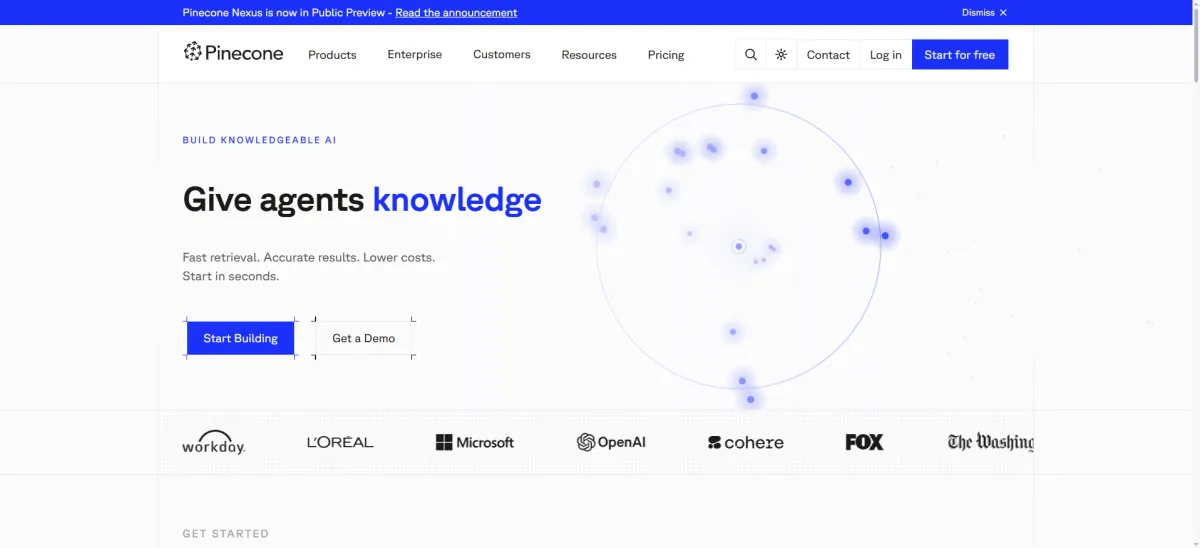
Screenshots & Interface
Pros
- ✓ Fully managed infrastructure eliminates cluster management, scaling, and patching overhead.
- ✓ Developer-friendly with well-documented SDKs for Python, Node.js, Java, Go, and Rust.
- ✓ Serverless pay-per-use pricing removes upfront costs and scales down to zero during idle periods.
- ✓ Deep integrations with LangChain, LlamaIndex, OpenAI, Cohere, Hugging Face, and AWS Bedrock.
- ✓ Hybrid sparse-dense search combines semantic understanding with keyword precision in a single query.
- ✓ Enterprise-grade security with SOC 2 Type II, SSO, VPC peering, and private link support.
Cons
- × Not open source, creating vendor lock-in risk as data and schemas reside on Pinecone's infrastructure.
- × Serverless pricing can become expensive at high query volumes due to per-read-unit charges.
- × No self-hosted deployment option, unlike competitors such as Weaviate, Qdrant, and Milvus.
- × Cold start latency on serverless indexes after periods of inactivity can affect responsiveness.
How to Use Pinecone in Your Workflow
Integrating Pinecone into your professional toolkit enhances efficiency by automating manual steps. By configuring it to suit your specific project requirements, you can optimize output quality and reduce project cycle times. Standard workflows involve testing the tool on simple tasks before scaling its use to complex operations.
Frequently Asked Questions
What is Pinecone?
Pinecone is a fully managed vector database designed specifically for AI applications. It stores vector embeddings — numerical representations of text, images, audio, or other data — and enables fast similarity search, making it a core infrastructure component for RAG pipelines, semantic search, recommendation engines, and AI agent memory
Does Pinecone support hybrid search?
Yes. Pinecone supports sparse-dense hybrid search, which combines dense vector embeddings (capturing semantic meaning) with sparse vectors (capturing keyword relevance, similar to BM25). This allows a single query to return results that are both semantically and lexically relevant, improving RAG accuracy especially for queries containing proper nouns, technical terms, or exact phrases.
Is my data secure on Pinecone?
Pinecone is SOC 2 Type II certified. Data is encrypted at rest and in transit. Enterprise plans add VPC peering, AWS PrivateLink, SSO (SAML/OIDC), audit logging, and optional data residency controls. Free and Standard tiers share multi-tenant infrastructure but maintain logical isolation between accounts.
What are Pinecone Agents?
Pinecone Agents is a higher-level product that combines Pinecone's retrieval capabilities with tool-use logic to power AI agents. Instead of building a custom RAG pipeline, developers can configure an agent that automatically decides when to search Pinecone, which indexes to query, and how to incorporate retrieved context into its responses. This is part of Pinecone's broader strategy to move up the AI stack from infrastructure to application-level primitives.
Alternative AI Tools

Hookdeck AI
Hookdeck AI is an event delivery platform that ensures webhooks and event streams are received, processed, and monitored reliably. It provides developers with observability and control over their event-driven workflows. A key differentiator is its ability to handle retries, log events, and filter traffic automatically.

API2Cart AI
API2Cart is a unified API for eCommerce SaaS providers. It connects your application to over 60 shopping platforms and marketplaces through a single integration. This eliminates the need for building and maintaining individual native connectors.

Stoplight AI
Stoplight AI is a tool for automating agent permissions, designed for businesses and developers, with a key differentiator being its ability to draft guardrails for review and activation.
Rating Details
Based on 0 ratings
Quick Comparisons
Related Tools
More AI tools from the same workflow, industry, or category.
NewsData.io
NewsData.io delivers structured global news data via a real-time API. It supports 100,000+ sources across 200+ countries with filtering by keyword and date. This tool helps developers integrate news intelligence into applications and dashboards.
Wisegrid
Wisegrid is a work management platform that combines spreadsheet functionality with application features like dashboards and automations. It allows teams to manage projects and data using rows and columns, including AI-driven formulas, with a flat pricing model.
TradeBB
TradeBB is a All-in-One Trading Journal and analysis tool that helps traders seamlessly record each transaction, deeply analyze trading data, and review trading processes.
Goalfinder
Goalfinder provides AI-driven audits for pre-launch, post-launch, and market analysis, helping early-stage startups identify growth blockers in under 60 seconds. It targets founders who need a quick, unbiased reality check on product-market fit and distribution challenges.
Reviews
No reviews submitted yet. Be the first to share your experience.
Write a Review
Share Your Experience
Join the community to write reviews, submit ratings, and bookmark your favorite AI tools.