

Schrodinger AI
Use Schrodinger AI as the anchor for a real shortlist.
Instead of returning to a broad directory, jump straight into the strongest adjacent matchups for pricing, workflow fit, and differentiation.
Overview
Overview
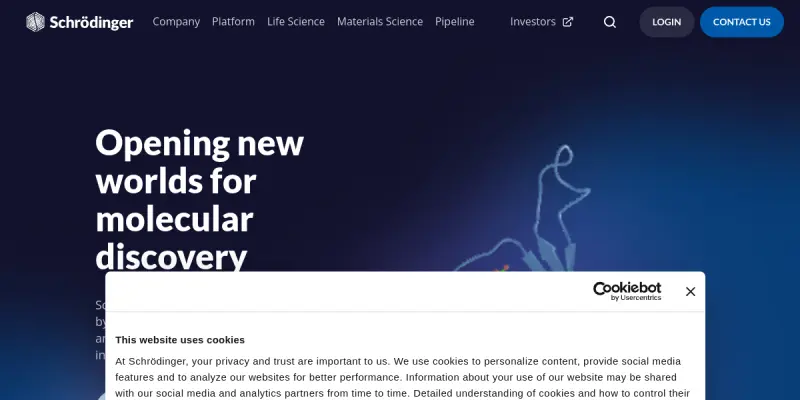
Schrödinger is a comprehensive computational platform designed primarily for pharmaceutical and materials science research. It combines rigorous physics-based quantum mechanics with advanced machine learning algorithms to model molecular behavior, predict compound properties, and accelerate drug discovery workflows. The platform serves as a central hub for researchers to visualize, analyze, and manipulate complex molecular data.
Key Features
- Molecular Simulation: Core engine for modeling atomic structures using quantum mechanics and molecular dynamics.
- Glide Docking: AI-powered tools for virtual screening and ligand binding prediction.
- ADMET Prediction: Algorithms to estimate Absorption, Distribution, Metabolism, Excretion, and Toxicity profiles.
- Materials Studio: Integrated environment for materials science research and property prediction.
- Quantum Mechanics: High-accuracy calculations for electronic structure analysis.
- Interactive Visualization: Maestro interface for complex data visualization and manipulation.
- AI-Enhanced Workflows: Automated workflows that reduce manual computational time.
Use Cases
-
Drug Discovery
Researchers use Schrödinger to screen vast libraries of compounds, identifying potential leads for new medications by simulating how these molecules interact with target proteins. -
Lead Optimization
Once a lead compound is found, chemists use the platform to refine its structure, improving efficacy while minimizing toxicity before moving to clinical trials. -
Materials Science
Material scientists utilize the suite to simulate the properties of new materials, such as polymers or catalysts, optimizing them for specific industrial applications without physical prototyping. -
Toxicology
The platform helps predict potential side effects and safety profiles of new chemical entities early in the development process.
Pricing & Plans
Schrödinger operates on a paid enterprise model rather than a free tier. It offers commercial licenses for pharmaceutical companies and academic licenses for university research groups. Detailed pricing is not publicly disclosed and requires contacting the sales team for enterprise solutions.
Integrations & Compatibility
The platform is designed for Windows and Linux environments, with limited macOS support. It integrates with laboratory automation systems and can export data to standard scientific formats like MOL2, SDF, and SMILES. APIs are available for specific components to integrate with custom research pipelines.
Who Is It For?
This tool is specifically designed for professional researchers, computational chemists, pharmaceutical scientists, and material engineers working in R&D departments. It is not suitable for general consumers or hobbyists due to the complexity and cost of the software.
Limitations
- High Cost: The software is expensive, limiting its accessibility to large organizations with significant budgets.
- Steep Learning Curve: Mastering the platform requires extensive training in chemistry and computational science.
- Hardware Requirements: Running complex simulations demands powerful, high-end workstations or clusters.
- Commercial Focus: The tool lacks the ease of use found in consumer-facing AI applications, prioritizing scientific depth over simplicity.
Final Verdict
Schrödinger represents the gold standard in computational chemistry software. While it lacks the accessibility of consumer AI tools, its robust physics-based modeling and AI integration provide unparalleled accuracy and depth for professional R&D. It is an essential investment for serious pharmaceutical and materials science teams.
Tool Facts
Screenshots & Interface
Pros
- ✓ Offers industry-standard physics-based methods for molecular simulation and modeling.
- ✓ Provides comprehensive tools for virtual screening and lead optimization.
- ✓ Integrates advanced AI models to predict protein-ligand interactions and ADMET properties.
- ✓ Supports complex materials science research and quantum mechanics calculations.
Cons
- × High cost and licensing requirements make it inaccessible for individual researchers or small startups.
- × Steep learning curve requires significant training and expertise in computational chemistry.
- × Requires substantial computational hardware resources for running simulations.
- × Interface complexity can be overwhelming for users unfamiliar with molecular modeling.
How to Use Schrodinger AI in Your Workflow
Integrating Schrodinger AI into your professional toolkit enhances efficiency by automating manual steps. By configuring it to suit your specific project requirements, you can optimize output quality and reduce project cycle times. Standard workflows involve testing the tool on simple tasks before scaling its use to complex operations.
Frequently Asked Questions
What is Schrodinger AI used for?
Schrödinger is a computational platform for molecular simulation and drug discovery. It utilizes physics-based methods and AI to predict molecular properties and optimize chemical compounds for pharmaceutical and materials science applications.
What is the pricing model for Schrodinger AI?
Schrodinger AI uses a Free pricing model.
What are the main advantages of Schrodinger AI?
The key benefits of Schrodinger AI include: Offers industry-standard physics-based methods for molecular simulation and modeling., Provides comprehensive tools for virtual screening and lead optimization., Integrates advanced AI models to predict protein-ligand interactions and ADMET properties., Supports complex materials science research and quantum mechanics calculations..
What are the main limitations of Schrodinger AI?
Some limitations or cons of Schrodinger AI are: High cost and licensing requirements make it inaccessible for individual researchers or small startups., Steep learning curve requires significant training and expertise in computational chemistry., Requires substantial computational hardware resources for running simulations., Interface complexity can be overwhelming for users unfamiliar with molecular modeling..
Alternative AI Tools

98point6 AI
98point6 AI is a virtual care platform using AI to deliver synchronous and asynchronous telehealth services. It empowers health systems to offload administrative tasks to AI-trained clinicians. The tool focuses on improving patient access and reducing wait times.

Insilico Medicine
Insilico Medicine uses generative AI to accelerate drug discovery and clinical research. It provides tools for target identification, molecule generation, and clinical trial prediction. Designed for pharmaceutical researchers, it combines deep learning with biomedical data.

Insight Timer AI
Insight Timer AI is an AI-powered feature of the Insight Timer meditation app, designed to personalize mental wellness recommendations. It helps users find guided meditations, sleep content, and mindfulness exercises based on their mood and preferences. The tool distinguishes itself by integrating advanced AI into an established meditation platform with a large content library.
Rating Details
Based on 0 ratings
Related Tools
More AI tools from the same workflow, industry, or category.
fr3n
fr3n is a creator platform that combines a link-in-bio page, digital storefront, community spaces, and newsletters into one hub. It helps creators sell digital products, run memberships, and build an audience with first-party data.
Aveva AI
Aveva AI optimizes industrial processes and predictive maintenance by leveraging AI models to detect anomalies and support risk-based decision-making in manufacturing.
Paddle AI
Paddle AI streamlines billing, tax compliance, and revenue management for digital businesses. This SaaS platform automates financial operations, supporting global revenue generation for apps like n8n and AdGuard. It integrates essential payment processing tools into a single interface.
Honeywell Forge AI
Honeywell Forge is an industrial IoT platform that combines digital twin technology with AI to optimize facility operations. It is designed for industrial manufacturers seeking predictive maintenance and operational efficiency.
Reviews
No reviews submitted yet. Be the first to share your experience.
Write a Review
Share Your Experience
Join the community to write reviews, submit ratings, and bookmark your favorite AI tools.