

Scite AI
Use Scite AI as the anchor for a real shortlist.
Instead of returning to a broad directory, jump straight into the strongest adjacent matchups for pricing, workflow fit, and differentiation.
Overview
Overview
Scite is an AI-driven research platform that transforms how users interact with academic literature. Unlike traditional search tools that rely on citation counts or keywords, Scite analyzes the context in which a study is cited, showing whether a citation supports, contrasts, or merely mentions the original work. This unique approach helps researchers uncover debates, verify claims, and build stronger arguments. Developed with the academic community in mind, Scite integrates with major scholarly databases and provides tools for writing, citing, and collaborating.
Key Features
- Smart Citation Analysis: Automatically categorizes citations as supporting, contradicting, or mentioning, providing a nuanced view of how a paper has been received in the literature.
- Citation Dashboard: Presents an interactive visual overview of a paper's citation history, including timelines and citation breakdowns by category.
- Reference Checking: Scans your manuscript drafts to flag potentially unreliable or outdated citations and suggests alternatives.
- AI Assistant: Answers questions about a paper's methodology, results, or limitations, drawing directly from the full text.
- Browser Extension: Integrates with Google Scholar, PubMed, and other databases to instantly show citation context and Smart Citations alongside search results.
- Team Collaboration: Allows research groups to share collections, annotate papers, and discuss findings within the platform.
- Search Engine: Advanced search with filters for citation type, publication date, journal, and author to find relevant papers quickly.
- API Access: Enables institutions and developers to integrate Scite’s citation data into their own workflows.
Use Cases
Literature Review
Researchers conducting systematic reviews can use Scite to assess the strength of evidence cited in a body of literature. By quickly seeing which studies support or contradict a finding, reviewers can identify consensus and controversy areas without reading every full paper.
Grant Writing
When writing grant proposals, researchers need to show they are aware of the latest debates. Scite helps by providing a visual citation map that demonstrates a thorough understanding of the field, strengthening the proposal’s credibility.
Academic Publishing
Editors and peer reviewers can use Scite’s reference checking tool to verify that manuscripts cite appropriate, high-quality sources. This reduces the risk of propagating erroneous or retracted studies in the published record.
Student Research Projects
Undergraduate and graduate students can leverage Scite to better understand the impact of key papers and to learn how to critically evaluate sources. The platform’s contextual citations teach students to think about scholarly influence beyond mere counts.
Pricing & Plans
Scite operates on a Freemium model. The free tier provides limited searches and citation views each month. Paid plans (monthly or annual) offer expanded quotas, advanced analytics, and team features. Institutional subscriptions are available for universities and research organizations. Detailed pricing is disclosed on the Scite website.
Integrations & Compatibility
Scite offers browser extensions for Chrome and Firefox. It integrates with Google Scholar, PubMed, and arXiv to display Smart Citations directly on those platforms. The platform also provides a REST API for programmatic access to citation data. Export options include BibTeX and RIS for citation management tools like Zotero and Mendeley.
Who Is It For?
Scite is primarily designed for academic researchers, faculty, and graduate students across disciplines. It is also valuable for science journalists, policy analysts, and evidence-based practitioners who need to evaluate scientific claims. Libraries and research institutions can use Scite as a resource for their patrons.
Limitations
- Coverage: Scite’s database, while large, does not include every paper. Older publications and some non-English journals may be missing.
- Dependency on Internet: The tool is web-based and requires a stable internet connection; offline access is not available.
- Cost: Advanced features and higher usage limits require a paid subscription, which may be a barrier for individual researchers without institutional support.
- Accuracy of AI Categorization: While generally reliable, the AI’s classification of citations as supporting or contradicting can occasionally be incorrect, requiring human verification.
Final Verdict
Scite AI offers a genuinely novel approach to interacting with scholarly literature. Its ability to contextualize citations provides a deeper, more critical understanding of research impact. The platform is well-suited for anyone who regularly reads or writes academic papers. Despite limitations in coverage and reliance on subscriptions, Scite’s core functionality is a significant step forward in research transparency and efficiency.
Tool Facts
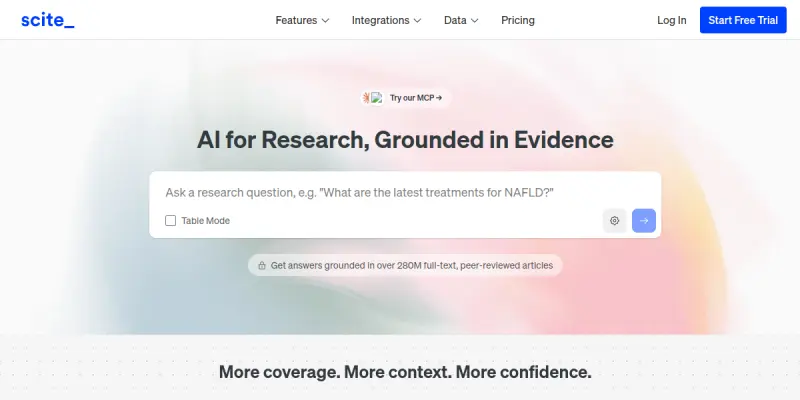
Screenshots & Interface
Pros
- ✓ Unique Smart Citation feature reveals whether a citation supports or contradicts a study.
- ✓ Browser extension integrates seamlessly with Google Scholar and PubMed.
- ✓ Reference checking tool helps ensure manuscript citations are reliable and up-to-date.
- ✓ AI assistant can answer specific questions about a paper's methods and results.
Cons
- × Limited to papers indexed in its database; older or non-English studies may be missing.
- × Free tier has restrictive daily search and citation view limits.
- × AI citation categorization can occasionally mislabel supporting or contradicting contexts.
- × No offline mode; full functionality requires an internet connection.
How to Use Scite AI in Your Workflow
Integrating Scite AI into your professional toolkit enhances efficiency by automating manual steps. By configuring it to suit your specific project requirements, you can optimize output quality and reduce project cycle times. Standard workflows involve testing the tool on simple tasks before scaling its use to complex operations.
Frequently Asked Questions
What is Scite AI used for?
Scite is an AI-powered platform that helps researchers discover and understand scientific literature. It analyzes citation contexts to reveal whether a study was supported or contradicted, enabling more informed research. This tool is designed for academics, writers, and students who need to evaluate research credibility.
What is the pricing model for Scite AI?
Scite AI uses a Freemium pricing model.
What are the main advantages of Scite AI?
The key benefits of Scite AI include: Unique Smart Citation feature reveals whether a citation supports or contradicts a study., Browser extension integrates seamlessly with Google Scholar and PubMed., Reference checking tool helps ensure manuscript citations are reliable and up-to-date., AI assistant can answer specific questions about a paper's methods and results..
What are the main limitations of Scite AI?
Some limitations or cons of Scite AI are: Limited to papers indexed in its database; older or non-English studies may be missing., Free tier has restrictive daily search and citation view limits., AI citation categorization can occasionally mislabel supporting or contradicting contexts., No offline mode; full functionality requires an internet connection..
Alternative AI Tools

Semantic Scholar
Semantic Scholar is an AI-powered academic search engine that helps researchers discover scientific literature. It analyzes the semantics of papers to provide relevant results and research recommendations. The tool is designed for students, scientists, and academics seeking efficient literature discovery.

Busuu AI
Busuu AI is a language learning platform that combines AI-powered lessons with a community of native speakers. It offers personalized study plans for learners of all levels. A key differentiator is its interactive speaking exercises with real-time feedback.

Gradescope AI
Gradescope AI is a grading platform that helps educators efficiently assess paper-based, digital, and code assignments. It uses AI to group similar answers, enabling faster and more consistent grading. The tool also provides detailed analytics on student performance to inform instruction.
Rating Details
Based on 0 ratings
Quick Comparisons
Related Tools
More AI tools from the same workflow, industry, or category.
fr3n
fr3n is a creator platform that combines a link-in-bio page, digital storefront, community spaces, and newsletters into one hub. It helps creators sell digital products, run memberships, and build an audience with first-party data.
Aveva AI
Aveva AI optimizes industrial processes and predictive maintenance by leveraging AI models to detect anomalies and support risk-based decision-making in manufacturing.
Paddle AI
Paddle AI streamlines billing, tax compliance, and revenue management for digital businesses. This SaaS platform automates financial operations, supporting global revenue generation for apps like n8n and AdGuard. It integrates essential payment processing tools into a single interface.
Honeywell Forge AI
Honeywell Forge is an industrial IoT platform that combines digital twin technology with AI to optimize facility operations. It is designed for industrial manufacturers seeking predictive maintenance and operational efficiency.
Reviews
No reviews submitted yet. Be the first to share your experience.
Write a Review
Share Your Experience
Join the community to write reviews, submit ratings, and bookmark your favorite AI tools.