

Semantic Scholar
Use Semantic Scholar as the anchor for a real shortlist.
Instead of returning to a broad directory, jump straight into the strongest adjacent matchups for pricing, workflow fit, and differentiation.
Overview
Overview
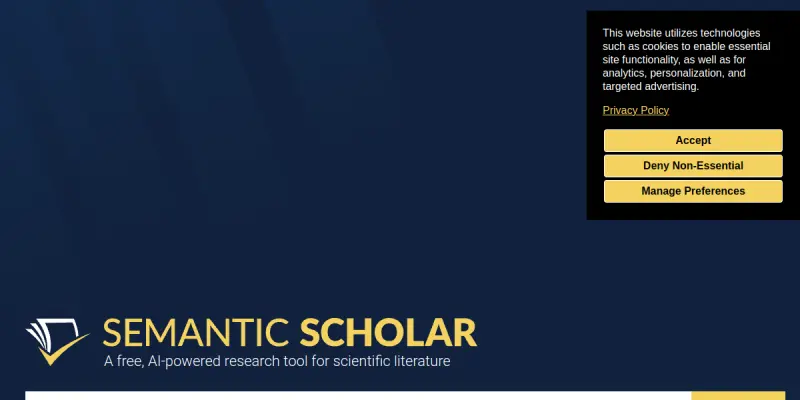
Semantic Scholar is an AI-enhanced academic search engine developed by the Allen Institute for AI. It indexes hundreds of millions of scientific papers across all fields of science, using advanced natural language processing to understand the meaning behind research publications. Unlike traditional keyword-based search engines, Semantic Scholar extracts key phrases, entities, and relationships to deliver more relevant results.
Key Features
- Semantic Search: Understands the meaning of queries and paper content to return contextually relevant results.
- Paper Recommendations: Uses collaborative filtering and citation analysis to suggest related papers.
- Citation Graph: Visualizes how papers cite one another, helping users trace research impact.
- Author Profiles: Aggregates publications by author, showing h-index, citation counts, and collaboration networks.
- Research Feeds: Allows users to follow topics or authors and receive updates on new publications.
- API Access: Provides a free API for developers to integrate scholarly data into their applications.
- PDF Viewer: Integrated reader that extracts and highlights citations and figures.
- TLDR (Too Long; Didn't Read): Generates one-sentence summaries for many papers.
Use Cases
Literature Reviews
Researchers conducting systematic reviews can use Semantic Scholar to quickly identify seminal papers and track how ideas evolved over time.
Grant Proposal Preparation
Academics preparing grant proposals can discover prior work and demonstrate the novelty of their proposed research by checking existing literature.
Teaching and Learning
Professors and students can find authoritative sources for assignments and lectures, ensuring they reference up-to-date and relevant science.
Staying Current
Professionals in fast-moving fields such as AI, biomedicine, and climate science can set up research feeds to receive daily or weekly digests of new papers.
Pricing & Plans
Semantic Scholar operates on a freemium model. Basic search, paper browsing, and recommendation features are free for all users. The API is also free with rate limits. There is no paid tier at the moment; however, certain enterprise-level features such as higher API rate limits may require custom agreements.
Integrations & Compatibility
Semantic Scholar offers a RESTful API that returns JSON data, compatible with any programming language. It also integrates with reference managers like Zotero through browser extensions and supports standard citation formats (BibTeX, RIS). The platform is web-based and works on all modern browsers.
Who Is It For?
- Academic researchers and scientists
- Graduate and undergraduate students
- Librarians and information specialists
- R&D professionals in industry
- Science journalists and writers
Limitations
- Coverage gaps: Not all papers are indexed, especially pre-2000 publications and non-English content.
- Free API rate limits: Heavy data mining may require negotiation for higher limits.
- No collaboration tools: Unlike ResearchGate or others, Semantic Scholar lacks direct messaging or group features.
- Dependency on open access: Full-text analysis is limited to papers that are freely available.
Final Verdict
Semantic Scholar is an indispensable tool for anyone serious about scientific literature discovery. Its semantic understanding sets it apart from traditional search engines, and its free access makes it widely available. While it has some limitations in coverage and collaboration, it remains a top choice for efficient research discovery.
Tool Facts
Screenshots & Interface
Pros
- ✓ Semantic understanding delivers more relevant search results than keyword-based engines.
- ✓ Free access to a vast corpus of hundreds of millions of papers.
- ✓ API enables developers to build custom research tools and integrations.
- ✓ TLDR summaries save time by providing quick paper overviews.
Cons
- × Coverage of non-English and older publications is limited.
- × API rate limits may restrict heavy data mining without a custom agreement.
- × No built-in collaboration or group features for teams.
- × Full-text analysis is restricted to open-access papers.
How to Use Semantic Scholar in Your Workflow
Integrating Semantic Scholar into your professional toolkit enhances efficiency by automating manual steps. By configuring it to suit your specific project requirements, you can optimize output quality and reduce project cycle times. Standard workflows involve testing the tool on simple tasks before scaling its use to complex operations.
Frequently Asked Questions
What is Semantic Scholar used for?
Semantic Scholar is an AI-powered academic search engine that helps researchers discover scientific literature. It analyzes the semantics of papers to provide relevant results and research recommendations. The tool is designed for students, scientists, and academics seeking efficient literature discovery.
What is the pricing model for Semantic Scholar?
Semantic Scholar uses a Freemium pricing model.
What are the main advantages of Semantic Scholar?
The key benefits of Semantic Scholar include: Semantic understanding delivers more relevant search results than keyword-based engines., Free access to a vast corpus of hundreds of millions of papers., API enables developers to build custom research tools and integrations., TLDR summaries save time by providing quick paper overviews..
What are the main limitations of Semantic Scholar?
Some limitations or cons of Semantic Scholar are: Coverage of non-English and older publications is limited., API rate limits may restrict heavy data mining without a custom agreement., No built-in collaboration or group features for teams., Full-text analysis is restricted to open-access papers..
Alternative AI Tools

SciSpace
SciSpace is an AI research assistant that helps students and researchers understand academic papers. It analyzes PDFs, explains figures and tables, and provides context for complex scientific content.

Scite AI
Scite is an AI-powered platform that helps researchers discover and understand scientific literature. It analyzes citation contexts to reveal whether a study was supported or contradicted, enabling more informed research. This tool is designed for academics, writers, and students who need to evaluate research credibility.

HelloTalk AI
HelloTalk AI connects language learners with native speakers for real-world practice. It supports over 260 languages through text, voice, and video exchanges. The free app offers an immersive, community-driven alternative to traditional courses.
Rating Details
Based on 0 ratings
Related Tools
More AI tools from the same workflow, industry, or category.
fr3n
fr3n is a creator platform that combines a link-in-bio page, digital storefront, community spaces, and newsletters into one hub. It helps creators sell digital products, run memberships, and build an audience with first-party data.
Aveva AI
Aveva AI optimizes industrial processes and predictive maintenance by leveraging AI models to detect anomalies and support risk-based decision-making in manufacturing.
Paddle AI
Paddle AI streamlines billing, tax compliance, and revenue management for digital businesses. This SaaS platform automates financial operations, supporting global revenue generation for apps like n8n and AdGuard. It integrates essential payment processing tools into a single interface.
Honeywell Forge AI
Honeywell Forge is an industrial IoT platform that combines digital twin technology with AI to optimize facility operations. It is designed for industrial manufacturers seeking predictive maintenance and operational efficiency.
Reviews
No reviews submitted yet. Be the first to share your experience.
Write a Review
Share Your Experience
Join the community to write reviews, submit ratings, and bookmark your favorite AI tools.