

Appian AI
Use Appian AI as the anchor for a real shortlist.
Instead of returning to a broad directory, jump straight into the strongest adjacent matchups for pricing, workflow fit, and differentiation.
Overview
Overview
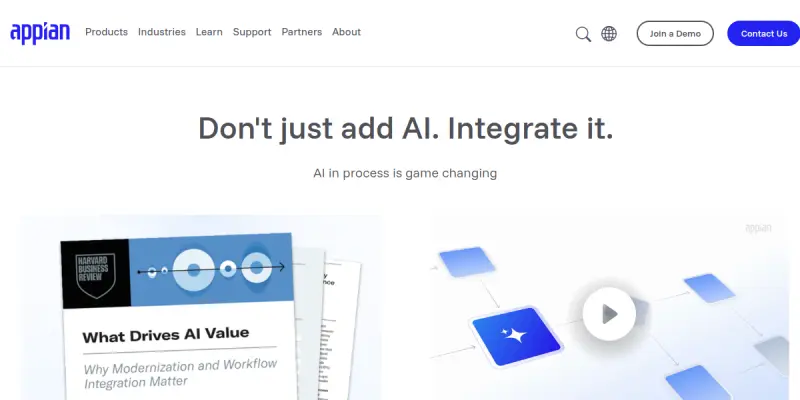
Appian AI is a platform that integrates artificial intelligence, low-code application development, and process automation into a single, unified offering. Designed for enterprises seeking to accelerate digital transformation, it enables teams to build AI-powered workflows and applications without deep coding expertise. Unlike standalone AI tools, Appian AI embeds intelligent capabilities directly into automated processes, allowing organizations to achieve operational excellence and faster decision-making.
Key Features
- AI-Powered Process Automation: Automate complex business processes using built-in AI models for document processing, classification, and decisioning.
- Low-Code Development Environment: Drag-and-drop interface to create applications and workflows with minimal hand-coding.
- Data Fabric Integration: Connect and unify data from disparate sources (on-premises and cloud) without complex data pipelines.
- Intelligent Document Processing (IDP): Extract, classify, and validate data from documents using AI.
- Process Mining: Analyze existing processes to identify bottlenecks and optimization opportunities.
- Natural Language Interaction: Allow users to query data and trigger actions using conversational commands.
- Robotic Process Automation (RPA) Integration: Combine AI with RPA to automate both cognitive and repetitive tasks.
- Enterprise-Grade Security & Governance: Built-in compliance, audit trails, and role-based access controls.
Use Cases
Automating Customer Onboarding
Enterprises use Appian AI to automate customer onboarding by extracting information from forms and documents, verifying against databases, and triggering account creation workflows. This reduces manual effort and speeds up time-to-revenue.
Intelligent Claims Processing
Insurance companies leverage Appian AI to process claims by automatically classifying claim types, extracting relevant data from claim forms, and routing them to appropriate handlers. AI-driven decision models can even approve straightforward claims without human intervention.
Streamlining Supply Chain Operations
Manufacturing and logistics firms implement Appian AI to monitor supply chain data, predict disruptions, and automatically adjust procurement or shipping schedules. Workflows can be reconfigured in real-time based on AI insights.
Enhancing Employee Onboarding
HR teams deploy Appian AI to create self-service portals for new hires, automatically provisioning system access, assigning training modules, and gathering feedback. Chatbots powered by AI answer common questions during the process.
Pricing & Plans
Appian AI follows a Freemium model. A free tier is available with limited features and process capacity, suitable for small teams or proof-of-concept projects. Paid plans (Standard, Enterprise) unlock full AI capabilities, higher process volumes, and premium support. Specific pricing is not publicly disclosed; interested organizations must contact Appian for a quote.
Integrations & Compatibility
Appian AI integrates with major enterprise systems including SAP, Salesforce, Oracle, Microsoft Dynamics, and various databases via its Data Fabric. It supports standard APIs (REST, SOAP) for custom integrations and offers pre-built connectors for common SaaS platforms. The platform is cloud-hosted and accessible through modern web browsers.
Who Is It For?
Appian AI is designed for large enterprises and government organizations with complex process automation needs. It is ideal for business analysts, process architects, and IT teams who want to build AI-infused applications without extensive coding. It is also suitable for operations managers looking to optimize workflows.
Limitations
- Dependency on internet connectivity: Being a cloud platform, Appian AI requires a stable internet connection for full functionality.
- Learning curve for advanced features: While low-code is accessible, mastering AI model tuning and complex workflow design may require training.
- Cost for enterprise scale: Advanced capabilities and high-volume processing are only available on paid plans, which can be expensive for smaller organizations.
- Limited offline capability: The platform is not designed for disconnected operation in low-connectivity environments.
Final Verdict
Appian AI stands out as a comprehensive platform that merges AI, low-code, and automation under one roof. It is an excellent choice for enterprises committed to operational efficiency and digital transformation. However, the freemium model primarily serves as a trial, and full value emerges with paid subscriptions. Organizations with existing low-code investments may find the platform particularly synergistic, while those seeking standalone AI tools might find it overly bundled. Overall, Appian AI delivers on its promise of process excellence through intelligent automation.
Tool Facts
Screenshots & Interface
Pros
- ✓ Unifies AI, low-code, and automation in a single platform, reducing tool sprawl.
- ✓ Low-code interface enables rapid application development by business users.
- ✓ Built-in AI capabilities eliminate the need for separate machine learning models.
- ✓ Data fabric integration simplifies connecting on-premises and cloud data sources.
Cons
- × Requires an active internet connection due to cloud-only deployment.
- × Advanced features and high-volume processing are only available on paid plans.
- × The platform's complexity can require training for users new to AI or automation.
- × Limited offline functionality restricts use in low-connectivity environments.
How to Use Appian AI in Your Workflow
Integrating Appian AI into your professional toolkit enhances efficiency by automating manual steps. By configuring it to suit your specific project requirements, you can optimize output quality and reduce project cycle times. Standard workflows involve testing the tool on simple tasks before scaling its use to complex operations.
Frequently Asked Questions
What is Appian AI used for?
Appian AI combines artificial intelligence, low-code development, and process automation into a unified platform. It helps enterprises automate complex workflows and build intelligent applications. Its key differentiator is the seamless integration of AI with low-code for rapid deployment.
What is the pricing model for Appian AI?
Appian AI uses a Freemium pricing model.
What are the main advantages of Appian AI?
The key benefits of Appian AI include: Unifies AI, low-code, and automation in a single platform, reducing tool sprawl., Low-code interface enables rapid application development by business users., Built-in AI capabilities eliminate the need for separate machine learning models., Data fabric integration simplifies connecting on-premises and cloud data sources..
What are the main limitations of Appian AI?
Some limitations or cons of Appian AI are: Requires an active internet connection due to cloud-only deployment., Advanced features and high-volume processing are only available on paid plans., The platform's complexity can require training for users new to AI or automation., Limited offline functionality restricts use in low-connectivity environments..
Alternative AI Tools

Budibase AI
Budibase AI enables teams to build, customize, and deploy AI agents and chatbots to automate internal business workflows without extensive coding. It is designed for operations and product teams seeking rapid internal tool development.

CodeStream AI
CodeStream is a VS Code extension for seamless code review and team collaboration. It integrates directly into the IDE to streamline pull request workflows and developer communication.

Redis AI
Redis AI is a database solution for developers, offering advanced capabilities and blazing fast app development, with a key differentiator in its robust developer API.
Rating Details
Based on 0 ratings
Quick Comparisons
Related Tools
More AI tools from the same workflow, industry, or category.
AICode
AICode is a spec-driven AI coding copilot for developers using Visual Studio Code. It enforces a disciplined workflow to prevent AI-generated technical debt and ensures maintainable code. Its key differentiator is forcing line-by-line human review before changes are applied.
Opik
Opik is an open-source platform for LLM observability and evaluation. It helps developers trace, test, and monitor AI applications and autonomous agents throughout development and production.
PlanetScale AI
PlanetScale provides serverless cloud hosting for Vitess and PostgreSQL databases. It targets developers and engineering teams requiring high-performance, scalable database infrastructure. The platform enables instant scaling and branching workflows.
CodeReview AI
CodeReview AI is a tool that uses artificial intelligence to analyze code and suggest improvements. It helps developers identify bugs, security issues, and style inconsistencies automatically. The tool integrates with popular version control systems to fit into existing workflows.
Reviews
No reviews submitted yet. Be the first to share your experience.
Write a Review
Share Your Experience
Join the community to write reviews, submit ratings, and bookmark your favorite AI tools.