
CAST AI
Use CAST AI as the anchor for a real shortlist.
Instead of returning to a broad directory, jump straight into the strongest adjacent matchups for pricing, workflow fit, and differentiation.
Overview
Overview
CAST AI is a comprehensive Kubernetes optimization platform designed to automate cloud cost management, improve cluster reliability, and enhance performance for DevOps teams. By leveraging real-time SLO (Service Level Objective) signals, CAST AI takes guardrailed actions in production environments, reducing manual intervention and minimizing human error. The platform integrates with major cloud providers (AWS, Azure, GCP) to rightsize nodes, auto-scale clusters, and continuously optimize resource allocation.
Key Features
- Automated Cost Optimization: Continuously analyzes resource usage and recommends or automatically applies right-sizing and spot instance policies to reduce cloud spend.
- SLO-Driven Guardrails: Uses SLO signals to automatically take actions such as scaling nodes or rescheduling pods to maintain reliability and performance.
- Multi-Cloud Support: Works seamlessly with AWS, Azure, and Google Cloud, enabling unified management across hybrid and multi-cloud environments.
- Cluster Autoscaling: Dynamically adjusts cluster size based on real-time demand, ensuring applications have the resources they need without over-provisioning.
- Spot Instance Management: Automatically provisions and manages spot instances to reduce costs while maintaining availability through diversity strategies.
- Intelligent Rightsizing: Analyzes containers and namespaces to recommend optimal resource requests and limits, preventing waste and improving efficiency.
- Real-Time Monitoring & Alerts: Provides dashboards and alerts for cost, performance, and reliability metrics, helping teams stay proactive.
- CI/CD Integration: Integrates with popular CI/CD pipelines to enforce cost policies and optimize deployments before they reach production.
Use Cases
Reducing Cloud Costs for Startups
Startups running Kubernetes on AWS, Azure, or GCP often face unpredictable cloud bills. CAST AI automatically optimizes node sizes, utilizes spot instances, and scales clusters to match workload demand, resulting in cost reductions of 50% or more without affecting performance.
Ensuring Reliability for Enterprise Deployments
Enterprise teams managing critical applications on Kubernetes need to maintain high availability while controlling costs. CAST AI’s SLO-driven guardrails automatically take corrective actions such as scaling or rescheduling when performance degrades, preventing outages and meeting SLAs.
Automating DevOps Operations
DevOps engineers spend significant time manually tuning clusters and responding to alerts. CAST AI automates routine optimization tasks like spot instance failover, cluster scaling, and resource rightsizing, freeing teams to focus on feature development.
Hybrid & Multi-Cloud Management
Organizations running workloads across multiple clouds or on-premises can use CAST AI to gain a single pane of glass for cost and performance optimization. The platform’s consistent policies and actions work across all major providers.
Pricing & Plans
CAST AI offers a Freemium pricing model. The free tier provides basic optimization suggestions and monitoring. Paid plans unlock automated actions, advanced analytics, and priority support. Specific pricing for team and enterprise plans is available upon request from CAST AI.
Integrations & Compatibility
CAST AI integrates with AWS, Azure, and Google Kubernetes Engine (GKE). It also works with popular CI/CD tools, monitoring platforms, and incident management systems. The platform provides a REST API for custom integrations.
Who Is It For?
CAST AI is designed for DevOps engineers, cloud architects, and platform teams who manage Kubernetes clusters at scale. It is also suitable for finance and operations teams looking to reduce cloud spending without sacrificing reliability.
Limitations
- Cloud Provider Lock-In: While multi-cloud, CAST AI only supports AWS, Azure, and GCP — not on-premises or bare-metal Kubernetes clusters.
- Learning Curve: Understanding SLO signals and guardrails may require initial experimentation for teams new to SLO-driven operations.
- Limited Free Tier: The free tier only provides recommendations; automated actions require a paid subscription.
- No Support for Non-Kubernetes Workloads: CAST AI is exclusively focused on Kubernetes and does not manage other cloud resources directly.
Final Verdict
CAST AI is a powerful Kubernetes optimization platform that effectively reduces cloud costs and improves reliability through automated, SLO-driven actions. Its guardrail approach minimizes risk while maximizing efficiency, making it a valuable tool for DevOps teams managing production clusters. The freemium model allows testing before commitment, but full benefits require a paid plan. Overall, CAST AI is a strong choice for organizations looking to automate Kubernetes cost and performance management.
Tool Facts
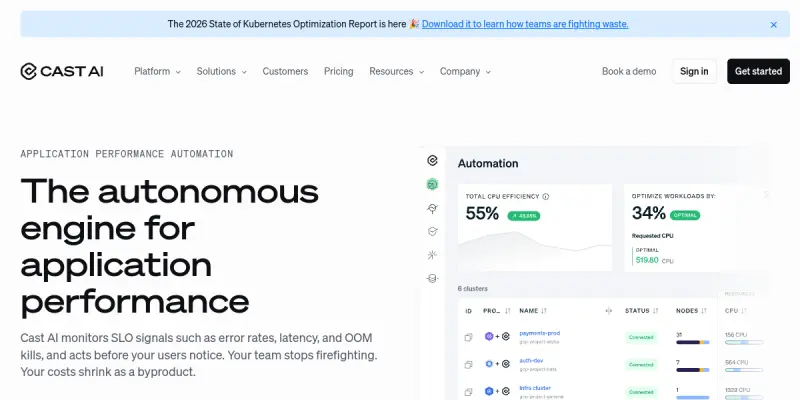
Screenshots & Interface
Pros
- ✓ Automatically reduces cloud costs by up to 50% through right-sizing and spot instance management.
- ✓ SLO-driven guardrails ensure reliability by automatically taking corrective actions in production.
- ✓ Supports AWS, Azure, and GCP for unified multi-cloud optimization.
- ✓ Real-time dashboards and alerts provide clear visibility into cost and performance metrics.
Cons
- × Only supports AWS, Azure, and GCP, excluding on-premises and bare-metal Kubernetes clusters.
- × The free tier only provides recommendations, not automated actions.
- × Teams new to SLO-driven operations may face a learning curve.
- × No native support for non-Kubernetes cloud resources.
How to Use CAST AI in Your Workflow
Integrating CAST AI into your professional toolkit enhances efficiency by automating manual steps. By configuring it to suit your specific project requirements, you can optimize output quality and reduce project cycle times. Standard workflows involve testing the tool on simple tasks before scaling its use to complex operations.
Frequently Asked Questions
What is CAST AI used for?
CAST AI is a Kubernetes optimization platform that automatically manages cloud costs, improves cluster reliability, and boosts performance. It uses SLO signals to take guardrailed actions in production, helping DevOps teams reduce waste and prevent outages.
What is the pricing model for CAST AI?
CAST AI uses a Freemium pricing model.
What are the main advantages of CAST AI?
The key benefits of CAST AI include: Automatically reduces cloud costs by up to 50% through right-sizing and spot instance management., SLO-driven guardrails ensure reliability by automatically taking corrective actions in production., Supports AWS, Azure, and GCP for unified multi-cloud optimization., Real-time dashboards and alerts provide clear visibility into cost and performance metrics..
What are the main limitations of CAST AI?
Some limitations or cons of CAST AI are: Only supports AWS, Azure, and GCP, excluding on-premises and bare-metal Kubernetes clusters., The free tier only provides recommendations, not automated actions., Teams new to SLO-driven operations may face a learning curve., No native support for non-Kubernetes cloud resources..
Alternative AI Tools

Jenkins AI
Jenkins is an open-source automation server for continuous integration and delivery. It supports building, testing, and deploying software with an extensive plugin ecosystem.
Checkmk AI
Checkmk AI unifies IT monitoring for cloud, on-prem, and containers. It uses AI to automate troubleshooting and root cause analysis.
Spot.io AI
Spot.io AI is a cloud cost optimization platform that uses machine learning to automatically manage and reduce cloud infrastructure spending. It is designed for DevOps teams and engineers looking to improve efficiency and lower costs without manual intervention.
Rating Details
Based on 0 ratings
Quick Comparisons
Related Tools
More AI tools from the same workflow, industry, or category.
AICode
AICode is a spec-driven AI coding copilot for developers using Visual Studio Code. It enforces a disciplined workflow to prevent AI-generated technical debt and ensures maintainable code. Its key differentiator is forcing line-by-line human review before changes are applied.
Opik
Opik is an open-source platform for LLM observability and evaluation. It helps developers trace, test, and monitor AI applications and autonomous agents throughout development and production.
PlanetScale AI
PlanetScale provides serverless cloud hosting for Vitess and PostgreSQL databases. It targets developers and engineering teams requiring high-performance, scalable database infrastructure. The platform enables instant scaling and branching workflows.
CodeReview AI
CodeReview AI is a tool that uses artificial intelligence to analyze code and suggest improvements. It helps developers identify bugs, security issues, and style inconsistencies automatically. The tool integrates with popular version control systems to fit into existing workflows.
Reviews
No reviews submitted yet. Be the first to share your experience.
Write a Review
Share Your Experience
Join the community to write reviews, submit ratings, and bookmark your favorite AI tools.