

DuckDB AI
Use DuckDB AI as the anchor for a real shortlist.
Instead of returning to a broad directory, jump straight into the strongest adjacent matchups for pricing, workflow fit, and differentiation.
Overview
Overview
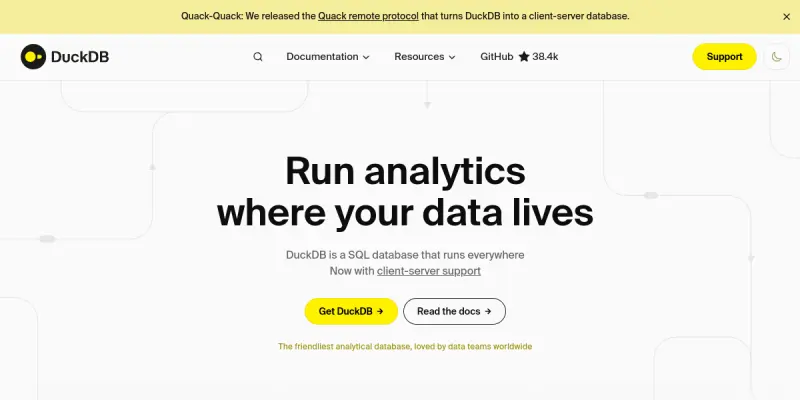
DuckDB is an in-process SQL OLAP database management system. It is designed to run side-by-side with the application that uses it, rather than on a separate server. It is columnar, meaning it stores data in columns rather than rows, which is more efficient for analytical queries. The system is open source, licensed under the MIT license, and written in C++.
Key Features
- In-Process Execution: Runs directly within the same process as the application, avoiding network overhead.
- Columnar Storage: Optimized for analytical workloads, allowing for faster data compression and retrieval.
- Parallel Query Execution: Automatically utilizes multiple CPU cores to speed up complex queries.
- Zero-Copy Data Sharing: Shares data directly with Python, R, and Julia without copying it, saving memory.
- Embedded SQL: Provides a standard SQL interface for data manipulation.
- SQLite Compatibility: Allows many existing SQLite applications to run on DuckDB with minimal changes.
Use Cases
Local Data Analysis
Data analysts often work with large CSV or Parquet files locally. DuckDB allows querying these files directly with SQL, eliminating the need to import data into a heavy server-side database like PostgreSQL or Snowflake.
Data Science Pipelines
Python data scientists use DuckDB to process data within their notebooks or scripts. Because it is in-process, it integrates seamlessly with pandas and NumPy, avoiding the "split-apply-combine" inefficiencies of traditional database tools.
Reporting Dashboards
Developers building dashboards can use DuckDB as the backend data store. It provides the performance needed for real-time analytics while keeping the data on-premise.
Pricing & Plans
DuckDB is free and open source under the MIT License. There are no usage limits or paid tiers. The community maintains the project, and enterprise support is available through third-party providers if needed.
Integrations & Compatibility
DuckDB integrates natively with the Python programming language, R, and Julia. It can be accessed via SQL clients like DBeaver, TablePlus, and the DuckDB shell. It also supports direct integration with data visualization tools like Streamlit and Plotly.
Who Is It For?
This tool is primarily for data analysts, data scientists, and backend developers who need to perform fast analytics on local datasets. It is not intended for transaction processing (OLTP) systems.
Limitations
- DuckDB is designed for analytical workloads (OLAP) and does not support concurrent writes or complex transactions required for OLTP systems.
- It lacks distributed computing capabilities, meaning it cannot scale horizontally across multiple nodes for massive datasets.
Final Verdict
DuckDB is an excellent choice for users needing high-performance SQL analytics on local data. Its in-process architecture and zero-copy sharing make it a powerful tool for the data science stack, particularly for those working with Python.
Tool Facts
Screenshots & Interface
Pros
- ✓ Executes complex SQL queries on local datasets instantly without requiring a separate server process.
- ✓ Supports zero-copy data sharing between Python and SQL environments, eliminating data duplication.
- ✓ Includes columnar storage and parallel execution for high-performance analytical workloads.
Cons
- × Primarily designed for analytical (OLAP) workloads, making it unsuitable for transactional (OLTP) applications like user authentication.
- × While highly performant, it lacks the distributed architecture required to scale to petabyte-scale datasets across multiple nodes.
How to Use DuckDB AI in Your Workflow
Integrating DuckDB AI into your professional toolkit enhances efficiency by automating manual steps. By configuring it to suit your specific project requirements, you can optimize output quality and reduce project cycle times. Standard workflows involve testing the tool on simple tasks before scaling its use to complex operations.
Frequently Asked Questions
What is DuckDB AI used for?
DuckDB is an in-process SQL OLAP database management system designed for high-performance analytics on local data. It targets data analysts and developers needing fast SQL queries without server overhead. Its key differentiator is zero-copy data sharing with Python and R.
What is the pricing model for DuckDB AI?
DuckDB AI uses a Freemium pricing model.
What are the main advantages of DuckDB AI?
The key benefits of DuckDB AI include: Executes complex SQL queries on local datasets instantly without requiring a separate server process., Supports zero-copy data sharing between Python and SQL environments, eliminating data duplication., Includes columnar storage and parallel execution for high-performance analytical workloads..
What are the main limitations of DuckDB AI?
Some limitations or cons of DuckDB AI are: Primarily designed for analytical (OLAP) workloads, making it unsuitable for transactional (OLTP) applications like user authentication., While highly performant, it lacks the distributed architecture required to scale to petabyte-scale datasets across multiple nodes..
Alternative AI Tools
Datactics AI
Datactics AI is an augmented data quality platform that uses machine learning to automate data cleansing, matching, and enrichment. It helps data teams and analysts improve data accuracy, reduce manual data preparation, and support regulatory compliance. Its key differentiator is the combination of rule-based and AI-driven data quality controls.

Talend AI
Talend, now part of Qlik, offers a cloud-based data integration, transformation, and governance platform. It helps data engineers and analysts prepare and manage data for AI, analytics, and informed decision-making across hybrid and multi-cloud environments.

ThoughtSpot
ThoughtSpot is a search-driven analytics platform that uses AI to let users query data with natural language and get instant visual insights. It targets business intelligence teams and data analysts who need to democratize data access across organizations.
Rating Details
Based on 0 ratings
Quick Comparisons
Related Tools
More AI tools from the same workflow, industry, or category.
NewsData.io
NewsData.io delivers structured global news data via a real-time API. It supports 100,000+ sources across 200+ countries with filtering by keyword and date. This tool helps developers integrate news intelligence into applications and dashboards.
Wisegrid
Wisegrid is a work management platform that combines spreadsheet functionality with application features like dashboards and automations. It allows teams to manage projects and data using rows and columns, including AI-driven formulas, with a flat pricing model.
TradeBB
TradeBB is a All-in-One Trading Journal and analysis tool that helps traders seamlessly record each transaction, deeply analyze trading data, and review trading processes.
Pinecone
Pinecone is a fully managed vector database for AI applications, enabling fast similarity search and retrieval-augmented generation (RAG). It targets developers and data scientists who need scalable vector storage without managing infrastructure.
Reviews
No reviews submitted yet. Be the first to share your experience.
Write a Review
Share Your Experience
Join the community to write reviews, submit ratings, and bookmark your favorite AI tools.