

GoodData AI
Use GoodData AI as the anchor for a real shortlist.
Instead of returning to a broad directory, jump straight into the strongest adjacent matchups for pricing, workflow fit, and differentiation.
Overview
Overview
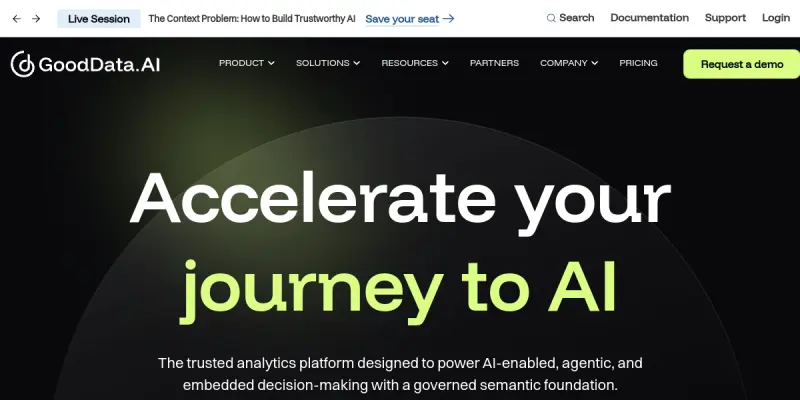
GoodData AI is a cloud-native business intelligence (BI) platform designed to help enterprises build data-driven applications. Unlike traditional BI tools that focus solely on reporting, GoodData emphasizes a 'governed semantic layer' that defines business metrics consistently across the organization. This approach separates business logic from raw data, allowing teams to build 'agentic' analytics—intelligent systems that can reason over data and make recommendations. The platform is particularly well-suited for embedding analytics directly into customer-facing applications.
Key Features
- Governed Semantic Layer: Ensures that metrics and definitions are consistent across the entire organization, preventing data silos.
- Agentic AI Analytics: Utilizes AI to provide natural language querying and automated insights, enabling users to ask questions and get answers without coding.
- Embedded BI: Allows developers to embed interactive dashboards and analytics directly into third-party applications.
- Data Fabric Connectivity: Connects seamlessly to a wide variety of data sources, including Snowflake, Databricks, Google BigQuery, and Salesforce.
- Real-time Reporting: Provides live data updates to ensure that decision-makers are always looking at the most current information.
- Mobile Optimization: Offers responsive dashboards that function well on mobile devices for on-the-go analysis.
Use Cases
Enterprise Performance Management
GoodData is frequently used by CFOs and finance teams to manage budgeting, forecasting, and profitability analysis. The governed layer ensures that financial metrics are calculated the same way everywhere, reducing errors and improving compliance.
Embedded Customer Analytics
Customer success and product teams use GoodData to embed self-service analytics into their own SaaS products. This allows end-users to view their own data and performance without leaving the application.
Operational Dashboards
Operations managers utilize the platform to monitor key performance indicators (KPIs) in real-time. The ability to connect to operational databases allows for immediate visibility into supply chain, logistics, or sales operations.
Pricing & Plans
GoodData operates on a Freemium model, allowing users to explore basic features and visualizations for free. For full capabilities, including the semantic layer and advanced AI features, users typically move to a paid subscription. Pricing is generally tiered based on the number of users and the complexity of the data implementation, with dedicated Enterprise plans available for large organizations requiring custom SLAs and on-premise deployment options.
Integrations & Compatibility
The platform offers robust integration capabilities via its API and native connectors. It supports major data warehouses and CRMs, making it a central hub for enterprise data. It is compatible with various deployment models, including cloud and on-premise environments.
Who Is It For?
GoodData AI is primarily designed for mid-sized to large enterprises, including Fortune 500 companies. It is ideal for data analysts, CTOs, product managers, and embedded BI developers who need a scalable, governed analytics solution rather than a simple spreadsheet replacement.
Limitations
- The initial implementation requires a significant investment of time and resources to set up the governed semantic layer.
- The learning curve can be steep for new users unfamiliar with semantic modeling concepts.
- The platform is generally considered expensive and may not be cost-effective for small startups or individual users.
Final Verdict
GoodData AI stands out as a powerful enterprise-grade analytics platform, particularly for organizations that require strict data governance and the ability to embed analytics into their own applications. While it offers a rich feature set and excellent scalability, potential users should be prepared for a complex setup process and a substantial budget commitment. It is less suited for small teams seeking quick, ad-hoc data exploration.
Tool Facts
Screenshots & Interface
Pros
- ✓ The governed semantic layer ensures consistent metrics across the organization, preventing data silos and calculation errors.
- ✓ Strong embedded analytics capabilities allow developers to integrate BI dashboards directly into customer-facing applications.
- ✓ Agentic AI features enable natural language querying for non-technical users, simplifying complex data analysis.
- ✓ Connects seamlessly with major data warehouses like Snowflake, Databricks, and Google BigQuery.
Cons
- × The learning curve is steep, requiring dedicated resources to set up the semantic layer and data models correctly.
- × Pricing is enterprise-focused and may be prohibitive for small businesses or individual users.
- × Optimization requires clean, structured data; messy data sources can lead to poor query performance and confusion.
How to Use GoodData AI in Your Workflow
Integrating GoodData AI into your professional toolkit enhances efficiency by automating manual steps. By configuring it to suit your specific project requirements, you can optimize output quality and reduce project cycle times. Standard workflows involve testing the tool on simple tasks before scaling its use to complex operations.
Frequently Asked Questions
What is GoodData AI used for?
GoodData AI is a governed business intelligence platform that empowers enterprises with AI-driven analytics and semantic modeling capabilities.
What is the pricing model for GoodData AI?
GoodData AI uses a Freemium pricing model.
What are the main advantages of GoodData AI?
The key benefits of GoodData AI include: The governed semantic layer ensures consistent metrics across the organization, preventing data silos and calculation errors., Strong embedded analytics capabilities allow developers to integrate BI dashboards directly into customer-facing applications., Agentic AI features enable natural language querying for non-technical users, simplifying complex data analysis., Connects seamlessly with major data warehouses like Snowflake, Databricks, and Google BigQuery..
What are the main limitations of GoodData AI?
Some limitations or cons of GoodData AI are: The learning curve is steep, requiring dedicated resources to set up the semantic layer and data models correctly., Pricing is enterprise-focused and may be prohibitive for small businesses or individual users., Optimization requires clean, structured data; messy data sources can lead to poor query performance and confusion..
Alternative AI Tools
Charticulator AI
Charticulator AI is a SaaS platform that transforms complex datasets into interactive, custom visualizations. It uses AI to help analysts, data scientists, and business users discover trends and patterns without manual chart building. Its key differentiator is drag-and-drop generation of bespoke charts directly from raw data.

Polars AI
Polars AI is an AI-powered data analytics assistant that helps users query, transform, and visualize datasets using natural language. It is designed for analysts and data professionals who want to speed up data exploration without writing complex code. Its key differentiator is the ability to generate insights and charts directly from plain English prompts.

HubSpot AI
HubSpot AI integrates machine learning into the HubSpot CRM platform to automate data analysis, predict customer behavior, and optimize marketing campaigns. It is designed for sales and marketing teams seeking actionable insights without manual data wrangling. A key differentiator is its seamless integration with HubSpot's existing suite of marketing, sales, and service tools.
Rating Details
Based on 0 ratings
Quick Comparisons
Related Tools
More AI tools from the same workflow, industry, or category.
NewsData.io
NewsData.io delivers structured global news data via a real-time API. It supports 100,000+ sources across 200+ countries with filtering by keyword and date. This tool helps developers integrate news intelligence into applications and dashboards.
Wisegrid
Wisegrid is a work management platform that combines spreadsheet functionality with application features like dashboards and automations. It allows teams to manage projects and data using rows and columns, including AI-driven formulas, with a flat pricing model.
TradeBB
TradeBB is a All-in-One Trading Journal and analysis tool that helps traders seamlessly record each transaction, deeply analyze trading data, and review trading processes.
Pinecone
Pinecone is a fully managed vector database for AI applications, enabling fast similarity search and retrieval-augmented generation (RAG). It targets developers and data scientists who need scalable vector storage without managing infrastructure.
Reviews
No reviews submitted yet. Be the first to share your experience.
Write a Review
Share Your Experience
Join the community to write reviews, submit ratings, and bookmark your favorite AI tools.