

Supabase AI
Use Supabase AI as the anchor for a real shortlist.
Instead of returning to a broad directory, jump straight into the strongest adjacent matchups for pricing, workflow fit, and differentiation.
Overview
Overview
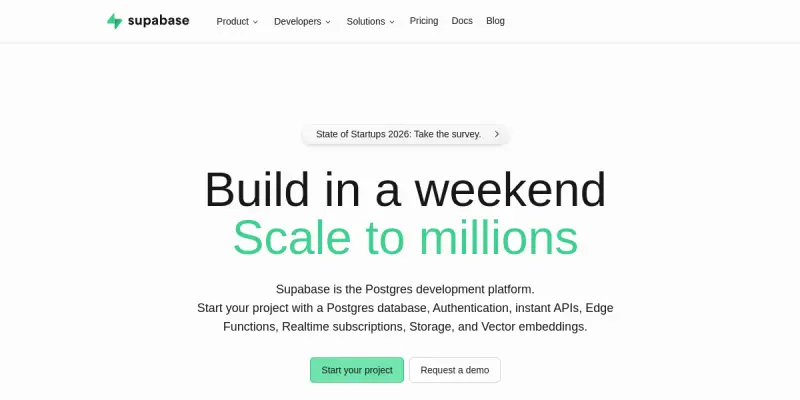
Supabase AI is an advanced evolution of the Supabase platform, integrating artificial intelligence capabilities directly into a PostgreSQL-based backend. It allows developers to build, deploy, and scale applications with features like vector embeddings for semantic search, AI functions for text processing, and seamless integration with major LLM providers like OpenAI and Anthropic. It bridges the gap between traditional database management and modern AI application development.
Key Features
- Vector Embeddings: Native support for storing and querying vector data using pgvector, enabling semantic search and similarity matching.
- AI Extensions: Pre-built extensions for OpenAI and Anthropic, allowing instant access to GPT-4 and Claude models.
- AI Functions: Serverless functions that can be triggered by database events or HTTP requests to perform AI tasks on the fly.
- PostgreSQL Integration: Leverages the full power of PostgreSQL for data storage, while using AI extensions for intelligence.
- Realtime Subscriptions: Built-in realtime capabilities to sync data changes instantly across clients.
- Authentication: Secure, easy-to-implement authentication (JWT, OAuth, Magic Links).
- Storage: File storage for images, videos, and documents with built-in CDN.
- Edge Functions: Compute at the edge for low-latency execution.
Use Cases
RAG Applications
Build Retrieval-Augmented Generation apps by storing vector embeddings of documents in a Supabase database and using AI Functions to query and retrieve relevant context for LLMs.
Content Moderation
Automatically filter user-generated content using AI extensions to detect inappropriate text or images before they reach your application.
Sentiment Analysis
Analyze customer feedback or social media posts in real-time using AI functions to gauge public sentiment.
Data Enrichment
Automatically enrich user profiles or product catalogs with AI-generated summaries or classifications.
Pricing & Plans
Supabase offers a generous free tier that includes 500MB of database space and 2GB of bandwidth per month. This is sufficient for prototyping and small projects. Paid plans (Pro, Enterprise) scale based on database size, bandwidth, and compute requirements.
Integrations & Compatibility
Integrates natively with OpenAI, Anthropic, Hugging Face, and Postgres. Compatible with frontend frameworks like React, Vue, and Angular via Supabase JS Client.
Who Is It For?
Frontend developers, backend engineers, startups building MVPs, and teams looking for a scalable backend solution that includes AI capabilities.
Limitations
- Requires a basic understanding of SQL and database management.
- The free tier has resource limits that may not suit high-traffic production applications.
- Custom AI model training requires setup outside of the managed service.
Final Verdict
Supabase AI is a powerful choice for developers who want a managed PostgreSQL backend with built-in AI features. It simplifies the complex task of integrating vector databases and LLMs, allowing teams to focus on building features rather than managing infrastructure.
Tool Facts
Screenshots & Interface
Pros
- ✓ Native vector database support via pgvector for efficient AI data storage
- ✓ Direct integration with OpenAI and Anthropic models without complex setup
- ✓ Familiar SQL interface reduces the learning curve for developers
- ✓ Comprehensive backend features (Auth, Storage, Realtime) included in one platform
Cons
- × Managed service costs can rise significantly with large-scale data and high traffic
- × Relies on external AI providers (OpenAI/Anthropic) which incur API costs
- × Requires SQL knowledge, which may be a barrier for non-technical users
How to Use Supabase AI in Your Workflow
Integrating Supabase AI into your professional toolkit enhances efficiency by automating manual steps. By configuring it to suit your specific project requirements, you can optimize output quality and reduce project cycle times. Standard workflows involve testing the tool on simple tasks before scaling its use to complex operations.
Frequently Asked Questions
What is Supabase AI used for?
Supabase AI extends the Supabase platform with vector embeddings and AI-powered features. It enables developers to build RAG applications and integrate OpenAI models directly into their database workflows.
What is the pricing model for Supabase AI?
Supabase AI uses a Free pricing model.
What are the main advantages of Supabase AI?
The key benefits of Supabase AI include: Native vector database support via pgvector for efficient AI data storage, Direct integration with OpenAI and Anthropic models without complex setup, Familiar SQL interface reduces the learning curve for developers, Comprehensive backend features (Auth, Storage, Realtime) included in one platform.
What are the main limitations of Supabase AI?
Some limitations or cons of Supabase AI are: Managed service costs can rise significantly with large-scale data and high traffic, Relies on external AI providers (OpenAI/Anthropic) which incur API costs, Requires SQL knowledge, which may be a barrier for non-technical users.
Alternative AI Tools

Puppeteer AI
Puppeteer AI provides voice-enabled, HIPAA-compliant AI agents for healthcare practices. It automates patient intake, scheduling, and triage workflows to reduce administrative burden. Designed for clinics and hospitals, it helps streamline front-office operations.

Semgrep
Semgrep is a static code analysis tool that scans codebases for security vulnerabilities and enforces coding standards. It is designed for developers and security teams who need fast, accurate code review. Unlike many tools, Semgrep offers powerful custom rule creation without needing a full language parser.

VictorOps AI
Splunk On-Call (formerly VictorOps) automates on-call operations and incident management for DevOps teams using AI-driven insights.
Rating Details
Based on 0 ratings
Quick Comparisons
Related Tools
More AI tools from the same workflow, industry, or category.
AICode
AICode is a spec-driven AI coding copilot for developers using Visual Studio Code. It enforces a disciplined workflow to prevent AI-generated technical debt and ensures maintainable code. Its key differentiator is forcing line-by-line human review before changes are applied.
Opik
Opik is an open-source platform for LLM observability and evaluation. It helps developers trace, test, and monitor AI applications and autonomous agents throughout development and production.
PlanetScale AI
PlanetScale provides serverless cloud hosting for Vitess and PostgreSQL databases. It targets developers and engineering teams requiring high-performance, scalable database infrastructure. The platform enables instant scaling and branching workflows.
CodeReview AI
CodeReview AI is a tool that uses artificial intelligence to analyze code and suggest improvements. It helps developers identify bugs, security issues, and style inconsistencies automatically. The tool integrates with popular version control systems to fit into existing workflows.
Reviews
No reviews submitted yet. Be the first to share your experience.
Write a Review
Share Your Experience
Join the community to write reviews, submit ratings, and bookmark your favorite AI tools.