
Talend AI
Use Talend AI as the anchor for a real shortlist.
Instead of returning to a broad directory, jump straight into the strongest adjacent matchups for pricing, workflow fit, and differentiation.
Overview
Overview
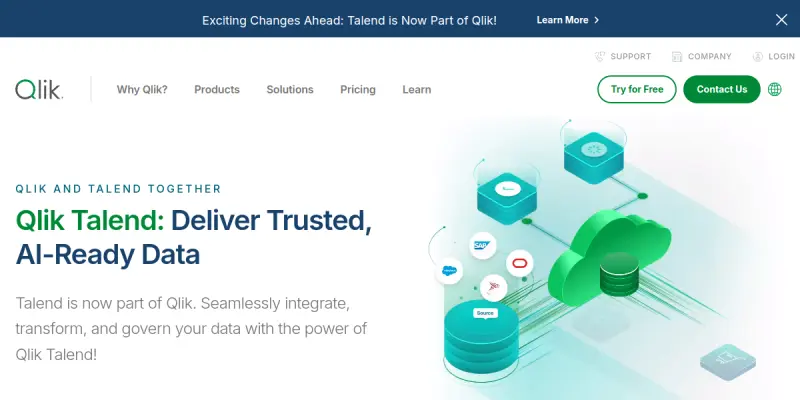
Talend, now part of Qlik, delivers Qlik Talend Cloud, a unified platform for data integration, transformation, and governance. Designed for modern data stacks, it enables organizations to connect, cleanse, and manage data across hybrid and multi-cloud environments. The platform leverages AI to automate data cataloging, quality checks, and pipeline creation, ensuring that analytics and AI initiatives are built on trusted, high-quality data. It is particularly suited for data engineers, data stewards, and analytics teams who need to operationalize data at scale.
Key Features
- AI-Powered Data Integration: Automatically discovers, maps, and transforms data from hundreds of sources using machine learning recommendations.
- Data Quality & Governance: Built-in profiling, cleansing, and stewardship capabilities to ensure data accuracy, consistency, and compliance with regulations like GDPR and CCPA.
- Hybrid & Multi-Cloud Connectivity: Connect to on-premises databases, cloud data warehouses (Snowflake, BigQuery, Redshift), and SaaS applications (Salesforce, SAP) without complex coding.
- Visual Data Pipeline Builder: Drag-and-drop interface to design, schedule, and monitor data pipelines with pre-built transformations and connectors.
- Data Catalog & Discovery: Automated metadata scanning and cataloging to help users find, understand, and trust their data assets.
- Real-Time Data Processing: Stream data in real time for use cases like fraud detection, IoT analytics, and operational dashboards.
- Collaboration & Lineage Tracking: Share datasets, track lineage, and collaborate on data models with team members.
- Scalability & Performance: Handles petabyte-scale data volumes with native cloud elasticity and parallel processing.
Use Cases
Centralized Data Management for AI/ML
Data science teams can use Qlik Talend Cloud to prepare training datasets, automate feature engineering, and ensure data lineage for model reproducibility. The platform integrates with AI/ML tools like Jupyter, Databricks, and SageMaker.
Regulatory Compliance & Data Governance
Data stewards can set up automated data quality rules, track sensitive data, and generate compliance reports to meet GDPR, HIPAA, or CCPA requirements. The data catalog provides a single source of truth for data assets.
Real-Time Operational Analytics
Business analysts can build real-time dashboards and alerts by streaming data from CRM, ERP, and IoT sources. The visual pipeline builder reduces time-to-insight from weeks to hours.
Cloud Migration & Modernization
Organizations migrating from on-premises data warehouses to cloud platforms (e.g., Snowflake, Databricks) can use Qlik Talend Cloud to discover, assess, and migrate data with minimal disruption.
Self-Service Data Preparation
Business users can clean and transform data using a guided, no-code interface without relying on IT. Pre-built connectors to popular SaaS apps simplify data blending.
Pricing & Plans
Qlik Talend Cloud offers a Freemium model with a limited free tier for individual users or small projects. Paid plans start with a standard subscription that includes additional connectors, higher data volumes, and priority support. Enterprise plans offer advanced governance, security controls, and dedicated support. Specific pricing is not publicly disclosed and is available on request.
Integrations & Compatibility
- Data Stores: Snowflake, Google BigQuery, Amazon Redshift, Azure Synapse, Databricks, PostgreSQL, MySQL, Oracle, SQL Server.
- SaaS Applications: Salesforce, SAP, NetSuite, Workday, Marketo, HubSpot.
- Storage & File Formats: Amazon S3, Azure Blob, Google Cloud Storage, CSV, Parquet, Avro, JSON, XML.
- AI/ML Platforms: Jupyter, Databricks, Amazon SageMaker, Azure Machine Learning.
- Streaming: Kafka, Kinesis, Azure Event Hubs.
- Governance Tools: Collibra, Alation, Informatica.
Who Is It For?
- Data Engineers responsible for building and maintaining data pipelines.
- Data Stewards & Governance Officers managing data quality and compliance.
- Data Scientists & ML Engineers needing clean, reliable data for models.
- Business Analysts who want self-service data preparation.
- Enterprise Architects overseeing cloud migration and data strategy.
Limitations
- Learning Curve for Advanced Features: The visual pipeline builder and data catalog require initial training to fully leverage advanced transformations and governance rules.
- Pricing Transparency: Exact pricing for paid plans is not publicly listed, making budget planning difficult for small teams.
- Dependency on Qlik Ecosystem: Deep integration with Qlik’s analytics platform may limit flexibility for organizations using other BI tools.
- Handling Unstructured Data: While excellent for structured data, the platform has limited native support for unstructured or semi-structured formats like images or free-text documents.
Final Verdict
Qlik Talend Cloud is a robust, enterprise-grade data integration and governance platform that combines Talend’s open-source heritage with Qlik’s analytics strength. Its AI-assisted pipeline creation, broad connector library, and emphasis on data trust make it a strong choice for organizations modernizing their data stack. However, potential users should evaluate the pricing model and the learning curve associated with its more advanced features. Overall, it is a solid investment for teams that need to operationalize data at scale.
Tool Facts
Screenshots & Interface
Pros
- ✓ AI-powered pipeline builder automates data mapping and transformation, reducing manual coding effort.
- ✓ Broad connector library supports hundreds of data sources and targets, simplifying hybrid and multi-cloud integration.
- ✓ Built-in data quality and governance features help maintain compliance with regulations like GDPR and CCPA.
- ✓ Visual drag-and-drop interface makes pipeline design accessible to non-technical users.
- ✓ Real-time data processing enables operational use cases such as fraud detection and live dashboards.
Cons
- × Advanced governance and transformation features have a steep learning curve for new users.
- × Pricing for paid tiers is not publicly disclosed, making budget comparisons difficult.
- × Native support for unstructured data (images, free text) is limited compared to structured data handling.
- × Heavy reliance on the Qlik ecosystem may create vendor lock-in for organizations using non-Qlik analytics tools.
How to Use Talend AI in Your Workflow
Integrating Talend AI into your professional toolkit enhances efficiency by automating manual steps. By configuring it to suit your specific project requirements, you can optimize output quality and reduce project cycle times. Standard workflows involve testing the tool on simple tasks before scaling its use to complex operations.
Frequently Asked Questions
What is Talend AI used for?
Talend, now part of Qlik, offers a cloud-based data integration, transformation, and governance platform. It helps data engineers and analysts prepare and manage data for AI, analytics, and informed decision-making across hybrid and multi-cloud environments.
What is the pricing model for Talend AI?
Talend AI uses a Freemium pricing model.
What are the main advantages of Talend AI?
The key benefits of Talend AI include: AI-powered pipeline builder automates data mapping and transformation, reducing manual coding effort., Broad connector library supports hundreds of data sources and targets, simplifying hybrid and multi-cloud integration., Built-in data quality and governance features help maintain compliance with regulations like GDPR and CCPA., Visual drag-and-drop interface makes pipeline design accessible to non-technical users., Real-time data processing enables operational use cases such as fraud detection and live dashboards..
What are the main limitations of Talend AI?
Some limitations or cons of Talend AI are: Advanced governance and transformation features have a steep learning curve for new users., Pricing for paid tiers is not publicly disclosed, making budget comparisons difficult., Native support for unstructured data (images, free text) is limited compared to structured data handling., Heavy reliance on the Qlik ecosystem may create vendor lock-in for organizations using non-Qlik analytics tools..
Alternative AI Tools

Sisense AI
Sisense provides AI-powered embedded analytics for creating interactive dashboards. It supports pro-code, low-code, and no-code data visualization.

ThoughtSpot
ThoughtSpot is a search-driven analytics platform that uses AI to let users query data with natural language and get instant visual insights. It targets business intelligence teams and data analysts who need to democratize data access across organizations.

Palantir AI
Palantir AI is a SaaS platform that applies predictive analytics to help businesses process and visualize complex datasets. It is designed for analysts and data teams who need to identify trends and segment customer data efficiently. Its key differentiator is automated pattern recognition that reduces manual spreadsheet work.
Rating Details
Based on 0 ratings
Quick Comparisons
Related Tools
More AI tools from the same workflow, industry, or category.
NewsData.io
NewsData.io delivers structured global news data via a real-time API. It supports 100,000+ sources across 200+ countries with filtering by keyword and date. This tool helps developers integrate news intelligence into applications and dashboards.
Wisegrid
Wisegrid is a work management platform that combines spreadsheet functionality with application features like dashboards and automations. It allows teams to manage projects and data using rows and columns, including AI-driven formulas, with a flat pricing model.
TradeBB
TradeBB is a All-in-One Trading Journal and analysis tool that helps traders seamlessly record each transaction, deeply analyze trading data, and review trading processes.
Pinecone
Pinecone is a fully managed vector database for AI applications, enabling fast similarity search and retrieval-augmented generation (RAG). It targets developers and data scientists who need scalable vector storage without managing infrastructure.
Reviews
No reviews submitted yet. Be the first to share your experience.
Write a Review
Share Your Experience
Join the community to write reviews, submit ratings, and bookmark your favorite AI tools.