

TestSigma
Use TestSigma as the anchor for a real shortlist.
Instead of returning to a broad directory, jump straight into the strongest adjacent matchups for pricing, workflow fit, and differentiation.
Overview
Overview
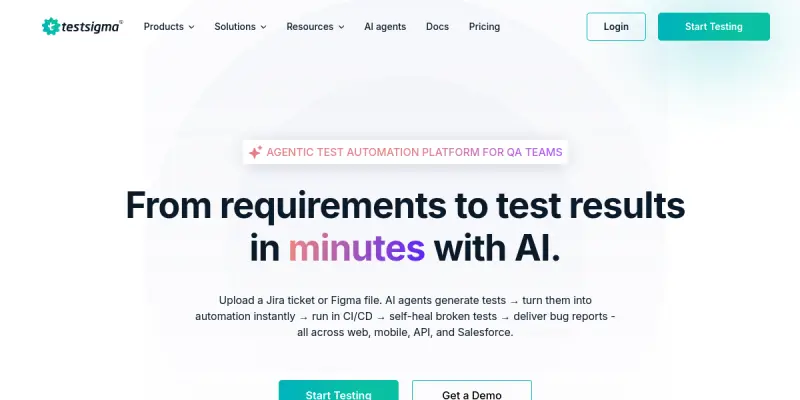
TestSigma is a unified, no-code test automation platform designed to empower QA teams of all skill levels. By leveraging AI agents, it enables users to generate, run, and manage end-to-end tests across web, mobile, and API interfaces without writing a single line of code. The platform aims to accelerate testing cycles, reduce manual effort, and improve overall software quality.
Key Features
- AI-Powered Test Generation: Automatically create test cases from natural language descriptions or by recording user interactions.
- No-Code Test Builder: Intuitive drag-and-drop interface allows non-technical team members to build and maintain tests.
- Cross-Platform Testing: Execute tests on web, mobile (iOS/Android), and API endpoints from a single dashboard.
- Self-Healing Scripts: AI agents automatically detect and fix element locators that break due to UI changes, reducing maintenance overhead.
- Parallel Test Execution: Run multiple tests simultaneously across different environments to shorten feedback loops.
- CI/CD Integration: Seamlessly plug into popular CI/CD pipelines for continuous testing.
- Built-in Reporting & Analytics: Visual dashboards provide insights into test results, coverage, and trends.
- Collaboration Tools: Share test cases, results, and dashboards with team members to foster collaboration.
Use Cases
Regression Testing for Agile Teams
Agile teams can leverage TestSigma to automatically run regression suites with every code change, ensuring that new features do not break existing functionality. The no-code interface allows product owners and business analysts to contribute test scenarios directly.
API Contract Testing
Developers can use TestSigma to validate API endpoints against defined contracts or schemas. The AI agents generate test payloads and verify responses, helping maintain reliability in microservices architectures.
Mobile App Cross-Browser Testing
QA teams can run the same suite of tests across multiple mobile devices and browser versions simultaneously. TestSigma’s cloud execution environment eliminates the need for maintaining an in-house device lab.
Onboarding Non-Technical Testers
Organizations shifting left can onboard manual testers or less technical staff onto automated testing. The platform’s visual workflow builder and natural-language test generation lower the barrier to automation.
Pricing & Plans
TestSigma offers a paid subscription model with multiple tiers. A free tier is available with limited test runs and concurrent executions for small teams. Paid plans scale up to support larger teams, more parallel executions, and advanced features like SSO and priority support. For precise pricing, it is advisable to visit the official TestSigma website or contact their sales team.
Integrations & Compatibility
TestSigma integrates with popular CI/CD tools such as Jenkins, GitHub Actions, GitLab CI, and Bitbucket Pipelines. It also supports integration with test management systems (e.g., Jira), communication tools (e.g., Slack), and version control platforms. The platform runs on the cloud, so no local infrastructure is required.
Who Is It For?
TestSigma is built for QA engineers, software developers, and product teams who need to automate testing processes without heavy coding overhead. It is especially beneficial for organizations with mixed technical skill levels that want a single tool covering web, mobile, and API testing.
Limitations
- Internet Dependency: As a cloud-based platform, TestSigma requires a stable internet connection for all operations.
- Deep Customization Limits: Very complex or highly customized test scenarios may still require scripting that the no-code interface cannot fully handle.
- Learning Curve for Advanced Features: While basic test creation is simple, mastering the AI agent configuration and analysis features may take time.
Final Verdict
TestSigma delivers a compelling value proposition for teams aiming to streamline test automation without extensive coding. Its AI agent-driven approach and no-code interface stand out in a crowded market. While it is not a perfect fit for every testing scenario—especially those requiring deep customization—it provides a strong foundation for accelerating QA cycles and improving software quality. It is worth evaluating for any modern QA team.
Tool Facts
Screenshots & Interface
Pros
- ✓ No-code interface enables non-technical team members to create and maintain automated tests.
- ✓ AI agents automatically generate test cases from natural language descriptions, reducing manual effort.
- ✓ Supports cross-platform testing across web, mobile, and API layers from a single dashboard.
- ✓ Self-healing scripts minimize maintenance overhead by automatically updating element locators.
Cons
- × Requires a stable internet connection as it is fully cloud-based.
- × Advanced features and higher execution limits require a paid subscription.
- × Complex test scenarios may still need scripting workarounds outside the no-code interface.
- × New users may experience a learning curve when configuring AI agent behaviors and analysis settings.
How to Use TestSigma in Your Workflow
Integrating TestSigma into your professional toolkit enhances efficiency by automating manual steps. By configuring it to suit your specific project requirements, you can optimize output quality and reduce project cycle times. Standard workflows involve testing the tool on simple tasks before scaling its use to complex operations.
Frequently Asked Questions
What is TestSigma used for?
TestSigma is a no-code test automation platform that uses AI agents to help teams create, run, and manage tests across web, mobile, and API interfaces. It targets both technical and non-technical QA professionals, distinguishing itself through an agentic approach that accelerates testing workflows.
What is the pricing model for TestSigma?
TestSigma uses a Paid pricing model.
What are the main advantages of TestSigma?
The key benefits of TestSigma include: No-code interface enables non-technical team members to create and maintain automated tests., AI agents automatically generate test cases from natural language descriptions, reducing manual effort., Supports cross-platform testing across web, mobile, and API layers from a single dashboard., Self-healing scripts minimize maintenance overhead by automatically updating element locators..
What are the main limitations of TestSigma?
Some limitations or cons of TestSigma are: Requires a stable internet connection as it is fully cloud-based., Advanced features and higher execution limits require a paid subscription., Complex test scenarios may still need scripting workarounds outside the no-code interface., New users may experience a learning curve when configuring AI agent behaviors and analysis settings..
Alternative AI Tools

Functionize
Functionize is an AI-powered test automation platform that enables QA teams to create end-to-end workflows using digital workers. It runs tests on any browser and self-heals as the website changes.

Test.ai
Test.ai automates software testing through AI agents that execute real browser tests. It identifies bugs and visual defects to improve code quality.

GraphQL AI
GraphQL AI streamlines API development by using artificial intelligence to generate, validate, and optimize queries.
Rating Details
Based on 0 ratings
Quick Comparisons
Related Tools
More AI tools from the same workflow, industry, or category.
AICode
AICode is a spec-driven AI coding copilot for developers using Visual Studio Code. It enforces a disciplined workflow to prevent AI-generated technical debt and ensures maintainable code. Its key differentiator is forcing line-by-line human review before changes are applied.
Opik
Opik is an open-source platform for LLM observability and evaluation. It helps developers trace, test, and monitor AI applications and autonomous agents throughout development and production.
PlanetScale AI
PlanetScale provides serverless cloud hosting for Vitess and PostgreSQL databases. It targets developers and engineering teams requiring high-performance, scalable database infrastructure. The platform enables instant scaling and branching workflows.
CodeReview AI
CodeReview AI is a tool that uses artificial intelligence to analyze code and suggest improvements. It helps developers identify bugs, security issues, and style inconsistencies automatically. The tool integrates with popular version control systems to fit into existing workflows.
Reviews
No reviews submitted yet. Be the first to share your experience.
Write a Review
Share Your Experience
Join the community to write reviews, submit ratings, and bookmark your favorite AI tools.