

Whisper (OpenAI)
Use Whisper (OpenAI) as the anchor for a real shortlist.
Instead of returning to a broad directory, jump straight into the strongest adjacent matchups for pricing, workflow fit, and differentiation.
Overview
Overview
Whisper is an open-source automatic speech recognition (ASR) system developed by OpenAI. Trained on 680,000 hours of multilingual and multitask supervised data collected from the web, Whisper can transcribe speech in 50+ languages and translate it into English. It is designed to be robust to background noise, accents, and technical jargon, making it suitable for a wide range of real-world applications. The model is available in multiple sizes (tiny, base, small, medium, large) to balance speed and accuracy.
Key Features
- Multilingual Support: Whisper supports 50+ languages for transcription and can translate non-English speech into English.
- Multiple Model Sizes: Choose from tiny (39M parameters) to large (1.5B parameters) to fit different computational constraints and accuracy needs.
- Robust to Noise: The model performs well even in challenging acoustic environments, such as background chatter, music, or poor recording quality.
- No Internet Required: As a local model, all processing happens on your machine, ensuring privacy and low latency.
- Task Flexibility: Supports transcription, translation, and language identification from audio input.
- Open Source: Fully open-source (MIT license) with community contributions welcome.
- Easy Integration: Can be used via Python library or command-line interface, and integrates with other tools like Otter.ai and Descript.
Use Cases
Transcription of Meetings and Lectures
Professionals and students can use Whisper to automatically transcribe recorded meetings, lectures, or interviews. The multilingual capability makes it ideal for international teams.
Content Creation and Subtitling
Video editors and content creators can generate subtitles in multiple languages, improving accessibility and reach. Whisper's timestamped output simplifies synchronization.
Voice Command Systems
Developers can integrate Whisper into custom voice-controlled applications, leveraging its accuracy and offline capabilities for hands-free operation.
Translation and Language Learning
Non-English audio can be translated into English text, aiding translation workflows or helping language learners understand foreign speech.
Accessibility Tools
Whisper can power real-time captioning for deaf or hard-of-hearing users, especially when integrated with other software.
Pricing & Plans
Whisper is completely free and open source under the MIT license. There are no subscription tiers or paid versions. Users can run the model on their own hardware at no cost. Cloud-hosted versions of Whisper are available through OpenAI's API, which follows a pay-as-you-go pricing model for developers who prefer not to self-host.
Integrations & Compatibility
Whisper can be used as a Python library (via pip) or command-line tool, making it compatible with most operating systems (Windows, macOS, Linux). It integrates with popular frameworks like PyTorch and TensorFlow. Community integrations exist for video editing software (e.g., DaVinci Resolve), note-taking apps (e.g., Obsidian), and transcription platforms (e.g., WhisperX).
Who Is It For?
Whisper is designed for developers, researchers, content creators, and organizations that need accurate, privacy-respecting speech recognition. It is especially suited for those who require multilingual support, offline processing, or custom integrations.
Limitations
- Resource Intensive: Larger models require significant GPU memory and processing power, which may be a barrier for lower-end hardware.
- No Built-in UI: Whisper is command-line and library based; users seeking a graphical interface must use third-party wrappers.
- Latency: Real-time transcription is possible with smaller models, but large models may introduce delay.
- Diacritics and Punctuation: Output can sometimes lack proper punctuation or diacritical marks in some languages.
Final Verdict
Whisper is a powerful, highly accurate, and flexible open-source ASR system that excels across diverse languages and audio conditions. Its offline capability and multiple model sizes make it a go-to choice for developers and researchers. While it requires some technical setup and may be resource-heavy, its strengths far outweigh its limitations for most use cases. It is a top-tier tool for anyone needing reliable speech recognition.
Tool Facts
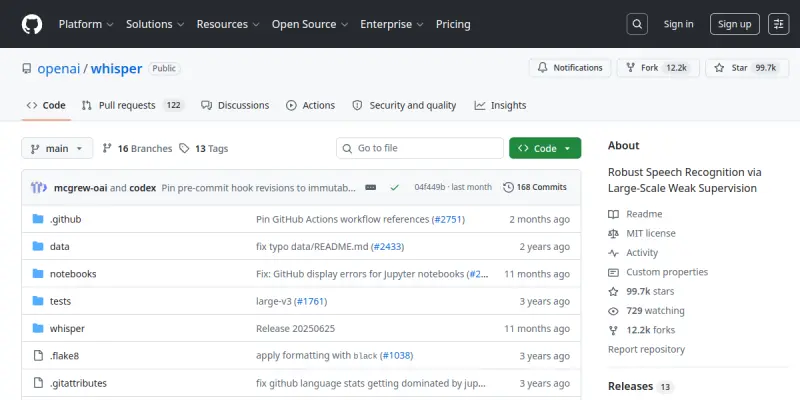
Screenshots & Interface
Pros
- ✓ Open source and free to use with an MIT license, enabling full customization.
- ✓ Supports over 50 languages for transcription and translation.
- ✓ Works offline, ensuring privacy and low latency.
- ✓ Offers multiple model sizes (tiny to large) to balance speed and accuracy.
- ✓ Robust to background noise, accents, and technical jargon.
- ✓ Can be integrated into custom applications via Python library or CLI.
Cons
- × Larger models require significant GPU memory and processing power.
- × No built-in graphical user interface; requires command-line or Python usage.
- × Punctuation and diacritical marks may be inconsistent in some languages.
- × Real-time transcription can be challenging with larger models.
How to Use Whisper (OpenAI) in Your Workflow
Integrating Whisper (OpenAI) into your professional toolkit enhances efficiency by automating manual steps. By configuring it to suit your specific project requirements, you can optimize output quality and reduce project cycle times. Standard workflows involve testing the tool on simple tasks before scaling its use to complex operations.
Frequently Asked Questions
What is Whisper (OpenAI) used for?
Whisper is an open-source automatic speech recognition (ASR) system developed by OpenAI. It supports transcription and translation across 50+ languages and is designed for developers and researchers. Its key differentiator is the ability to handle diverse audio conditions with strong accuracy.
What is the pricing model for Whisper (OpenAI)?
Whisper (OpenAI) uses a Free / Open Source pricing model.
What are the main advantages of Whisper (OpenAI)?
The key benefits of Whisper (OpenAI) include: Open source and free to use with an MIT license, enabling full customization., Supports over 50 languages for transcription and translation., Works offline, ensuring privacy and low latency., Offers multiple model sizes (tiny to large) to balance speed and accuracy., Robust to background noise, accents, and technical jargon., Can be integrated into custom applications via Python library or CLI..
What are the main limitations of Whisper (OpenAI)?
Some limitations or cons of Whisper (OpenAI) are: Larger models require significant GPU memory and processing power., No built-in graphical user interface; requires command-line or Python usage., Punctuation and diacritical marks may be inconsistent in some languages., Real-time transcription can be challenging with larger models..
Alternative AI Tools

Cleanvoice AI
Cleanvoice AI removes background noise, mouth sounds, and filler words from podcasts to improve audio quality efficiently.

ScreenApp AI
ScreenApp AI is a platform that provides AI-powered screen recording, transcription, summarization, and video analysis for teams, educators, and professionals. It distinguishes itself by offering automated note-taking and content repurposing directly from recordings.

Jukebox (OpenAI)
Open-source generative music model from OpenAI that creates full songs from text prompts. Designed for researchers and developers to explore neural audio generation.
Rating Details
Based on 0 ratings
Related Tools
More AI tools from the same workflow, industry, or category.
ClipTrend.ai
ClipTrend.ai is an AI image-to-video workspace for creators, marketers, and short-form video teams.
SongR
SongR is a text-to-song app that generates custom music tracks from a few keywords. It is designed for content creators and social media users who need quick, royalty-free songs in genres like pop, rock, hip-hop, and chant. Its key differentiator is instant generation without requiring musical expertise.
Quantum Capture
Quantum Capture generates AI-powered talking head videos from text input. It is designed for content creators and marketers who need quick, studio-quality video clips without expensive equipment. The platform specializes in creating realistic avatars with consistent lip-sync and facial expressions.
Kaltura AI
Kaltura is an enterprise video platform that combines cloud hosting with AI tools for content creation, marketing, and learning management. It helps businesses create branded video experiences for webinars, social media, and internal training.
Reviews
No reviews submitted yet. Be the first to share your experience.
Write a Review
Share Your Experience
Join the community to write reviews, submit ratings, and bookmark your favorite AI tools.