
Best AI Video Generation Tools in 2026: Which AI Video Generator Should You Actually Use?
The AI video market has changed quickly.
A few years ago, choosing an AI video tool was relatively simple. Most platforms were competing to turn a text prompt into a short generated clip.
Today, that's no longer the case.
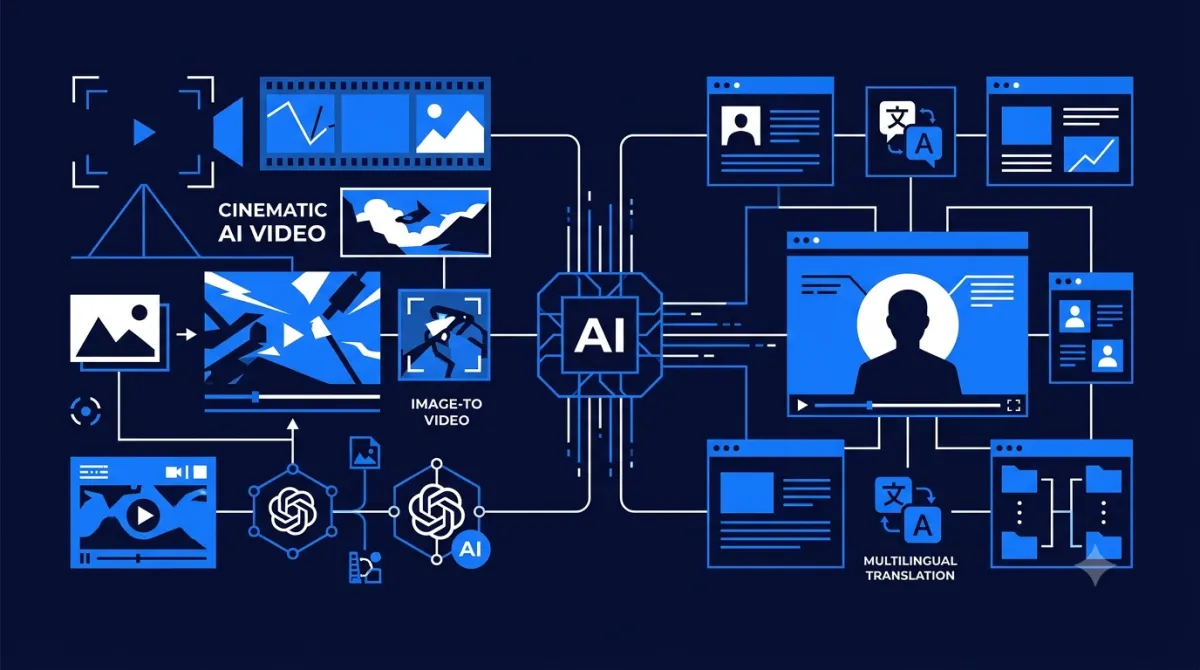
AI video platforms are increasingly specializing in different parts of the production workflow.
Some focus on cinematic text-to-video generation.
Others are built around AI avatars and business presentations.
Some specialize in marketing localization.
Others combine generation, editing, image creation, and creative production into a broader media workflow.
That makes the usual "best AI video generator" ranking increasingly difficult to justify.
The right question isn't:
Which AI video tool is the best?
It's:
Which AI video tool is best for the type of video you're actually trying to create?
This guide compares the major categories and platforms shaping AI video generation in 2026, focusing on where each tool fits, what it does well, and where its limitations become important.
The Short Answer
If you want cinematic generative video, start by evaluating platforms such as Google Veo, Runway, and Kling AI.
If you need business training, presentations, or internal communications, platforms such as Synthesia are better aligned with the workflow.
If you're focused on avatar-based marketing and multilingual content, HeyGen is worth considering.
If you're an early adopter interested in emerging AI video platforms, newer tools such as Velo 3.0 deserve attention, but should be evaluated carefully against more established alternatives.
The key point is that these tools are increasingly solving different problems.
A filmmaker and an HR department may both search for "AI video generation," but they are not looking for the same product.
1. Google Veo — Best for Generative Video Quality
Google Veo is one of the most important platforms to evaluate if your priority is generative video rather than avatar-based business communication.
The Veo family has been positioned around high-quality video generation, with capabilities spanning text-to-video, image-to-video, and increasingly sophisticated audiovisual generation.
The appeal is straightforward.
You can start with a concept and generate visual content without traditional filming.
That makes this category of tools particularly interesting for:
- Concept development
- Advertising
- Visual storytelling
- Short-form creative content
- Film experimentation
- Product visualization
The biggest advantage is the ability to move from an idea to a visual sequence quickly.
Instead of planning a shoot, arranging locations, hiring a production team, and waiting for post-production, creators can iterate on visual concepts much faster.
But this doesn't eliminate the need for creative direction.
The challenge shifts from production logistics to prompt design, visual consistency, selection, and iteration.
A generated clip may look impressive in isolation while still being difficult to integrate into a coherent production.
That's why teams evaluating Veo should look beyond individual generations.
The real question is whether the platform can consistently produce usable content across an entire workflow.
Best for
Creators and teams prioritizing high-quality generative video and visual storytelling.
Not ideal for
Organizations primarily looking to create structured training, onboarding, or avatar-led corporate content.
2. Runway — Best for Creative Professionals
Runway has become one of the most recognizable names in AI-powered creative production.
Its appeal comes from combining generative AI with a broader creative workflow.
Rather than positioning itself only as a text-to-video generator, Runway has developed tools around image generation, video generation, transformation, and creative control.
This makes it particularly relevant for:
- Filmmakers
- Designers
- Creative agencies
- Advertising teams
- Visual artists
- Content creators
The platform is especially interesting when AI generation is only one part of the workflow.
Creative professionals often need to generate an idea, modify it, iterate on it, and combine it with other media.
That makes workflow flexibility important.
The challenge is that creative generation can require significant iteration.
A single successful clip doesn't necessarily mean a production is finished.
You may need multiple generations to achieve:
- The right composition
- Consistent characters
- Correct movement
- Specific camera behavior
- The desired visual style
As a result, the most useful metric isn't simply the quality of the best generation.
It's the percentage of generations that are actually usable.
Best for
Creative professionals who want generative video integrated into a broader creative workflow.
Not ideal for
Teams whose main requirement is turning business documents or scripts into presenter-led videos at scale.
3. Synthesia — Best for Business Video
Synthesia represents a different side of the AI video market.
The platform is primarily designed around business communication rather than cinematic generation.
Its use cases include:
- Employee training
- Onboarding
- Internal communications
- Sales enablement
- Product education
- Customer support
- Corporate presentations
This distinction matters.
A company creating hundreds of training videos has different requirements from a filmmaker creating a short film.
For business teams, the most important features may be:
- AI avatars
- Voice generation
- Localization
- Translation
- Collaboration
- Brand consistency
- Reusable templates
The goal isn't necessarily to create a spectacular cinematic scene.
The goal is to communicate information efficiently.
That makes Synthesia particularly relevant for organizations that need to turn existing knowledge into scalable video content.
Instead of organizing a recording session for every training module, teams can build a repeatable production process.
This is where specialized AI video platforms can outperform general-purpose generative video models.
Best for
Businesses creating training, onboarding, educational, and internal communication videos.
Not ideal for
Creators primarily interested in cinematic storytelling or experimental generative filmmaking.
4. HeyGen — Best for Avatar Marketing and Localization
HeyGen is another major platform in the avatar-led AI video category.
Its strongest use cases are closely connected to marketing, sales, and multilingual content production.
The advantage becomes especially clear when organizations need to create multiple versions of the same content.
For example:
- Different languages
- Different markets
- Different presenters
- Different customer segments
- Different product messages
Traditional video localization can be expensive and slow.
AI-based workflows can significantly reduce the production effort required to adapt content.
This makes platforms such as HeyGen particularly interesting for global marketing teams.
The key benefit isn't simply that AI can generate a video.
It's that one piece of content can potentially become many localized versions.
That changes the economics of video production.
A marketing team can create a campaign once and adapt it across different audiences without rebuilding the entire production from scratch.
Best for
Marketing, sales, and global teams creating avatar-led and multilingual video content.
Not ideal for
Teams looking for maximum cinematic control over generated environments and visual storytelling.
5. Kling AI — Best for Generative Video Experimentation
Kling AI has attracted attention from creators interested in generative video quality and visual experimentation.
It sits closer to the creative generation side of the market than traditional business video platforms.
That makes it relevant for:
- Text-to-video experiments
- Image-to-video generation
- Short-form content
- Visual storytelling
- Social media content
- Creative exploration
For creators, the attraction is the ability to experiment with visual ideas that would otherwise require significant production resources.
However, the same challenge applies to most generative video platforms.
Generating an impressive clip is not the same as producing a finished video.
Creators still need to consider:
- Consistency
- Scene transitions
- Character identity
- Motion quality
- Editing
- Audio
- Story structure
The best tool is therefore the one that fits into the entire production pipeline.
A platform that generates excellent individual clips but requires extensive manual correction may not be the most efficient choice.
Best for
Creators experimenting with generative video and visual storytelling.
Not ideal for
Organizations that need structured enterprise workflows, collaboration, and business-focused video production.
6. Velo 3.0 — An Emerging AI Video Platform to Watch
Velo 3.0 is an interesting emerging platform in the AI video category.
Your editorial pipeline identifies it as a strong opportunity because it generated significant Product Hunt interest and because the broader AI video generation category currently represents an editorial gap for TipJournal. :contentReference[oaicite:2]{index=2}
However, emerging tools should be evaluated differently from established platforms.
Launch momentum is useful.
It tells you that people are paying attention.
But attention doesn't necessarily prove long-term product quality.
Before recommending an emerging AI video platform for serious production, teams should evaluate:
- Generation quality
- Consistency
- Speed
- Pricing
- Commercial usage rights
- Export capabilities
- Editing workflow
- Product stability
Velo 3.0 is therefore worth watching and testing, but it should not automatically be presented as a replacement for established platforms without sufficient hands-on validation.
This also creates an opportunity for TipJournal.
Instead of treating emerging tools as established market leaders, the editorial approach can focus on what they actually offer and whether their advantages are meaningful compared with existing alternatives.
Best for
Early adopters exploring emerging AI video generation workflows.
Not ideal for
Organizations that require a mature, extensively validated enterprise platform.
How to Choose the Right AI Video Generator
The best way to choose an AI video platform is to start with the final output.
Don't start with the tool.
Start with the problem.
If You Want Cinematic Video
Consider:
- Google Veo
- Runway
- Kling AI
Prioritize:
- Visual quality
- Motion
- Prompt adherence
- Character consistency
- Camera control
- Audio
- Image-to-video capabilities
The key metric is not the best clip the model can produce.
It's how consistently you can produce usable footage.
If You Want Business Training Videos
Consider:
- Synthesia
- HeyGen
Prioritize:
- AI avatars
- Voice quality
- Translation
- Localization
- Templates
- Brand controls
- Collaboration
For these workflows, production efficiency often matters more than cinematic quality.
If You Want Marketing Content
Consider:
- HeyGen
- Synthesia
- Runway
- Google Veo
But first decide what type of marketing content you're creating.
There is a major difference between:
Presenter-led marketing
and:
Generative visual advertising.
The first category benefits from avatars, localization, and scalable production.
The second benefits from visual generation and creative control.
If You Want to Make Films
Consider:
- Runway
- Google Veo
- Kling AI
Focus on:
- Visual consistency
- Character continuity
- Camera movement
- Scene control
- Iteration speed
- Editing workflow
The challenge is moving from individual generated clips to a coherent production.
That's where the next generation of AI video tools will likely compete.
The Biggest Mistake: Choosing Based on Demos
AI video demos are designed to impress.
That's understandable.
A platform needs to show what its technology can do.
But demos rarely represent the full production experience.
The real workflow may involve:
- Multiple failed generations
- Repeated prompt changes
- Inconsistent characters
- Incorrect movements
- Editing work
- Audio correction
- Manual compositing
This means teams should test AI video tools using real projects.
Before committing to a platform, evaluate:
1. Consistency
Can the system maintain visual identity across multiple shots?
2. Prompt Adherence
Does it follow detailed instructions reliably?
3. Iteration Speed
How quickly can you correct an unusable generation?
4. Cost Per Usable Output
How many generations do you need before producing something you can actually publish?
5. Workflow Integration
Can the output move easily into your existing editing pipeline?
6. Commercial Rights
Can you legally use the generated content for your intended purpose?
7. Localization
Can you adapt content for different audiences and markets?
8. Scalability
Does the workflow remain efficient when you need to create 100 videos instead of one?
This is where the real economics of AI video generation become visible.
The best platform isn't necessarily the one with the cheapest subscription.
It's the one that produces the lowest cost per usable outcome.
AI Video Generation Is Becoming a Workflow Decision
The AI video market is beginning to resemble other areas of AI software.
There is no longer one universal tool.
Instead, specialized platforms are emerging around specific jobs.
One platform may excel at cinematic generation.
Another may focus on business presentations.
Another may specialize in localization.
Another may combine generation and editing.
This fragmentation is actually a positive development.
It means users can choose tools based on their workflows instead of forcing every problem into the same platform.
The question is no longer:
Which AI video generator is the best?
The better question is:
Which part of my video workflow am I trying to improve?
That shift is important.
AI video generation is becoming less about replacing the entire production process and more about removing specific bottlenecks.
For some teams, the bottleneck is filming.
For others, it's localization.
For others, it's creating visual concepts.
For others, it's producing training content at scale.
The winning platform is the one that solves the most expensive bottleneck in your workflow.
Final Verdict
There is no universal winner in AI video generation in 2026.
Google Veo is compelling for teams focused on advanced generative video and visual storytelling.
Runway is a strong option for creative professionals who want AI integrated into a broader creative workflow.
Synthesia is better suited to organizations producing structured business, training, and communication content.
HeyGen is particularly relevant for avatar-led marketing and multilingual video production.
Kling AI is worth evaluating for creators focused on generative visual experimentation.
Velo 3.0 is an emerging platform worth watching, although its long-term position should be judged by sustained product performance rather than launch momentum.
The most important takeaway is that AI video generation is no longer a single category.
It is becoming an ecosystem of specialized production tools.
For most users, the best strategy isn't to choose one platform and ignore everything else.
It's to identify the most expensive or time-consuming part of the video workflow and choose the tool that removes that bottleneck.
That's where AI video generation creates its real value.