
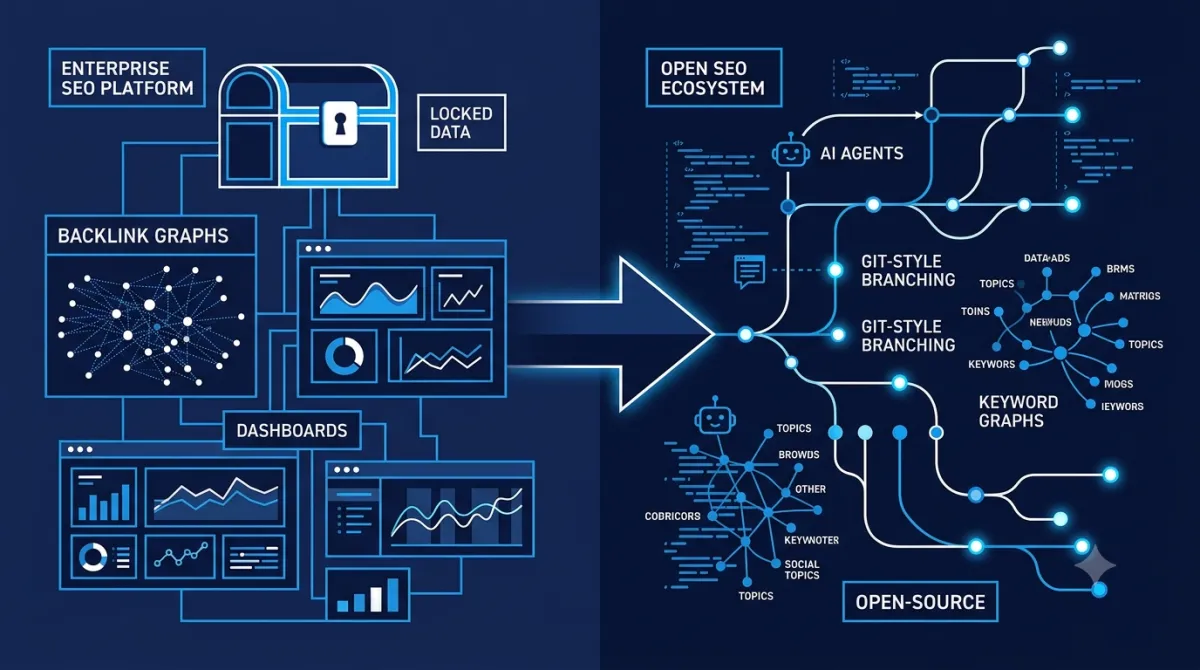
OpenSEO vs Ahrefs: Can an Open-Source SEO Platform Replace Enterprise Tools?
SEO software has historically followed the same pattern: closed platforms, subscription pricing, and proprietary datasets. While developers embraced open-source alternatives across nearly every other software category, SEO remained dominated by a handful of commercial vendors.
OpenSEO is attempting to change that model. Instead of asking whether it's "better" than Ahrefs, the more useful question is whether an open-source platform can satisfy the needs of modern marketing teams.
Why OpenSEO Matters Beyond Cost Savings
The appeal of OpenSEO isn't simply that it's open source.
For engineering-led organizations, agencies, and technical marketers, openness offers advantages that proprietary platforms cannot easily match:
- Greater transparency
- Potential for self-hosting
- Community-driven improvements
- Faster experimentation with AI-powered workflows
- Flexibility to integrate into internal systems
These benefits matter most to teams that view SEO as part of a broader data and automation stack rather than a standalone marketing function.
Where Ahrefs Still Holds a Clear Advantage
Ahrefs has spent years building one of the industry's largest proprietary link indexes and refining workflows for SEO professionals.
Its strengths include:
- Mature backlink intelligence
- Extensive historical keyword data
- Stable reporting
- Large educational ecosystem
- Proven enterprise reliability
Organizations that depend on highly accurate competitive intelligence or manage SEO across hundreds of clients are likely to value this maturity.
For many businesses, reliability and data depth remain more important than software openness.
Where OpenSEO Could Disrupt the Market
OpenSEO represents a different philosophy.
Instead of competing solely on dataset size, it emphasizes openness, extensibility, and AI-native workflows.
Potential advantages include:
- Faster integration into developer workflows
- Community contributions
- Flexible deployment models
- Opportunity to customize features
- Lower barriers for experimentation
As AI agents become more common in SEO research and content operations, open platforms may evolve more rapidly than traditional closed ecosystems.
Which Teams Should Choose Each Platform?
The decision depends less on company size than on technical capability.
OpenSEO may be a strong fit for:
- Technical marketing teams
- Developer-first startups
- Organizations interested in self-hosting
- Companies building custom SEO workflows
Ahrefs remains a strong choice for:
- Agencies
- Enterprise SEO departments
- Teams requiring highly mature backlink intelligence
- Businesses prioritizing stability over customization
The best platform depends on whether your competitive advantage comes from operational flexibility or access to proprietary SEO data.
The Bigger Trend: Open Infrastructure Is Reaching Marketing Software
The emergence of projects like OpenSEO reflects a broader shift.
AI has lowered the barrier to building sophisticated software, while developer communities increasingly expect transparency, extensibility, and API-first design.
Whether OpenSEO ultimately succeeds or not, its appearance signals growing demand for open alternatives in categories once dominated by proprietary vendors.
For readers exploring adjacent developer tooling, our guide to AI coding assistants and our analysis of open-source AI's rapid progress provide additional context on how open ecosystems are reshaping software.
Final Thoughts
OpenSEO is unlikely to replace Ahrefs overnight. Enterprise SEO platforms benefit from years of proprietary data collection, mature workflows, and established customer trust.
However, OpenSEO represents an important milestone. It demonstrates that SEO software is beginning to follow the same trajectory as databases, developer tools, and AI frameworks: greater openness, stronger community participation, and deeper integration with automation.
Teams evaluating modern SEO platforms should look beyond feature checklists. The more important question is whether they need a polished enterprise product today or a flexible foundation that can evolve alongside AI-powered marketing workflows.