
Best AI Meeting Assistants in 2026: A Practical Framework for Enterprise Teams
Buying an AI meeting assistant used to be simple.
Teams compared transcription quality, looked at pricing, and chose the platform that generated the cleanest meeting notes.
That evaluation process is no longer sufficient.
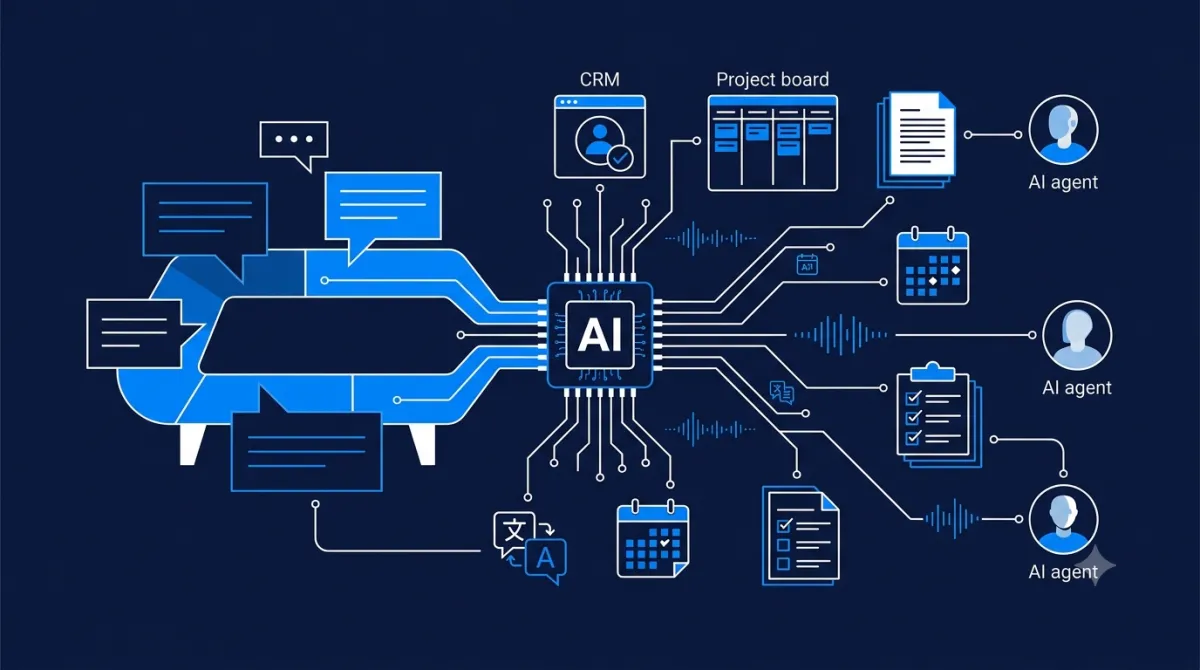
Modern meeting assistants have evolved into workflow orchestration platforms. They don't just record conversations—they extract decisions, assign follow-up tasks, update business systems, and increasingly provide structured context for AI agents.
As the category expands, choosing the right platform requires evaluating how well it fits into your organization's workflows rather than how accurately it transcribes speech.
AI Meeting Assistants Are Becoming Operational Infrastructure
Most meetings generate valuable information, but very little of it reaches the systems where work actually happens.
Action items remain buried in notes.
Customer feedback never reaches product teams.
Sales commitments stay inside recordings.
Engineering decisions disappear into calendar archives.
The newest generation of meeting assistants aims to solve this problem by transforming conversations into structured business data.
Instead of producing static summaries, these platforms can support workflows such as:
- extracting action items
- assigning owners
- updating CRM records
- generating project documentation
- creating follow-up emails
- feeding AI knowledge bases
- providing context for enterprise AI agents
This represents a shift from passive documentation to active workflow automation.
Best AI Meeting Assistants in 2026: A Practical Evaluation Framework
Instead of asking which platform has the highest transcription accuracy, enterprise buyers should evaluate six dimensions.
1. Speech Recognition Quality
Accurate transcription remains the foundation.
Evaluate performance using real meetings rather than vendor demonstrations.
Test:
- multiple speakers
- background noise
- remote participants
- technical terminology
- multilingual conversations
- overlapping dialogue
A platform that performs well in controlled demos may struggle in actual business environments.
2. Actionable Intelligence
The real value begins after transcription.
Can the assistant reliably identify:
- decisions
- risks
- deadlines
- commitments
- action items
- unresolved questions
The best systems reduce manual follow-up rather than simply generating longer summaries.
3. Workflow Integration
Meeting intelligence should flow into existing business systems.
Consider integrations with:
- CRM platforms
- project management software
- documentation tools
- ticketing systems
- messaging platforms
- enterprise search
Disconnected AI creates additional work instead of reducing it.
4. Governance and Security
Enterprise adoption depends on trust.
Evaluate:
- data retention policies
- administrative controls
- permission management
- compliance certifications
- audit logging
- deployment options
Meeting recordings often contain sensitive customer and internal information, making governance just as important as AI capabilities.
5. AI Agent Readiness
A growing number of organizations are building AI agents that require structured conversational context.
Meeting assistants should increasingly be viewed as data providers for downstream AI systems.
Can conversations become searchable organizational memory?
Can AI agents retrieve meeting decisions automatically?
Can structured outputs trigger automated workflows?
These capabilities will likely become more important than transcript formatting over the next several years.
6. Total Operational Value
Finally, evaluate business outcomes rather than individual features.
Measure:
- hours saved each week
- reduction in manual documentation
- faster follow-up
- improved knowledge sharing
- better customer visibility
- increased meeting accountability
These metrics determine return on investment far more effectively than feature comparisons.
Emerging Platforms Are Redefining the Category
The market itself illustrates this evolution.
According to TipJournal's Trend Intelligence Feed, ElevenLabs Scribe V2 Realtime is positioned around low-latency speech recognition for AI-driven workflows rather than traditional meeting transcription alone. Its focus on approximately 150 ms latency and multilingual support reflects the growing demand for real-time conversational infrastructure rather than post-meeting documentation.
Other platforms are moving in complementary directions by emphasizing privacy, enterprise workflows, or automated action tracking.
The broader trend is clear: meeting assistants are becoming foundational components of enterprise AI systems rather than standalone productivity tools.
Common Buying Mistakes
Organizations frequently make three mistakes when evaluating AI meeting software.
Mistake 1: Optimizing only for transcription quality
Accurate transcripts are necessary, but they are rarely sufficient.
Mistake 2: Ignoring workflow integration
Even excellent summaries create little value if employees must manually copy information into business systems.
Mistake 3: Underestimating governance
Security, compliance, and administrative controls often determine whether enterprise deployment succeeds.
A structured evaluation framework helps organizations avoid purchasing decisions based solely on impressive product demonstrations.
Final Thoughts
The next generation of meeting assistants won't compete solely on transcription quality. They'll compete on how effectively they convert conversations into organizational knowledge and automated workflows.
For enterprise teams, the best purchasing decision comes from evaluating the complete operational lifecycle: speech recognition, workflow integration, governance, AI readiness, and measurable business outcomes.
This framework for choosing the best AI meeting assistants in 2026 shifts the conversation away from feature checklists and toward long-term operational value. As conversational AI becomes embedded across enterprise software, meeting intelligence will increasingly serve as one of the most valuable sources of structured business context.