
A new coding model reaches the top of a benchmark. Another announces lower inference costs. A third claims stronger reasoning on software engineering tasks.
Six months ago, these announcements often reshaped the AI landscape. Today, they rarely change how engineering teams work.
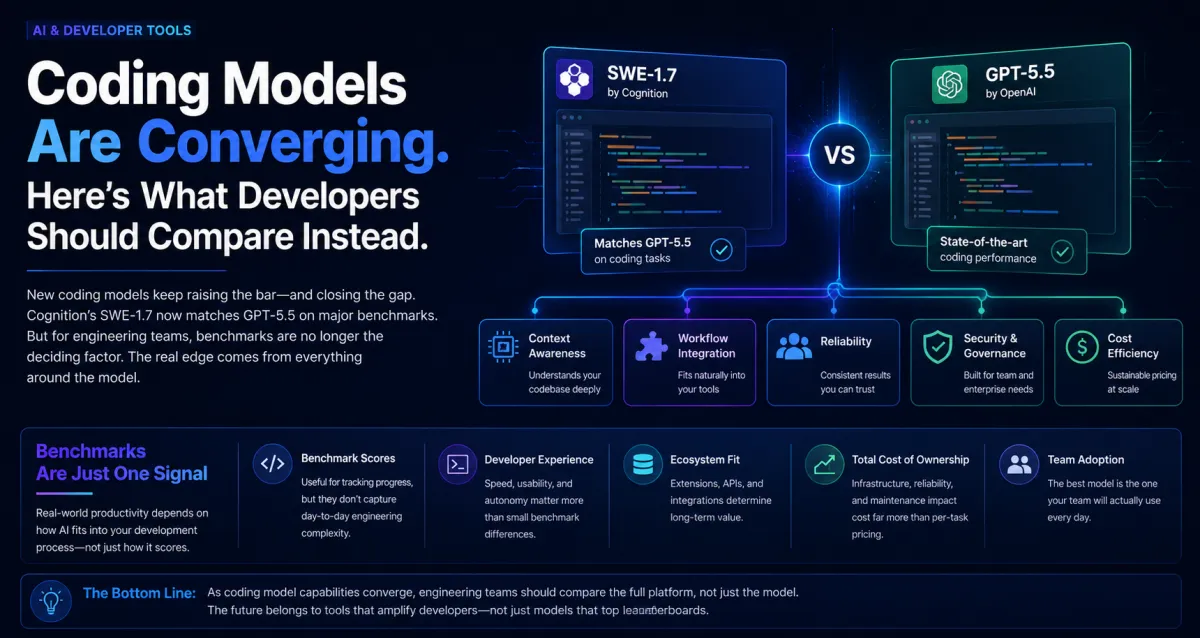
The latest examples—including Cognition's SWE-1.7 achieving performance comparable to leading frontier models on coding evaluations—highlight an important trend. The headline isn't that another model has closed the gap. It's that the gap itself is becoming increasingly difficult to use as a buying criterion.
As coding models mature, engineering teams are discovering that productivity depends far less on benchmark leadership than on everything surrounding the model: context awareness, workflow integration, reliability, governance, and developer experience.
The AI coding race is entering a new phase.
Benchmark Leadership Is Becoming a Short-Lived Advantage
Benchmarks remain valuable.
They measure reasoning ability, problem solving, and software engineering performance under controlled conditions. They also provide an objective way to compare models developed by different organizations.
But benchmarks were never designed to predict day-to-day developer productivity.
A model that performs exceptionally well on curated coding tasks may still struggle with:
- understanding a decade-old codebase
- following company-specific engineering standards
- navigating unfamiliar architectures
- collaborating across multiple repositories
- maintaining context during long development sessions
Meanwhile, another model with slightly lower benchmark scores may save developers significantly more time because it integrates naturally into existing workflows.
The difference between first and fourth place on a leaderboard often matters less than the difference between an AI assistant that fits seamlessly into daily work and one that constantly interrupts it.
Benchmarks remain useful signals—but they are no longer the whole story.
The Real Product Isn't the Model—It's the Workflow
The industry's focus is gradually shifting from foundation models to development environments.
Modern AI coding platforms are no longer competing solely on intelligence.
They're competing on questions like:
- Can the assistant understand an entire repository?
- Does it remember previous conversations?
- Can it modify multiple files safely?
- Does it integrate with Git?
- Can it explain architectural decisions?
- Does it fit naturally into existing IDEs and terminals?
These capabilities determine whether AI becomes part of a developer's daily workflow or remains an occasional productivity tool.
This explains why many leading platforms increasingly differentiate themselves through user experience rather than model exclusivity.
The underlying model may change every few months.
The workflow tends to stay.
Context Is Becoming More Valuable Than Raw Intelligence
Developers rarely work on isolated functions.
They work inside evolving systems with years of accumulated decisions, dependencies, documentation, and technical debt.
The most valuable coding assistants aren't necessarily those with the strongest reasoning in isolation—they're the ones that understand context.
Context now includes:
- repository structure
- project conventions
- previous edits
- documentation
- issue trackers
- terminal history
- pull requests
- deployment pipelines
Without this information, even highly capable models spend much of their time reconstructing the problem developers already understand.
This is one reason AI-native development environments have gained traction. They reduce the need for repetitive prompting by keeping AI connected to the work itself rather than isolated conversations.
As models continue improving, context quality is likely to become one of the strongest predictors of developer productivity.
Falling Costs Will Shift Attention to Total Value
Competition among AI providers is steadily reducing the cost of inference.
That benefits developers, but it also changes purchasing decisions.
Organizations are beginning to evaluate AI platforms using broader economic questions:
- How much engineering time does this save?
- How much maintenance does it eliminate?
- How quickly can new developers become productive?
- Does it reduce context switching?
- Can it improve code quality?
These questions are more meaningful than comparing the cost of a single coding task.
An inexpensive model that requires constant manual correction may ultimately cost more than a slightly more expensive solution that integrates smoothly into the development process.
The conversation is moving from "cost per request" to "cost per productive outcome."
Enterprise Adoption Will Be Won by Reliability, Not Headlines
Large organizations rarely choose software based on benchmark charts alone.
They evaluate:
- security
- governance
- auditability
- compliance
- integration
- support
- reliability
- scalability
AI coding platforms are increasingly subject to the same evaluation criteria.
Engineering leaders need confidence that AI-generated code can be reviewed, traced, tested, and managed within existing software delivery processes.
This makes operational maturity just as important as model capability.
The vendors most likely to succeed over the next several years won't simply publish impressive benchmark results. They'll build ecosystems that organizations can trust for long-term software development.
The Next Competitive Advantage Is Developer Experience
Coding models are improving at an extraordinary pace.
That progress has created an unexpected consequence: intelligence is becoming easier to access.
As more providers reach comparable levels of coding performance, differentiation shifts elsewhere.
The next generation of AI development platforms will compete on:
- workflow integration
- repository awareness
- persistent collaboration
- ecosystem compatibility
- organizational knowledge
- developer experience
In many ways, this mirrors the evolution of cloud infrastructure. Compute eventually became commoditized, while tooling, automation, and platform experience became the primary sources of value.
AI coding appears to be following a similar trajectory.
Final Recommendation
Announcements like Cognition's SWE-1.7 demonstrate how quickly the AI coding landscape is evolving. But the broader lesson isn't that one model has reached another benchmark milestone. It's that benchmark leadership is becoming increasingly temporary.
For engineering teams, the better question is no longer "Which model scores highest?" but "Which platform helps developers build better software?"
That means evaluating AI coding tools based on how they fit into real engineering workflows—how well they understand context, reduce repetitive work, support collaboration, and integrate with existing development practices.
As coding models continue to converge, the organizations that gain the greatest advantage won't be those chasing every new benchmark leader. They'll be the ones choosing AI platforms that amplify their engineers over months of real-world software delivery, not just on benchmark leaderboards.