
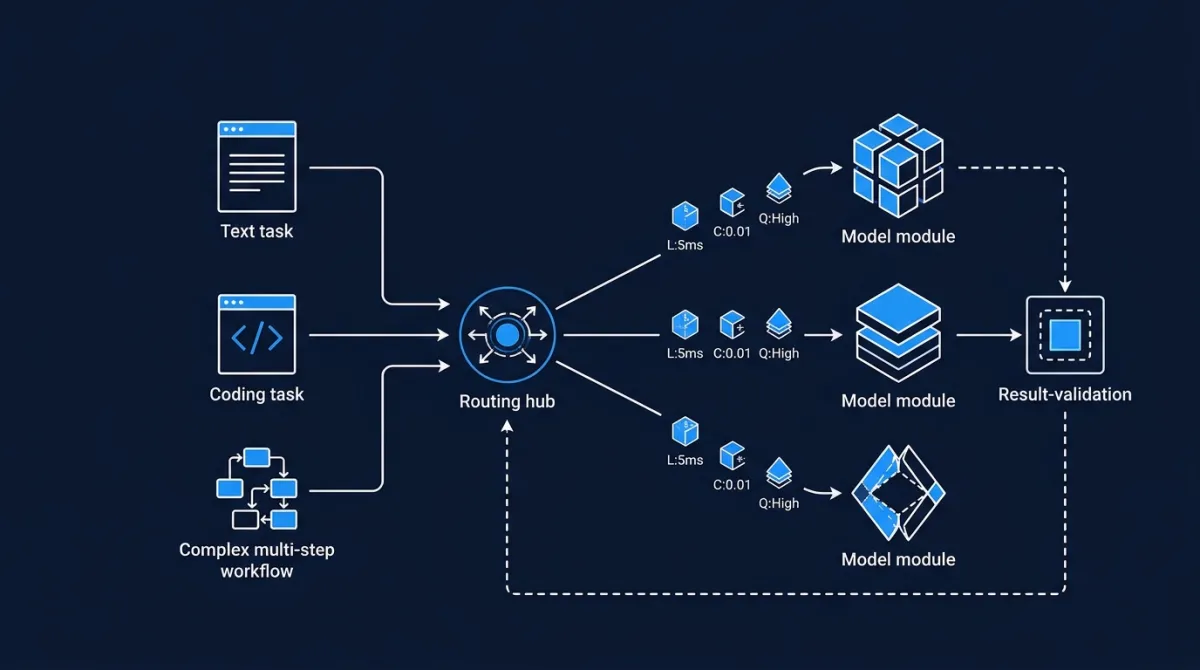
Model Routers Are Becoming Decision Engines, Not Just Cost Optimizers
Subtitle: As applications use multiple AI models, routing becomes a question of quality, latency, reliability, and task context—not simply sending every prompt to the cheapest available endpoint.
A user asks an AI assistant to summarize a short email. Another asks it to debug a race condition across several files. A third asks an agent to analyze a spreadsheet, call an external API, and produce a report.
Sending all three requests to the same model may be convenient. It may also be wasteful.
The first task probably does not require the most capable model available. The second may benefit from stronger reasoning and coding ability. The third could require a model that handles structured data and tool use reliably, with enough context to complete the workflow.
This is the problem model routing tries to solve.
Instead of binding an application to one model, a router selects among several candidates for a particular request. That choice can be based on cost, latency, task type, context length, availability, or an estimate of which model is most likely to succeed.
At first glance, this sounds like a straightforward cost optimization problem: use a cheap model whenever possible and escalate to a more capable one when necessary.
But agentic applications make the decision more complicated. The cheapest response is not necessarily the cheapest completed task. A model that fails, retries, calls the wrong tool, or produces an output that requires extensive human correction can cost more overall than a model with a higher initial price.
The emerging challenge is to route work according to the outcome the application needs—not just the model call it is about to make.
1. Why one model is not always the right answer
AI models differ in ways that matter to applications.
A smaller model may provide excellent latency and cost for classification, extraction, or simple transformations. A more capable model may be preferable for complex coding tasks, difficult reasoning, or ambiguous instructions. Other models may offer advantages in long-context processing, structured outputs, multimodal inputs, or tool calling.
There is no universal ranking that captures all of these dimensions for every task.
A model that performs well on a reasoning benchmark may not be the fastest option for a short request. A fast model may produce structured output reliably but struggle with a difficult edge case. A model with a large context window may still be a poor choice if the task requires capabilities it does not handle well.
Routing lets an application treat models as a set of possible execution paths.
For example:
- A short classification request can go to a fast, inexpensive model.
- A complex coding task can be sent to a model that performs well on relevant coding evaluations.
- A request requiring image understanding can be restricted to compatible multimodal models.
- A task that fails validation can be retried or escalated under a defined policy.
The point is not that every application needs dozens of models. It is that model selection should reflect the actual requirements of the request.
2. Cost per token is not the same as cost per successful task
Consider a hypothetical workflow that processes customer support tickets.
A low-cost model can classify a ticket and draft a response. If it gets the classification right, the task is inexpensive. If it frequently misclassifies difficult tickets, those failures may trigger retries, escalations, or manual review.
A more expensive model might cost more per request but resolve a greater share of tickets correctly on the first attempt.
The relevant comparison is not just the price of one model call. It is the total cost of reaching an acceptable outcome.
A simplified measure is:
[ \text{Cost per successful task}
\frac{\text{Total workflow cost}}{\text{Number of successful tasks}} ]
Total workflow cost can include model inference, retries, tool calls, validation, infrastructure, and human review. Depending on the application, it may also include the cost of failures or delayed completion.
This does not mean that a more capable model is automatically more economical. The answer depends on actual success rates, prices, latency, and the cost of correcting mistakes.
It does mean that optimizing for the cheapest individual call can produce the wrong system-level decision.
A hypothetical example
Suppose two routing strategies handle 1,000 tasks.
| Measure | Strategy A | Strategy B |
|---|---|---|
| Average cost per initial attempt | $0.01 | $0.03 |
| Initial success rate | 80% | 95% |
| Initial inference cost | $10 | $30 |
| Successful initial tasks | 800 | 950 |
| Initial cost per successful task | $0.0125 | $0.0316 |
Strategy A is cheaper for each successful initial attempt. But this calculation excludes retries and human intervention. If the remaining failures are expensive to recover from, the final ranking could change.
These numbers are illustrative, not measured results. Their purpose is to show why a router needs application-specific data before deciding which model is actually the better choice.
3. A router needs to understand the task before choosing a model
The simplest routers use static rules. A developer might direct all summarization requests to one model and all coding requests to another.
This can be effective when the application's workloads are predictable. It is also easy to debug because the routing policy is explicit.
More dynamic routers estimate the characteristics of an incoming request and use them to select a model.
Relevant signals can include:
Task category. Is the request a classification, summary, coding problem, data extraction, or multi-step workflow?
Difficulty. Does the task appear routine, or is it likely to require deeper reasoning?
Context size. How much input must the model process, and does the candidate support it?
Output requirements. Does the application need strict JSON, a tool call, a concise answer, or a longer synthesis?
Latency target. Must the system respond immediately, or can it tolerate a slower process?
Quality threshold. What error rate is acceptable for this particular operation?
Operational availability. Is the preferred model currently available and healthy?
A router can use lightweight classifiers, learned routing policies, explicit rules, historical evaluation results, or combinations of these techniques.
The crucial point is that routing is not necessarily the same as asking another language model to decide which language model to use. A small classifier or a deterministic policy may be cheaper, faster, and easier to control.
The routing mechanism itself has costs. If selecting a model requires an expensive preliminary inference call, the system may lose much of the benefit it hoped to achieve.
4. Routing becomes harder when the request is part of an agent workflow
A single prompt gives the router one decision point. An agent can create many.
Imagine a coding agent working through a repository:
- Identify the relevant files.
- Understand the failure.
- Propose a change.
- Edit the code.
- Run tests.
- Interpret the results.
- Revise the implementation if necessary.
These steps do not necessarily require the same model.
A fast model may be sufficient to classify a test failure. A stronger coding model may be justified when modifying several interacting components. A small model may then generate a concise summary of the completed work.
The appropriate routing policy can therefore depend on the current step, not just the original user request.
There is an additional complication: the result of one step affects the next decision.
If a test fails, the system may need to escalate. If a tool returns incomplete data, it may need to gather more context. If an attempted approach repeatedly fails, the router may need to change models or alter the strategy.
That makes model routing part of the workflow's control logic.
However, switching models is not automatically beneficial. Different models may interpret instructions differently, have different tool interfaces, or handle structured output inconsistently. Switching can also introduce additional latency and context-transfer costs.
A robust system should define when a switch is permitted, what context must be preserved, and how the result will be validated.
5. Escalation is useful, but retries need rules
One practical routing pattern is escalation.
A request starts with a cheaper model. If its output fails a validation check or does not meet a defined quality threshold, the system sends the task to a stronger alternative.
This can reduce costs when many requests are easy and only a minority need more capable models.
But escalation works only when the system has a meaningful signal that the initial attempt is inadequate.
Possible signals include:
- Invalid structured output.
- A failed tool call.
- A test suite that reports an error.
- A response that omits a required field.
- A confidence estimate that has been calibrated for the specific task.
- An independent evaluator that identifies a substantive defect.
Some signals are more reliable than others. Valid JSON, for example, does not guarantee correct reasoning. A model's self-reported confidence should not be treated as a dependable probability of correctness without validation.
Retries also have failure modes. A router can repeatedly send the same task to different models without addressing missing information or a broken external service. It can increase latency, multiply costs, and create duplicate side effects if tools are not designed for safe retries.
A practical escalation policy should specify:
- What constitutes a failed attempt.
- Which alternative model or strategy should be tried.
- How many retries are allowed.
- Whether the failed attempt changed any external state.
- When to stop and ask a human for help.
The goal is not to keep trying until something looks plausible. It is to recover from identifiable failures under controlled conditions.
6. The best model depends on more than intelligence
It is tempting to think of models as a simple ladder, from less capable and inexpensive to more capable and expensive.
Real routing decisions are multidimensional.
A model might be excellent at code generation but less suitable for strict structured extraction. Another might have low latency but limited context capacity. A third may produce strong results but be temporarily unavailable or impose rate limits that make it unsuitable for a latency-sensitive workflow.
This means a router needs a candidate-selection stage before it can meaningfully compare performance.
First, eliminate models that cannot meet the hard requirements: compatible input types, context length, tool support, output format, security constraints, and availability.
Then compare the remaining candidates on quality, latency, cost, and reliability for the task at hand.
This distinction matters because not every trade-off should be negotiable. If a task requires a specific modality or a strict data-handling boundary, the cheapest model that violates that requirement is not a valid candidate.
Routing is best understood as constrained optimization: find a suitable model, then select the option that best balances the application's objectives.
7. How to evaluate a model router
A router should be evaluated against a baseline, not just against its own internal estimates.
Start with a representative collection of real application tasks. Where possible, run each candidate model against the same examples and evaluate outputs using task-specific criteria.
For a coding workload, that might mean test results, patch correctness, and review effort. For extraction, it might mean field-level accuracy and schema compliance. For customer support, it could include resolution quality and escalation rates.
Measure at least five dimensions.
Task success rate: How often does the workflow reach the required outcome?
Total cost: Include retries, validation, tools, and human intervention where measurable.
Latency: Measure both individual response time and end-to-end completion time.
Reliability: Track timeouts, rate-limit errors, invalid outputs, and unavailable models.
Consistency: Check whether the routing policy performs acceptably across different task categories and difficult edge cases.
Then compare three strategies:
- A single fixed model.
- A rule-based router.
- A dynamic router that uses task characteristics or evaluation signals.
This comparison helps establish whether routing creates real value. A complex router that adds overhead without improving outcomes is not an improvement.
Also test the difficult cases. A router may look effective on average while sending the most consequential tasks to an unsuitable model. Break down results by task category, complexity, and impact rather than relying on a single aggregate score.
8. Routing needs observability and fallback behavior
When a router selects the wrong model, developers need to understand why.
A useful routing log should record the selected model, the relevant task category, the routing policy or version, the reason for escalation, and the outcome of the attempt. It should also track latency, token usage, tool failures, and fallback events.
Sensitive prompts and customer data should not automatically be copied into unrestricted logs. Observability must follow the application's privacy and retention requirements.
Fallback behavior is equally important.
If a preferred model becomes unavailable, the router may choose a compatible alternative. But it should not silently fall back to a model that cannot meet the task's requirements.
For example, a task requiring a particular structured output or security property should fail safely if no suitable candidate is available. A low-risk summarization task may be able to use a fallback with slightly different latency or quality.
The application should make these decisions explicit.
The routing policy itself should also be versioned and monitored. A change that lowers average cost could increase error rates for a specific task category. Without tracking those outcomes, the optimization can quietly degrade the user experience.
9. What developers should build first
Teams do not need a sophisticated learned router to benefit from model selection.
A practical starting point is:
- Define task categories. Identify the distinct kinds of work your application performs.
- Set hard constraints. Determine required modalities, context length, tool support, output formats, and data-handling restrictions.
- Benchmark candidate models. Test them against representative tasks using consistent evaluation criteria.
- Start with explicit rules. Route predictable tasks using simple, auditable policies.
- Add escalation where measurable. Use validation failures or other task-specific signals to trigger retries or model changes.
- Track total cost and success. Include the work required to reach a verified result.
- Introduce dynamic routing only when justified. Use observed workload data to decide whether a more sophisticated policy is worth its added complexity.
The order matters. A router cannot reliably optimize a workload that the team has not measured or defined.
And a dynamic policy is not inherently better than a static one. For many applications, a small number of carefully benchmarked rules will provide most of the benefit with less operational complexity.
The router is becoming part of the application logic
As AI systems use more models, model selection is moving from a developer's configuration file into the runtime behavior of the application.
The router must account for the task, the constraints, the expected quality, and the cost of failure. In agentic systems, it may also need to react to tool results and determine when another attempt is justified.
That makes routing an engineering discipline in its own right.
The most useful router is not necessarily the one that always chooses the smartest model, nor the one that always chooses the cheapest. It is the one that reliably selects an appropriate model for the current job and knows what to do when that choice does not work.
The objective is not to minimize the price of every model call.
It is to minimize the cost of achieving the right result, within the application's requirements for latency, reliability, and safety.
Further reading
- LiteLLM — Model routing and fallback documentation
- Martian — Model routing
- OpenRouter — Models and provider routing
- RouteLLM — Learning to Route LLMs with Preference Data
TipJournal covers the engineering decisions behind AI tools and systems—not just the announcements.