OpenAI Agents SDK vs Google ADK vs LangGraph: Which AI Agent Framework Should Developers Choose in 2026?
Choosing an agent framework is an architectural decision
Building an AI agent is relatively easy to demonstrate. Give a model a set of instructions, connect a few tools, and let it perform a task.
Building an agent that reliably executes work in production is a different problem.
The application must manage execution state, coordinate tools, handle failures, control permissions, preserve context, and determine when a human should intervene. As workflows become more complex, developers need an architecture that can manage these responsibilities without turning the application into an unpredictable collection of model calls.
This is where agent frameworks become important.
Three frameworks deserve particular attention in 2026: OpenAI Agents SDK, Google Agent Development Kit (ADK), and LangGraph.
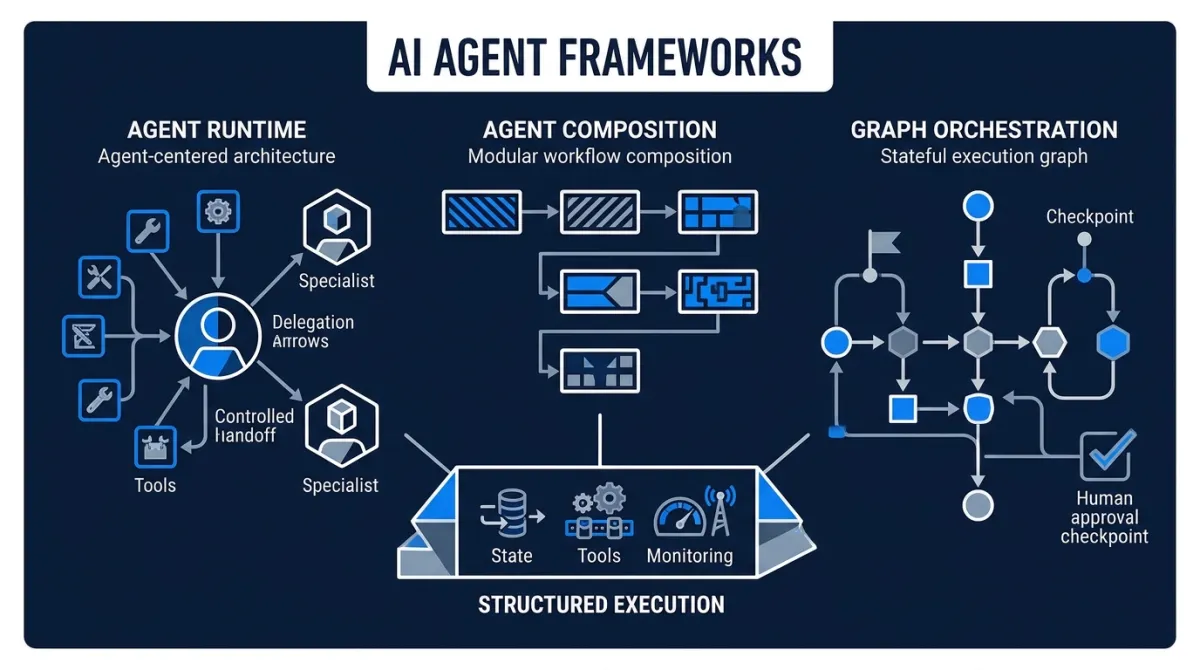
They overlap in their ability to build agents and multi-agent systems, but their architectural philosophies are different.
- OpenAI Agents SDK provides a code-first agent runtime with built-in primitives for tools, handoffs, guardrails, and tracing.
- Google ADK provides a modular framework for building agents and composing predictable or dynamic workflows.
- LangGraph provides low-level graph orchestration with explicit state management, persistence, and execution control.
The distinction is important: choosing a framework is not simply choosing which model provider to use. It determines how much of the agent's execution logic the framework manages and how much the developer must design.
1. The three frameworks at a glance
| Dimension | OpenAI Agents SDK | Google ADK | LangGraph |
|---|---|---|---|
| Main philosophy | Code-first agent runtime | Modular agent development framework | Explicit graph-based orchestration |
| Primary abstraction | Agent, tool, handoff, guardrail | Agent, workflow, tool, session | State, node, edge, graph |
| Workflow design | Agent loop and handoffs | Sequential, parallel, loop, dynamic delegation | Explicit control-flow graph |
| Multi-agent support | Handoffs and agents as tools | Hierarchical and workflow-based composition | Subgraphs and custom graph structures |
| State management | Sessions and resumable run state | Sessions, state, and artifacts | Explicit graph state and checkpointing |
| Human intervention | Guardrails and human review patterns | Callbacks and workflow integration | Native interrupt and resume patterns |
| Observability | Built-in tracing | Development UI, events, and evaluation | Graph execution visibility and LangSmith integrations |
| Model flexibility | Multiple model providers and transports | Multiple model integrations | Model-agnostic orchestration |
| Languages | Python and TypeScript | Python, TypeScript, Go, Java | Python and JavaScript/TypeScript |
| Best suited for | Agent applications with clear tool and delegation patterns | Modular agents and integrated workflows | Stateful, long-running, explicitly controlled workflows |
The table describes architectural characteristics, not a performance ranking. Actual capabilities depend on SDK versions, integrations, deployment choices, and the infrastructure around the framework.
Official documentation:
2. OpenAI Agents SDK: an agent runtime built around delegation
The OpenAI Agents SDK is a code-first framework for building single agents and networks of agents.
Its central abstraction is relatively straightforward: an agent has a model, instructions, and tools. The SDK manages the agent execution loop and provides primitives for coordinating multiple agents.
Instead of implementing every interaction manually, developers can define the behavior of an agent and let the SDK manage the repeated cycle of model execution, tool calls, and subsequent model responses.
How its architecture works
The core building blocks include:
Agents
An agent represents a specialist with its own instructions, model configuration, and available tools.
For example, an e-commerce application could contain:
- A customer support agent.
- An order management agent.
- A refund specialist.
- A product information agent.
Each agent receives a defined responsibility and the tools needed to perform it.
Tools
Tools allow agents to interact with external systems. They can be custom functions, supported platform tools, or integrations such as MCP servers.
A customer support agent might call a function that retrieves an order from a database or checks the status of a shipment.
Handoffs
Handoffs allow an agent to transfer control to another agent.
For example:
- A customer asks about a missing order.
- The support agent identifies an order-status request.
- It hands the conversation to the order management agent.
- The specialist retrieves the information.
- The specialist returns the result through the workflow.
The important point is that a handoff changes which agent owns the next part of the interaction.
Agents as tools
An alternative is to keep one agent responsible for the final answer while calling specialist agents as bounded capabilities.
This is useful when the main agent needs to coordinate specialists without transferring ownership of the conversation.
OpenAI documents both patterns and explains when to use each.
Guardrails and tracing
Two features matter when moving from prototypes to production.
Guardrails provide mechanisms for validating inputs and outputs and controlling whether a workflow should continue. Human review patterns can introduce approval before sensitive actions.
Tracing records execution events such as model generations, tool calls, handoffs, and guardrail activity. Developers can inspect these events to understand how a workflow reached its result.
This makes debugging more structured than simply inspecting the final response.
Where it stands out
A relatively direct development experience. Developers can start with one agent and add tools, guardrails, and specialists as requirements grow.
Clear delegation primitives. Handoffs and agents-as-tools provide two distinct ways to coordinate specialists.
Built-in execution visibility. Tracing helps developers understand what happened during an agent run.
Python and TypeScript support. The SDK offers two practical language choices for application development.
Limitations and trade-offs
The SDK provides useful abstractions, but it does not remove the need to design the surrounding application.
Developers remain responsible for deployment, application-level storage, tool implementation, permissions, and important business rules.
There is also a distinction between using the SDK and using OpenAI's managed agent services. The SDK runs within the developer's application, while managed services can provide different execution and infrastructure responsibilities.
For workflows requiring a very explicit sequence of state transitions, conditional branches, and recovery paths, developers may prefer a graph-oriented abstraction.
Best fit: Teams building agent applications with clear responsibilities, tool interactions, and delegation patterns, particularly when they want a relatively direct code-first development experience.
Documentation: OpenAI Agents SDK.
3. Google ADK: modular agent development and workflow composition
Google's Agent Development Kit takes a broader framework approach.
ADK is designed to help developers build, test, evaluate, and deploy agents, from simple assistants to multi-agent applications.
Its central idea is that agents should be modular components that can be composed into larger workflows.
A developer can begin with one agent and introduce additional agents or deterministic workflow steps when the application becomes more complex.
How its architecture works
ADK provides several types of building blocks.
LLM agents
An LLM agent combines a model, instructions, and optional tools.
It can handle a specific responsibility and delegate work to another agent when the workflow requires it.
Workflow agents
ADK provides workflow-oriented agents for predictable execution patterns.
Three important examples are:
- Sequential agents: Execute components in a defined order.
- Parallel agents: Run independent components concurrently.
- Loop agents: Repeat a sequence of operations according to defined conditions.
These abstractions are useful when developers want to combine model-driven reasoning with deterministic execution.
Consider a market research application.
A workflow might contain:
- A source discovery agent.
- A competitor analysis agent.
- A financial data extraction agent.
- A report generation agent.
Some tasks can execute in parallel, while the final report must wait for the previous results.
ADK provides workflow components that make this architecture easier to express.
Tools and integrations
ADK supports custom tools, prebuilt integrations, MCP tools, and connections to external systems.
It also provides support for artifacts, callbacks, plugins, and agent communication patterns.
State and sessions
Sessions provide a way to maintain interaction context, while state and artifacts help applications manage information and outputs beyond an individual model response.
Model flexibility
One of ADK's important architectural characteristics is its support for different model providers.
Developers can work with Google's models and integrate other supported providers through the framework's available integrations.
This makes ADK more than a framework for applications that exclusively use Gemini.
However, model compatibility does not mean every provider exposes identical features or behavior. Developers still need to check the capabilities of their chosen model and integration.
Development, evaluation, and deployment
ADK provides a development experience that includes local execution, debugging tools, and evaluation capabilities.
Google's documentation also describes deployment options including Cloud Run and Google Kubernetes Engine.
This is relevant because agent development does not end when the first workflow works locally. Teams need ways to test execution trajectories, identify failures, and operate the application in a controlled environment.
Where it stands out
Modular composition. Agents and workflow components can be combined without forcing every task into one large agent.
Predictable workflow patterns. Sequential, parallel, and loop-based execution are useful for applications mixing deterministic and model-driven tasks.
Multi-agent development. Hierarchical agent structures and delegation are part of the framework's design.
Language flexibility. ADK supports Python, TypeScript, Go, and Java according to Google's current documentation.
Development-to-deployment tooling. The framework provides tools for building, evaluating, and deploying applications.
Limitations and trade-offs
ADK's flexibility introduces architectural decisions.
Developers must determine when a task should be handled by one agent, when it needs a workflow, and when dynamic delegation is appropriate.
The framework also has a larger conceptual surface than a simple single-agent abstraction. Teams should understand its session, state, workflow, and deployment concepts before building a complex architecture.
Google Cloud deployment options may be attractive to organizations already using that infrastructure, but developers should evaluate portability and operational requirements rather than assume a framework automatically removes cloud dependencies.
Best fit: Developers building modular multi-agent applications, especially when they need predictable workflow composition, multiple model integrations, and a development-to-deployment framework.
Documentation: Google ADK.
4. LangGraph: explicit control over state and execution
LangGraph approaches agent development from a different direction.
Instead of primarily defining agents and allowing the framework to coordinate them, developers define a graph that describes how the application executes.
A graph consists of:
- State: Information shared across execution steps.
- Nodes: Individual operations, such as model calls, tool execution, or custom functions.
- Edges: Connections that determine which node executes next.
This model makes LangGraph particularly relevant when an application needs precise control over its execution path.
Understanding graph-based orchestration
Imagine an insurance claim processing agent.
A simplified workflow might be:
- Receive a claim.
- Extract information from submitted documents.
- Check whether required information is available.
- If information is missing, request clarification.
- If information is complete, evaluate the claim.
- Pause for human approval if the claim exceeds a defined threshold.
- Continue processing after approval.
A conventional agent might attempt to manage much of this sequence through instructions and tool calls.
In LangGraph, the developer can represent the process explicitly as nodes, conditions, and transitions.
This does not mean every node must be deterministic. Some nodes can call language models, while others execute ordinary application code.
The developer controls how those components connect.
State management and persistence
State management is one of LangGraph's defining strengths.
Its persistence system uses checkpoints to preserve graph execution state.
This supports several important patterns:
Resuming interrupted workflows
If an application pauses or encounters a failure, it can resume from a saved state rather than rebuilding the entire workflow.
Human-in-the-loop execution
The graph can pause, allow a human to inspect or modify information, and then continue.
Conversation continuity
State can be associated with a thread, enabling the application to maintain context across interactions.
Long-term memory
LangGraph also supports stores for application-defined information that needs to persist across threads.
The distinction between a checkpointer and a store matters: one preserves execution state for a thread, while the other stores information that can be reused across different threads.
Human intervention and execution control
LangGraph's interrupt and resume patterns are particularly useful for consequential operations.
For example, an agent may prepare a payment but should not execute it automatically.
The graph can pause before the payment node, present the proposed action for approval, and resume only after the application receives the appropriate decision.
This creates a clear separation between preparing an action and authorizing its execution.
What about LangChain?
LangGraph is associated with the broader LangChain ecosystem, but it does not require developers to use LangChain.
It can be used independently as an orchestration framework.
This distinction matters because LangGraph is lower-level than a conventional agent abstraction. It provides the execution primitives rather than prescribing one specific agent architecture.
LangChain's documentation positions LangGraph as a low-level runtime for stateful, long-running agents, with higher-level abstractions available separately.
Where it stands out
Explicit execution paths. Developers can see and control how the workflow moves between operations.
Stateful execution. Checkpointing supports persistence, interruption, and recovery.
Human approval. Workflows can pause for human decisions and continue afterward.
Flexible architecture. Deterministic functions and model-driven operations can coexist in the same graph.
Framework independence. Developers can use LangGraph without adopting the full LangChain ecosystem.
Limitations and trade-offs
The additional control comes with implementation complexity.
Developers need to design state structures, nodes, transitions, and failure handling. For a basic agent that simply calls two tools and returns a response, this can introduce unnecessary overhead.
The graph also requires thoughtful design. Poorly structured state and excessive branching can make a workflow difficult to maintain.
LangGraph is powerful when explicit control is necessary, but developers should not mistake a more complex architecture for a more reliable one by default.
Best fit: Applications that need long-running execution, persistent state, conditional workflows, human approval, and precise control over how tasks progress.
Documentation: LangGraph overview.
5. The architectural difference: agent loop vs workflow composition vs execution graph
The easiest way to understand the three frameworks is to look at how each one organizes a task.
Consider a business application that processes customer requests.
A customer asks:
“I want to return an order because the product arrived damaged. Check the order, verify the return conditions, and prepare a refund.”
All three frameworks can support this application. But their approaches differ.
OpenAI Agents SDK: delegate to the right specialist
The application starts with a customer support agent.
That agent can:
- Call an order lookup tool.
- Delegate eligibility checks to a returns specialist.
- Ask a refund specialist to prepare the refund.
- Apply guardrails before sensitive operations.
The application is organized around agents, tools, and handoffs.
Conceptual execution model
Customer Request
       |
       v
Support Agent
       |
       v
Order Lookup Tool
       |
       v
Returns Specialist
       |
       v
Refund Specialist
       |
       v
Approval / Guardrail
       |
       v
Final Response
This approach is attractive when responsibilities can be separated into clear specialists.
Google ADK: compose agents into a workflow
ADK allows developers to define the application as a composition of agents and workflow components.
For example:
- The order lookup and policy checks can run as independent tasks.
- A sequential workflow can combine their results.
- A specialist can handle the refund preparation.
- The final response agent can communicate the outcome.
Conceptual execution model
Customer Request
       |
       v
   Coordinator
       |
       +------------------+
       |                  |
       v                  v
 Order Agent         Policy Agent
       |                  |
       +--------+---------+
                |
                v
       Refund Preparation
                |
                v
          Final Response
This approach works well when the workflow has reusable stages and a combination of predictable execution and agent delegation.
LangGraph: define the execution path explicitly
LangGraph allows developers to model the process as a graph.
The workflow can evaluate conditions and route execution accordingly.
For example:
- If the order cannot be found, request clarification.
- If the return is ineligible, explain why.
- If the return is eligible, prepare the refund.
- If approval is required, pause execution.
- After approval, continue to the refund execution node.
Conceptual execution model
Customer Request
       |
       v
   Load Order
       |
       v
 Check Eligibility
       |
       v
   Eligible?
    /     \
   No      Yes
   |        |
   v        v
 Explain  Prepare Refund
            |
            v
      Approval Needed?
         /       \
        Yes       No
         |         |
         v         |
    Human Review   |
         |         |
         +----+----+
              |
              v
       Execute Refund
              |
              v
        Final Response
The advantage is not that the graph is inherently smarter. It is that the developer has a direct representation of the business process.
6. Comparing the frameworks by critical engineering requirements
Architecture becomes more important when the application moves beyond a demonstration.
Here are the areas that should influence the decision.
A. Multi-agent orchestration
All three frameworks support multi-agent applications, but they expose different ways of organizing them.
| Requirement | OpenAI Agents SDK | Google ADK | LangGraph |
|---|---|---|---|
| Agent delegation | Handoffs and agents as tools | Agent transfer and composition | Graph-controlled routing |
| Parallel tasks | Can be implemented through application and orchestration patterns | Dedicated parallel workflow agent | Parallel graph branches |
| Sequential workflows | Agent execution and custom application logic | Dedicated sequential workflow agent | Explicit graph edges |
| Complex conditional routing | Custom logic and handoffs | Workflow and dynamic routing | Conditional edges |
| Explicit workflow topology | Less central to its abstraction | Available through workflow components | Core design principle |
The decision depends on how much of the workflow needs to be visible and controlled by the developer.
If the task is primarily delegation between specialists, OpenAI's abstractions are direct.
If the application consists of modular agent components and predictable workflow patterns, ADK provides relevant building blocks.
If the workflow contains extensive branching and conditional transitions, LangGraph's graph model is a natural fit.
B. State and memory
State management becomes critical when agents perform tasks that last longer than one model interaction.
A useful architecture must distinguish between:
- Current execution state.
- Conversation history.
- Information that persists across sessions.
- Files and artifacts generated during execution.
OpenAI Agents SDK provides session and run-state primitives, while application-level storage remains part of the surrounding architecture.
ADK offers sessions, state, and artifact management.
LangGraph provides explicit checkpoints and stores for thread-level and longer-term information.
The important question is not simply which framework has memory. It is how much control the developer has over persistence, recovery, and information sharing.
C. Human-in-the-loop execution
An agent should not automatically execute every action it can technically perform.
Consider these operations:
- Reading a document.
- Drafting an email.
- Updating a customer record.
- Issuing a refund.
- Transferring money.
They require different levels of authorization.
OpenAI provides guardrails and human review patterns. ADK can integrate approval logic through workflow components and callbacks. LangGraph offers explicit interrupt-and-resume execution patterns.
For workflows where approval is a central part of the process, LangGraph's explicit state transitions can be particularly useful.
However, the framework alone does not establish a complete authorization system. The application still needs secure identity checks, permission enforcement, and reliable audit records.
D. Observability and evaluation
An agent's final response does not reveal everything that happened during execution.
Developers need to understand:
- Which tools were called.
- Which model decisions influenced the workflow.
- Where execution failed.
- How many attempts were required.
- Whether the agent followed the intended path.
- Whether the output met the application's requirements.
OpenAI Agents SDK includes tracing for model calls, tools, handoffs, and guardrails.
ADK includes development and debugging tools, event inspection, and evaluation capabilities.
LangGraph can expose graph execution and state transitions, with LangSmith providing additional tracing, evaluation, and monitoring integrations.
No framework makes evaluation optional. A production system still needs task-specific test cases, failure analysis, and monitoring.
E. Model and infrastructure flexibility
This is where the differences can influence long-term architecture.
OpenAI Agents SDK
Provides integrations with OpenAI models and other supported model providers. Developers can control model configuration, tools, and runtime behavior.
Google ADK
Supports Google's models and other model providers through its available integrations. It also provides deployment paths that connect naturally with Google Cloud infrastructure.
LangGraph
Focuses on orchestration rather than requiring a particular model provider. This makes it useful when the application needs to combine different models or change providers without redesigning its workflow architecture.
Model flexibility is not the same as feature parity. Tool calling, structured outputs, streaming, multimodal capabilities, and other behaviors can differ between model integrations.
7. Developer experience: which framework is easiest to work with?
Ease of use depends on the developer's existing skills and the complexity of the application.
A developer familiar with Python or TypeScript who wants to create a tool-using agent may find the OpenAI Agents SDK straightforward.
A developer building modular applications with multiple workflow stages may appreciate ADK's agent and workflow abstractions.
A developer experienced in backend architecture, state machines, or workflow engines may find LangGraph's explicit graph model more natural.
The difference becomes clearer as complexity increases.
| Project complexity | Framework worth evaluating first | Reason |
|---|---|---|
| Simple tool-using assistant | OpenAI Agents SDK | Direct agent and tool abstractions |
| Specialist delegation | OpenAI Agents SDK | Handoffs and agents as tools |
| Sequential and parallel agent workflows | Google ADK | Dedicated workflow components |
| Reusable multi-agent architecture | Google ADK | Modular agent composition |
| Conditional business process | LangGraph | Explicit graph transitions |
| Long-running stateful workflow | LangGraph | Checkpointing and resumability |
| Human approval at multiple stages | LangGraph | Explicit interruption and continuation |
| Model-provider flexibility | Google ADK or LangGraph | Broad integrations or provider-independent orchestration |
These are starting points for evaluation, not hard limitations. All three can implement many of the listed patterns with additional application code.
8. A practical decision framework
Before selecting a framework, answer one architectural question:
Is your application primarily an agent, a composition of agents, or a controlled workflow that happens to use agents?
This distinction is more useful than comparing feature counts.
Choose OpenAI Agents SDK if:
- You want a direct code-first approach.
- Your application is organized around agents and tools.
- Specialist agents need to delegate work to one another.
- You value built-in tracing and guardrail primitives.
- You want to keep the runtime inside your own application.
Choose Google ADK if:
- You need modular agent development.
- Your workflow combines sequential, parallel, and dynamic execution.
- You want multiple model integrations.
- Your application has several reusable agents.
- You value an integrated development, evaluation, and deployment experience.
Choose LangGraph if:
- Your application has complex conditional execution.
- State must persist across long-running tasks.
- Workflows need to pause and resume.
- Human approval is part of the business process.
- You want explicit control over every major execution transition.
A fourth option: combine frameworks
These frameworks are not necessarily mutually exclusive.
A team can use one framework for agent behavior and another system for a broader workflow, provided the integration boundaries are well designed.
For example, a graph-based workflow could coordinate business processes while individual nodes invoke specialized agents.
The trade-off is additional complexity: multiple runtimes, state boundaries, observability systems, and integration points need to be maintained.
Combining frameworks should solve a concrete architectural problem, not simply increase the number of tools in the stack.
9. How to evaluate them before committing
A framework should be tested against the application it is intended to support.
Build the same small workflow with each candidate.
A useful test project is a research and reporting agent:
- Receive a research request.
- Search a defined set of sources.
- Extract structured information.
- Verify important claims.
- Generate a report.
- Pause for human review.
- Resume and produce the final output.
Evaluate each implementation using the same test cases.
| Evaluation criterion | What to measure |
|---|---|
| Development effort | Time required to implement the workflow |
| Execution reliability | Percentage of tasks completed correctly |
| State recovery | Whether interrupted tasks can resume correctly |
| Tool reliability | Failed calls, retries, and malformed arguments |
| Workflow control | Ability to enforce required execution order |
| Human approval | Correct handling of approval and rejection |
| Observability | How easily developers can identify failures |
| Model portability | Effort required to switch providers |
| Maintenance | Complexity of updating and extending the workflow |
| Operational cost | Model usage, infrastructure, storage, and monitoring |
Run the test multiple times, including failure scenarios.
For example, deliberately make a tool unavailable, provide incomplete source material, interrupt execution, and reject a human approval request.
A framework that performs well in a successful demonstration may behave very differently under these conditions.
Do not use the number of agents as a success metric. More agents can introduce additional communication, coordination, latency, and failure points.
The goal is to build the simplest architecture that reliably completes the required work.
10. Final verdict: which AI agent framework should you choose in 2026?
There is no universal winner because these frameworks solve overlapping but different architectural problems.
OpenAI Agents SDK is a strong starting point for code-first agent applications. Its agent, tool, handoff, guardrail, and tracing abstractions make it practical for applications where specialists need to collaborate without requiring a fully explicit workflow graph.
Google ADK is a strong option for modular agent systems. Its combination of agent composition, sequential and parallel workflows, model integrations, evaluation, and deployment tooling makes it worth considering for applications that need a broader development framework.
LangGraph is particularly compelling when execution control is the main engineering requirement. Its explicit graph structure, state persistence, and human-in-the-loop patterns are useful when the workflow must be inspectable, recoverable, and predictable.
The decision can be reduced to three questions:
- Do you mainly need agents that can use tools and delegate? Start with OpenAI Agents SDK.
- Do you need to compose reusable agents into structured workflows? Evaluate Google ADK.
- Do you need explicit control over state, transitions, and long-running execution? Evaluate LangGraph.
The most important lesson is that an agent framework does not automatically make an agent reliable.
Reliability comes from the architecture around it: well-defined tools, limited permissions, persistent state, meaningful evaluations, observability, and clear boundaries between autonomous execution and human authorization.
The best framework is therefore not the one with the most abstractions. It is the one that makes the architecture required by your application easiest to implement, test, and maintain.
Sources and further reading
Official documentation
- OpenAI — Agents SDK
- OpenAI — Orchestration and Handoffs
- OpenAI — Tracing
- Google Cloud — Agent Development Kit
- Google ADK — Agent Architecture
- Google Developers Blog — Building Multi-Agent Applications with ADK
- LangGraph — Overview
- LangGraph — Persistence
Editorial note: This comparison describes framework architecture and documented capabilities, not independent performance benchmarks. Verify current language support, API availability, deployment options, and pricing before selecting a framework. Features may differ across SDK versions and integrations.