
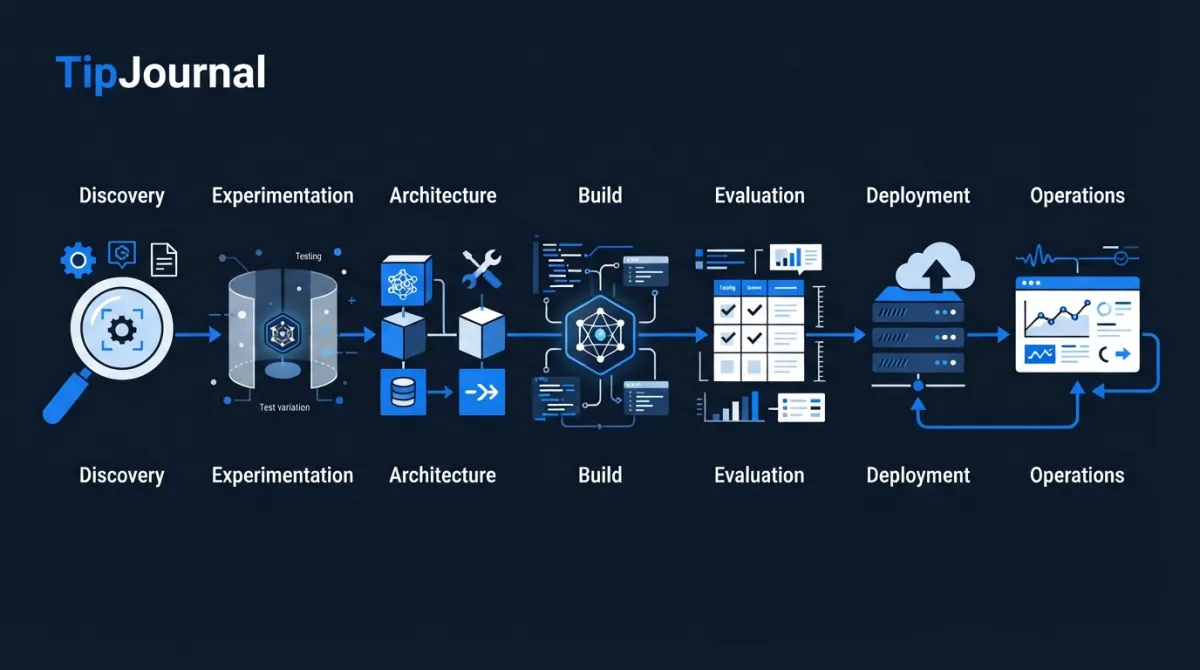
The Agent Development Lifecycle: From Prototype to Production
Building an AI agent is relatively easy. Building one that consistently performs useful work, handles failures, respects permissions, and remains reliable in production is a different engineering challenge.
A prototype can demonstrate that a language model can call an API, retrieve information, or complete a sequence of tasks. But that demonstration does not establish whether the system is ready for real users.
Production agents operate in environments with incomplete information, unpredictable inputs, external service failures, changing data, security requirements, and operational constraints. They must be evaluated and maintained like software systems—not treated as prompts that happen to work.
This is why AI agent development needs a lifecycle.
The process extends from identifying a suitable use case to designing the architecture, implementing the agent, evaluating its behavior, deploying it safely, and continuously improving it using production evidence.
This guide breaks down each stage and provides a practical framework for engineering teams.
1. What makes agent development different?
Traditional software generally follows explicitly programmed logic. Developers define the conditions, operations, and expected outcomes.
An AI agent introduces a different execution model: a language model can decide which actions to take, select tools, interpret their results, and determine what to do next.
A simplified agent may operate through the following loop:
- Receive a task.
- Interpret the objective and available context.
- Select an action or tool.
- Execute the action.
- Observe the result.
- Decide whether to continue, retry, ask for assistance, or finish.
This introduces uncertainty into execution.
The same request can produce different tool selections, different reasoning paths, or different outputs. An external API might fail, a tool might return unexpected data, or the model might misunderstand the task.
Consequently, agent development requires more than testing whether the final response looks correct.
Developers must also examine:
- Whether the agent selected appropriate tools.
- Whether it followed the intended workflow.
- Whether it respected authorization boundaries.
- Whether it recovered from errors.
- Whether it completed the task within acceptable cost and latency.
- Whether its behavior remains consistent after changes.
OpenAI's practical guide to building agents emphasizes use-case selection, tool design, orchestration, and guardrails. Microsoft's lifecycle guidance similarly describes agent development as an iterative process involving discovery, experimentation, building, deployment, and ongoing operations.
Sources: OpenAI — A Practical Guide to Building Agents · Microsoft — Agent Development Lifecycle
2. Stage One: Discover the right use case
The first engineering decision is not which model or framework to use. It is whether the problem actually requires an agent.
A common mistake is starting with a technology and searching for a problem to justify it.
Instead, begin with a workflow that has measurable business value.
Identify the problem
Consider a customer-support workflow.
A traditional application might allow a customer to search documentation, submit a support ticket, or check an order status.
An AI agent could potentially:
- Understand a customer's request.
- Retrieve relevant account information.
- Search internal documentation.
- Check an order through an API.
- Propose an appropriate resolution.
- Escalate the issue when necessary.
The value comes from completing a useful task, not simply generating a natural-language response.
Determine whether an agent is necessary
Not every workflow benefits from autonomous decision-making.
| Problem characteristics | Appropriate solution |
|---|---|
| Fixed sequence of predictable operations | Traditional automation |
| One question requiring a language response | Single LLM call |
| Retrieval from documents with a fixed process | RAG pipeline |
| Several predefined LLM steps | LLM workflow |
| Dynamic decisions and variable execution paths | AI agent |
Anthropic distinguishes predefined workflows from agents that dynamically direct their own processes and tool usage. Its recommendation is to begin with the simplest solution and introduce additional complexity only when necessary.
This is important because autonomy often introduces additional latency, cost, and failure modes.
Source: Anthropic — Building Effective Agents
Define measurable objectives
Before development, establish what successful execution means.
For example, a customer-support agent could have the following objectives:
- Correctly identify the customer's request.
- Retrieve the correct order information.
- Avoid disclosing information belonging to another customer.
- Resolve eligible cases without human intervention.
- Escalate uncertain or sensitive cases.
- Complete requests within an acceptable response time.
Define operational constraints as well:
- Maximum execution time.
- Maximum number of tool calls.
- Cost per completed task.
- Permitted tools and data sources.
- Actions requiring human approval.
Deliverable: A use-case specification describing the target users, task boundaries, success criteria, constraints, and acceptable failure behavior.
3. Stage Two: Experiment before committing to an architecture
Once the use case is defined, the next step is experimentation.
The objective is to validate the fundamental assumptions before investing in a complete system.
At this stage, developers should test:
- Whether the selected model can understand the task.
- Whether it can reliably select the required tools.
- Whether external data sources provide sufficient information.
- Whether the workflow can be completed at an acceptable cost.
- Whether the model behaves safely when information is missing.
Start with a narrow prototype
Avoid implementing the complete product immediately.
For the customer-support example, begin with a limited agent that can:
- Receive a customer request.
- Retrieve an order using a read-only API.
- Explain the order status.
- Return a structured result.
Do not initially provide unrestricted access to payment systems, customer databases, or account modification operations.
A smaller prototype makes it easier to isolate problems.
Test with realistic data
A prototype that works with five manually written examples is not sufficient evidence of production readiness.
Use representative inputs, including:
- Normal requests.
- Incomplete requests.
- Ambiguous requests.
- Incorrect identifiers.
- Unexpected API responses.
- Requests outside the agent's responsibilities.
- Attempts to manipulate the agent into ignoring its instructions.
Microsoft specifically recommends grounding experimentation in real-world datasets and current models rather than relying exclusively on synthetic or limited test data.
Deliverable: A validated proof of concept, an initial evaluation dataset, and a record of the main technical risks.
4. Stage Three: Design the architecture
After validating the use case, design the system that will support it.
An agent is not simply a model connected to a collection of APIs. It is an application composed of several interacting components.
A typical architecture includes:
| Component | Responsibility |
|---|---|
| User interface | Receives requests and presents results |
| Agent runtime | Executes the agent loop |
| Model | Interprets instructions and selects actions |
| Tools and integrations | Connect to APIs, databases, and external systems |
| Context and state | Maintain relevant information across execution |
| Guardrails | Enforce safety and behavioral constraints |
| Authorization layer | Determines which actions are permitted |
| Evaluation and observability | Measure behavior and diagnose failures |
Choose the right orchestration pattern
The architecture should reflect the complexity of the task.
Common patterns include:
Single-agent architecture
One agent handles the complete task using a defined collection of tools.
This is usually the best starting point when the workflow does not require separate specialized responsibilities.
Sequential workflow
The system executes predefined steps, potentially using an LLM at specific points.
For example:
Receive request
      |
Classify request
      |
Retrieve order
      |
Validate information
      |
Generate response
This is appropriate when the execution path is predictable.
Multi-agent architecture
Several specialized agents collaborate, with an orchestrator assigning work and combining results.
For example:
             Main Agent
                 |
       +---------+---------+
       |         |         |
    Research  Validation  Reporting
       |         |         |
       +---------+---------+
                 |
           Final Result
This can be useful when responsibilities are genuinely distinct, but it also introduces coordination overhead, additional model calls, and more complex failure handling.
Design tool interfaces carefully
Tools are one of the most important parts of an agent architecture.
A poorly designed tool can create unpredictable behavior even when the underlying model is capable.
A good tool should have:
- A clear name and description.
- Explicit input and output schemas.
- Narrow responsibilities.
- Defined error responses.
- Appropriate authorization checks.
- Limits on destructive operations.
For example, separate get_order_status from cancel_order rather than exposing one unrestricted order-management tool.
Separate reasoning from authorization
The model may decide that an action is appropriate, but it should not be responsible for granting itself permission.
The application should enforce authorization independently.
For instance:
Agent requests: cancel_order(order_id)
                  |
             Tool Gateway
                  |
         Authorization Check
                  |
          +-------+-------+
          |               |
        Allowed         Denied
          |               |
     Execute action   Return error
The model proposes an action. Deterministic application logic decides whether that action is allowed.
Deliverable: An architecture specification covering components, tool contracts, state management, permissions, integrations, and failure boundaries.
5. Stage Four: Build the production implementation
The prototype demonstrates feasibility. The build phase turns that experiment into maintainable software.
This requires moving important behavior out of informal experimentation and into version-controlled application code.
Organize the implementation
A practical project structure could look like this:
agent-application/
│
├── agents/
│   ├── support_agent.py
│   └── instructions.py
│
├── tools/
│   ├── orders.py
│   ├── customers.py
│   └── knowledge_base.py
│
├── services/
│   ├── authorization.py
│   └── customer_service.py
│
├── evaluations/
│   ├── dataset.jsonl
│   └── graders.py
│
├── tests/
│   ├── test_tools.py
│   ├── test_permissions.py
│   └── test_workflows.py
│
├── config/
│   └── settings.py
│
└── app.py
This is an illustrative structure, not a mandatory framework convention.
The important principle is separation of responsibilities.
The agent should not contain every database operation, permission check, and business rule inside one large prompt or function.
Implement essential engineering controls
A production-oriented implementation should include:
Input validation: Validate requests and tool parameters before execution.
Timeouts: Prevent a slow external service from blocking the entire workflow indefinitely.
Retries: Retry temporary failures with appropriate limits and backoff. Avoid retrying operations that could cause duplicate side effects without an idempotency strategy.
State management: Persist relevant execution state when tasks must survive interruptions or continue across sessions.
Structured outputs: Use schemas where downstream application logic depends on predictable response formats.
Version control: Track changes to prompts, tools, models, configuration, and evaluation datasets.
Error handling: Define what happens when the agent cannot complete a task.
For example, the agent should be able to stop and request human assistance rather than repeatedly calling a failing API.
Keep the system observable from the beginning
Logging should not be postponed until after deployment.
Capture useful execution information, including:
- Request and session identifiers.
- Model and configuration versions.
- Tool names and execution status.
- Latency and token usage.
- Errors and retry attempts.
- Approval decisions.
- Final task outcome.
Avoid logging passwords, access tokens, or unnecessary personal information.
Deliverable: A version-controlled implementation with defined interfaces, validation, error handling, security controls, and instrumentation.
6. Stage Five: Evaluate before release
One of the most important differences between traditional application development and agent development is the need to evaluate behavior across many possible execution paths.
A successful demonstration does not establish reliability.
Testing should happen at several levels.
Unit testing
Test individual components independently.
Examples:
- Does the order lookup tool return the expected schema?
- Does the authorization service reject unauthorized requests?
- Does input validation reject malformed identifiers?
These tests should generally be deterministic.
Integration testing
Test interactions between components.
Examples:
- Can the agent retrieve an order and interpret its status?
- Does the tool gateway correctly enforce permissions?
- What happens when the external API returns an error?
Agent-level evaluation
Test the complete task from the initial request to the final outcome.
Build a dataset containing representative tasks and expected results.
Evaluate dimensions such as:
| Dimension | Example question |
|---|---|
| Task success | Was the customer's problem resolved? |
| Accuracy | Was the correct order retrieved? |
| Tool selection | Did the agent choose the appropriate tool? |
| Policy compliance | Did it respect permission boundaries? |
| Recovery | Did it handle failed API calls correctly? |
| Efficiency | How many calls and tokens were required? |
Some criteria can be checked programmatically. Others may require human review or an LLM-based grader.
Evaluate the execution trace, not only the final answer
Suppose an agent gives the correct order status but retrieves it using an unauthorized or inappropriate tool.
The final response may look correct, but the execution was unacceptable.
This is why trace evaluation matters.
A trace records the sequence of model calls, tool executions, handoffs, and other workflow events. It allows developers to investigate how a result was produced.
OpenAI's agent evaluation guidance describes the use of traces, graders, datasets, and evaluation runs to identify workflow-level failures and regressions.
Sources: OpenAI — Evaluate Agent Workflows · OpenAI — Tracing
Create regression tests
Every significant improvement should be checked against existing evaluation cases.
For example, changing the system instructions might improve order retrieval but accidentally make the agent less likely to escalate sensitive requests.
A regression suite helps detect these trade-offs before release.
Deliverable: A repeatable evaluation process, a baseline performance report, and documented release criteria.
7. Stage Six: Deploy safely
A successful evaluation is a prerequisite for deployment, not a guarantee that production will behave identically.
Production environments introduce real users, changing data, external dependencies, and unexpected traffic patterns.
A controlled deployment process reduces the risk of introducing failures.
Prepare the production environment
Before launch, verify:
- API keys and secrets are stored securely.
- Permissions are configured correctly.
- Network and database access are restricted.
- Tool operations have appropriate limits.
- Logging and monitoring are enabled.
- Rate limits and execution timeouts are configured.
- Human approval is required for sensitive actions.
- Rollback and incident-response procedures exist.
Use staged releases
Instead of immediately exposing the agent to every user, introduce it gradually.
A possible release strategy:
- Internal testing: Allow developers and selected employees to use the agent.
- Limited release: Enable a restricted group of real users.
- Controlled expansion: Increase usage after reviewing performance.
- General availability: Open access once operational requirements are satisfied.
Monitor both successful and unsuccessful executions during each stage.
Preserve the ability to roll back
Agent behavior depends on several changing components: model versions, prompts, tool definitions, integrations, and evaluation criteria.
Keep known-good versions so that a problematic release can be reversed.
Deliverable: A production deployment with access controls, monitoring, release procedures, and rollback capability.
8. Stage Seven: Monitor and improve in production
Deployment does not end the development lifecycle.
It begins the operational phase.
An agent may perform well during controlled testing and still fail when users introduce unfamiliar requests or external systems change.
Production monitoring should cover three broad areas.
Operational performance
Track:
- Request volume.
- Success and failure rates.
- Average and percentile latency.
- Model and tool errors.
- Token consumption.
- Cost per completed task.
- External service availability.
Agent quality
Track:
- Task completion rate.
- Incorrect tool selection.
- Escalation frequency.
- Policy violations.
- User feedback.
- Repeated execution failures.
Security and governance
Track:
- Unauthorized access attempts.
- Suspicious tool usage.
- Unexpected permission requests.
- Sensitive actions and approval decisions.
- Unusual data access patterns.
Turn production failures into evaluation cases
This is where the lifecycle becomes a continuous feedback loop.
Imagine that a support agent repeatedly fails when customers provide an order number with an extra character.
The engineering team should:
- Inspect the failed execution trace.
- Identify whether the problem came from the model, input validation, or the tool.
- Reproduce the issue.
- Add the scenario to the evaluation dataset.
- Implement and test a correction.
- Deploy the new version.
- Verify that the failure rate decreases without introducing regressions.
This process gradually improves the agent's reliability using evidence from actual operation.
Microsoft describes the operational steady state as an ongoing process of monitoring, evaluating, and adjusting agent performance as business requirements and underlying technologies evolve.
Source: Microsoft — Agent Development Lifecycle
9. The complete lifecycle at a glance
The seven stages can be summarized as follows:
| Stage | Main question | Key deliverable |
|---|---|---|
| 1. Discovery | Should this problem use an agent? | Use-case specification |
| 2. Experimentation | Can the approach work? | Validated prototype |
| 3. Architecture | How should the system be designed? | Architecture specification |
| 4. Build | Can we implement it reliably? | Production-ready application |
| 5. Evaluation | Does it meet quality and safety requirements? | Evaluation report |
| 6. Deployment | Can it be released safely? | Production release |
| 7. Operations | Does it remain reliable over time? | Monitoring and improvement cycle |
The stages are not strictly linear. Evaluation should begin during experimentation, security should influence architecture from the start, and production feedback should inform future design decisions.
The lifecycle is better understood as an iterative engineering process.
10. Common mistakes when moving from prototype to production
Mistake 1: Starting with the framework instead of the problem
Choosing a framework before defining the workflow can lead to unnecessary architectural complexity.
Start with the requirements, then select the tools and framework that support them.
Mistake 2: Treating a successful demo as proof of reliability
A prototype usually demonstrates a narrow set of successful scenarios.
Use representative datasets, edge cases, and repeatable evaluations before release.
Mistake 3: Giving agents unrestricted tool access
A model should not have unrestricted access to databases, financial operations, or administrative systems.
Enforce permissions in the application layer and require approvals for high-impact actions.
Mistake 4: Ignoring execution traces
Looking only at the final response makes it difficult to understand why an agent failed.
Capture the steps involved in execution and investigate failure patterns.
Mistake 5: Adding multi-agent orchestration too early
More agents mean more coordination, communication, and potential failure points.
Use multiple agents only when their separation provides measurable benefits.
Mistake 6: Treating deployment as the end of development
Models, data, integrations, and user behavior change.
Maintain evaluation datasets and continuously compare production behavior against defined expectations.
11. Tools and resources across the lifecycle
The following tools and platforms can support different stages of agent engineering. They are examples, not a recommendation to adopt one complete vendor stack.
| Development need | Relevant tools and resources |
|---|---|
| Agent implementation | OpenAI Agents SDK, Google ADK, LangGraph |
| Agent orchestration | LangGraph, CrewAI, Microsoft Agent Framework |
| Evaluation | OpenAI Agent Evals, DeepEval, Promptfoo |
| Tracing and observability | OpenAI Tracing, LangSmith, Arize Phoenix |
| Security and policy | Open Policy Agent, OAuth, workload identity systems |
| Deployment and infrastructure | Docker, Kubernetes, cloud platforms |
The right combination depends on the application, infrastructure, engineering team's experience, and operational requirements.
For a small application, an API, a simple workflow, and a reliable evaluation process may be enough. A large enterprise deployment may require dedicated orchestration, identity, observability, and governance infrastructure.
Conclusion: Build agents as software systems, not experiments
The transition from an agent prototype to a production system is fundamentally an engineering process.
It requires developers to understand the problem, validate assumptions, design the architecture, implement reliable components, evaluate behavior, deploy safely, and learn from production evidence.
The most important principle is to avoid treating autonomy as the objective.
The objective is to complete a useful task reliably, securely, and at an acceptable cost.
A successful agent is not necessarily the one with the most tools, the most complex orchestration, or the greatest degree of autonomy. It is the one whose behavior can be understood, measured, controlled, and improved.
The real measure of an AI agent is not what it can do in a demonstration. It is what an engineering team can trust it to do repeatedly in production.
Sources and further reading
- OpenAI — A Practical Guide to Building Agents
- Microsoft — Agent Development Lifecycle
- Anthropic — Building Effective Agents
- OpenAI — Evaluate Agent Workflows
- OpenAI — Tracing
- OpenAI — Observability and Usage
- Microsoft Foundry — Agent Development Lifecycle
Editorial note: Frameworks and platform capabilities evolve quickly. The lifecycle described here is intentionally vendor-neutral; consult the official documentation for current implementation details.