
The End of Single-Model AI: Why Multi-Model Architectures Are Becoming the Default
There probably isn't a "best" AI model.
There are only models that are best for particular jobs.
That realization is changing enterprise AI architecture.
The first generation of AI applications treated the language model as the center of the system. Pick one provider, integrate its API, and send every request through the same model.
It was simple.
It was also inefficient.
Today's AI workloads are far more diverse. Writing code, summarizing documents, answering customer questions, extracting structured data, reasoning through legal contracts, and generating images all place different demands on AI systems.
Expecting one model to excel at every task is becoming increasingly unrealistic.
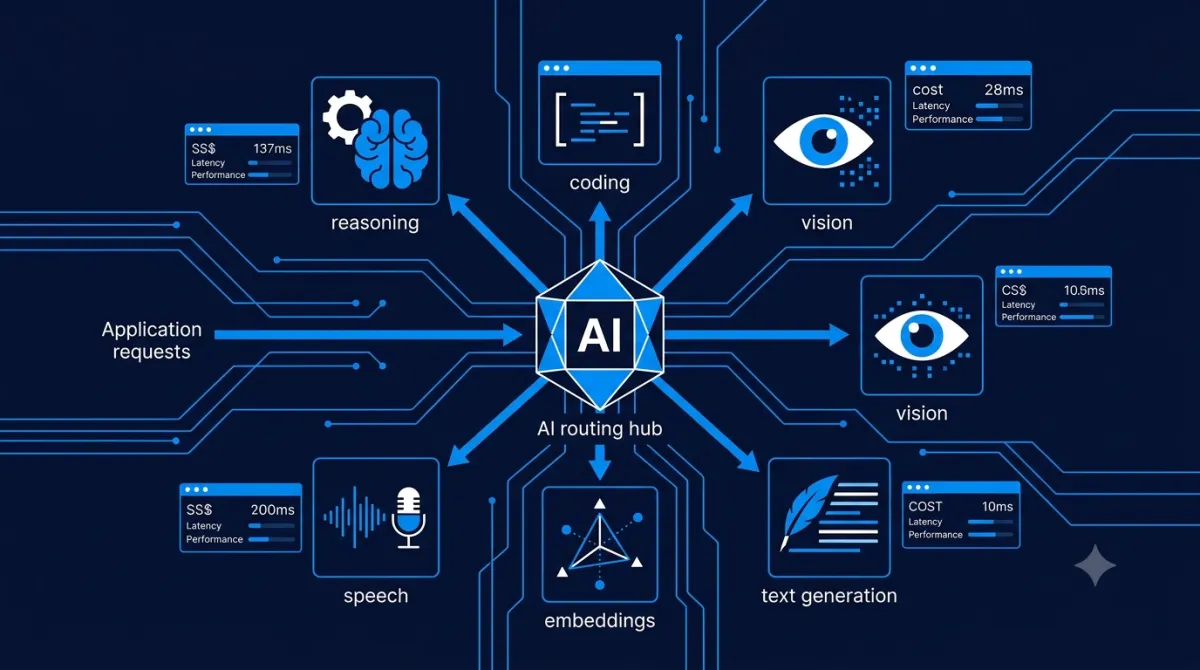
Instead, engineering teams are building multi-model architectures, where several AI models collaborate within the same platform, each selected for its strengths.
Why the Single-Model Strategy Is Breaking Down
Choosing one model offers simplicity.
It also introduces trade-offs.
A highly capable reasoning model may deliver excellent answers but at higher cost and increased latency.
A lightweight model may respond quickly but struggle with complex planning.
Open-weight models provide deployment flexibility but may not match frontier models for specialized reasoning.
Every model optimizes for a different balance of:
- reasoning quality
- response speed
- operating cost
- context length
- multimodal capabilities
- deployment options
As AI becomes embedded across business operations, optimizing every workload with the same model becomes increasingly difficult to justify.
What Is a Multi-Model Architecture?
A multi-model architecture is an AI platform that dynamically selects different models based on the characteristics of each request.
Rather than treating all AI workloads equally, the platform routes requests according to business and technical requirements.
For example:
- A lightweight model classifies incoming support tickets.
- A reasoning model analyzes legal agreements.
- A coding model assists software developers.
- A vision model processes uploaded images.
- A speech model transcribes meetings.
- An embedding model powers semantic search.
Each model performs the work it is best equipped to handle.
The application feels unified.
The infrastructure is specialized.
Model Routing Becomes a Core Capability
Selecting the right model automatically is becoming as important as choosing the models themselves.
Modern routing decisions may consider:
- task complexity
- expected latency
- cost budgets
- geographic availability
- regulatory requirements
- context length
- confidence scores
- historical performance
Some platforms even retry failed requests with alternative models or escalate particularly difficult tasks to more capable reasoning systems.
Model routing transforms AI from a static integration into a dynamic platform.
The Business Case for Multiple Models
Multi-model systems aren't only a technical improvement.
They also solve practical business problems.
Lower Costs
Not every request needs a premium frontier model.
Routing routine tasks to smaller or open-weight models can significantly reduce inference costs.
Better Performance
Specialized models often outperform general-purpose models on specific workloads.
Choosing the right model for each task improves overall application quality.
Reduced Vendor Lock-In
Organizations become less dependent on a single provider.
New models can be introduced without redesigning the application.
Higher Availability
If one provider experiences an outage, requests can be redirected to alternative models.
This improves operational resilience.
The Challenges of Multi-Model AI
Running several models introduces new operational complexity.
Engineering teams must solve problems such as:
Consistent Interfaces
Every provider exposes different APIs, response formats, and capabilities.
AI gateways and middleware often normalize these differences.
Evaluation
How do you determine which model performs best for each workload?
Continuous evaluation pipelines become essential.
Observability
Monitoring now extends beyond a single provider.
Teams need visibility into:
- routing decisions
- latency
- token usage
- costs
- model accuracy
- failure rates
Governance
Different models may have different licensing terms, regional availability, and compliance considerations.
Policy engines help enforce organizational standards consistently.
Multi-Model Platforms Require New Infrastructure
Supporting multiple models changes the surrounding architecture.
Instead of one API integration, organizations increasingly rely on:
- AI gateways
- model routers
- evaluation pipelines
- observability platforms
- prompt management systems
- policy engines
- AI middleware
- control planes
Together, these components coordinate model selection, quality assurance, security, and operational governance.
The AI platform becomes more important than any individual model.
The Future Is Model Portfolios, Not Model Loyalty
The cloud industry offers a useful comparison.
Few enterprises rely on a single database technology.
Different databases serve different purposes.
The same pattern is emerging in AI.
Organizations are building model portfolios instead of committing exclusively to one provider.
As new models are released, they become additional options rather than disruptive replacements.
Competitive advantage shifts from owning the "best" model to operating the smartest routing strategy.
Final Thoughts
The question enterprises once asked was, "Which AI model should we use?"
Increasingly, the better question is, "Which model should handle this request?"
That subtle shift represents a major change in AI architecture.
Multi-model systems allow organizations to balance performance, cost, resilience, and flexibility by matching workloads to specialized models rather than forcing every request through a single provider.
As enterprise AI matures, success will depend less on choosing one dominant model and more on designing platforms that can intelligently coordinate many of them. In the coming years, the most capable AI applications are unlikely to run on a single model—they will run on an ecosystem of models working together.