

Devin AI
Use Devin AI as the anchor for a real shortlist.
Instead of returning to a broad directory, jump straight into the strongest adjacent matchups for pricing, workflow fit, and differentiation.
Overview
Overview
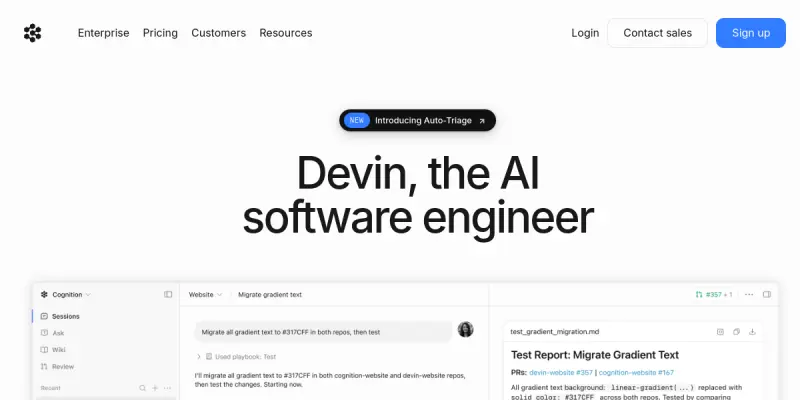
Devin is an autonomous AI software engineer developed by Cognition AI. Unlike traditional coding assistants that require constant human intervention, Devin can plan, write, test, and deploy code independently. It is designed to handle full-stack development tasks, from debugging existing codebases to building new applications from scratch. By leveraging a multi-agent architecture, Devin can parallelize tasks to solve complex engineering problems more efficiently than a single model.
Key Features
- Autonomous Development: Devin autonomously plans, executes, and verifies code changes without manual intervention.
- Multi-Agent Cloud Architecture: Utilizes parallel agents to handle different aspects of a project simultaneously.
- Self-Healing Capabilities: The system can detect and fix bugs in real-time, testing changes before merging.
- Full-Stack Support: Capable of working across frontend (React, Vue) and backend (Python, Node.js) technologies.
- Cloud Deployment: Seamlessly deploys code to cloud environments like AWS or Vercel.
- Deep GitHub Integration: Works directly within the GitHub ecosystem for issue tracking and PR management.
Use Cases
Building Complex Applications
Developers can use Devin to build entire applications from natural language requirements. It handles the setup, implementation, and testing, allowing engineers to focus on high-level architecture rather than boilerplate code.
Debugging and Refactoring
When faced with a broken codebase, Devin can analyze the structure, identify bugs, and propose fixes. It can also refactor legacy code to improve maintainability and performance.
Automating Repetitive Tasks
Routine tasks such as writing unit tests, updating documentation, or migrating databases can be automated by Devin, significantly speeding up the software development lifecycle.
Pricing & Plans
Devin operates on a freemium model, allowing users to start with limited access to explore its capabilities. For serious engineering teams requiring full autonomy and parallel processing, paid subscription tiers are available. Enterprise support is offered for custom integrations and dedicated infrastructure.
Integrations & Compatibility
Devin integrates deeply with GitHub, allowing it to read and modify repositories directly. It is compatible with various cloud hosting providers and supports multiple programming languages and frameworks essential for modern web development.
Who Is It For?
Devin is ideal for senior software engineers, technical leads, and development teams looking to accelerate their delivery pipeline. It is particularly useful for startups and companies looking to reduce the time-to-market for new features.
Limitations
- Cost: Access to the full capabilities of Devin can be expensive, often requiring an invite or a significant subscription.
- Learning Curve: Effectively prompting Devin requires a good understanding of software engineering principles.
- Dependency: As a cloud-based agent, it requires a stable internet connection and relies on external APIs.
Final Verdict
Devin represents a significant leap forward in AI-assisted software engineering. Its ability to work autonomously on full-stack projects makes it a powerful tool for experienced developers. While the learning curve and cost are factors, the potential for massive productivity gains makes it a top contender in the AI agent space.
Tool Facts
Screenshots & Interface
Pros
- ✓ Autonomous end-to-end development that plans, writes, tests, and deploys code
- ✓ Multi-agent cloud architecture allowing parallel task execution
- ✓ Self-healing capabilities that debug and fix errors autonomously
- ✓ Deep integration with GitHub for direct repository management
- ✓ Full-stack support covering frontend and backend technologies
Cons
- × High cost and often invite-only access restricts widespread adoption
- × Steep learning curve for users unfamiliar with prompting complex engineering tasks
- × Reliance on cloud infrastructure requires consistent and stable internet connectivity
- × May struggle with highly ambiguous requirements or legacy code with poor documentation
How to Use Devin AI in Your Workflow
Integrating Devin AI into your professional toolkit enhances efficiency by automating manual steps. By configuring it to suit your specific project requirements, you can optimize output quality and reduce project cycle times. Standard workflows involve testing the tool on simple tasks before scaling its use to complex operations.
Frequently Asked Questions
What is Devin AI used for?
Devin is an autonomous AI coding agent that builds, tests, and deploys full-stack software projects end-to-end. It leverages cloud-based parallel agents to handle complex engineering tasks.
What is the pricing model for Devin AI?
Devin AI uses a Freemium pricing model.
What are the main advantages of Devin AI?
The key benefits of Devin AI include: Autonomous end-to-end development that plans, writes, tests, and deploys code, Multi-agent cloud architecture allowing parallel task execution, Self-healing capabilities that debug and fix errors autonomously, Deep integration with GitHub for direct repository management, Full-stack support covering frontend and backend technologies.
What are the main limitations of Devin AI?
Some limitations or cons of Devin AI are: High cost and often invite-only access restricts widespread adoption, Steep learning curve for users unfamiliar with prompting complex engineering tasks, Reliance on cloud infrastructure requires consistent and stable internet connectivity, May struggle with highly ambiguous requirements or legacy code with poor documentation.
Alternative AI Tools

ToolJet AI
Build enterprise apps and AI agents with low-code. ToolJet provides secure, SOC2 and GDPR compliant internal tools for teams.

Redis AI
Redis AI is a database solution for developers, offering advanced capabilities and blazing fast app development, with a key differentiator in its robust developer API.

Semgrep
Semgrep is a static code analysis tool that scans codebases for security vulnerabilities and enforces coding standards. It is designed for developers and security teams who need fast, accurate code review. Unlike many tools, Semgrep offers powerful custom rule creation without needing a full language parser.
Rating Details
Based on 0 ratings
Quick Comparisons
Related Tools
More AI tools from the same workflow, industry, or category.
AICode
AICode is a spec-driven AI coding copilot for developers using Visual Studio Code. It enforces a disciplined workflow to prevent AI-generated technical debt and ensures maintainable code. Its key differentiator is forcing line-by-line human review before changes are applied.
Opik
Opik is an open-source platform for LLM observability and evaluation. It helps developers trace, test, and monitor AI applications and autonomous agents throughout development and production.
PlanetScale AI
PlanetScale provides serverless cloud hosting for Vitess and PostgreSQL databases. It targets developers and engineering teams requiring high-performance, scalable database infrastructure. The platform enables instant scaling and branching workflows.
CodeReview AI
CodeReview AI is a tool that uses artificial intelligence to analyze code and suggest improvements. It helps developers identify bugs, security issues, and style inconsistencies automatically. The tool integrates with popular version control systems to fit into existing workflows.
Reviews
No reviews submitted yet. Be the first to share your experience.
Write a Review
Share Your Experience
Join the community to write reviews, submit ratings, and bookmark your favorite AI tools.