

TypeDB AI
Use TypeDB AI as the anchor for a real shortlist.
Instead of returning to a broad directory, jump straight into the strongest adjacent matchups for pricing, workflow fit, and differentiation.
Overview
Overview
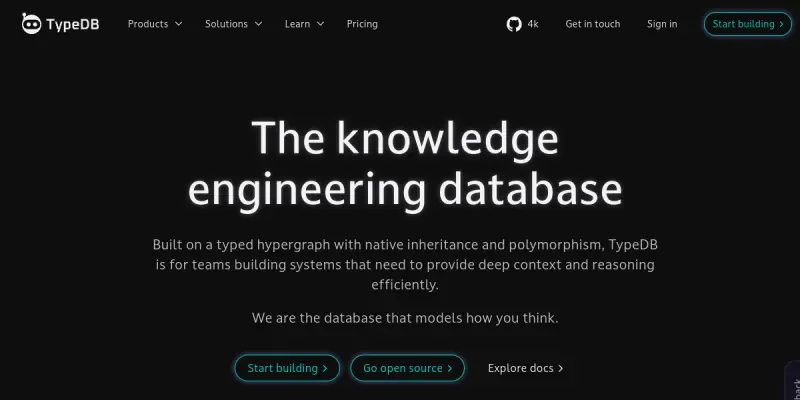
TypeDB AI is a knowledge engineering database designed to enforce business logic directly at the data layer. Unlike traditional relational or graph databases that rely on external application code for constraints and relationships, TypeDB AI embeds type theory and logical inference into the database engine. This approach reduces code duplication, improves data consistency, and enables developers to model complex domains with ease.
Key Features
- Type-Theoretic Data Modeling: Define rich, polymorphic data types and relationships using an intuitive schema language.
- Inference Engine: Automatically infer new facts and relationships based on defined rules and constraints.
- Polymorphic Queries: Write queries that automatically adapt to different subtypes without manual condition checks.
- Negation as Failure: Use safe negation to express complex logical conditions in queries.
- High Performance: Optimized for graph traversal and complex join operations while maintaining ACID transactions.
- Open Source Core: The core engine is available under the Apache 2.0 license, allowing self-hosting and customization.
Use Cases
Knowledge Graph Construction
TypeDB AI excels at building knowledge graphs where entities have multiple types and relationships evolve over time. Researchers and data engineers can model scientific data, medical ontologies, or enterprise knowledge bases with high fidelity.
Financial Compliance and Risk Analysis
Financial institutions can enforce complex regulatory rules directly in the database. TypeDB AI ensures that all transactions and entities comply with constraints without requiring separate rule-checking code.
Healthcare Data Integration
Healthcare systems often deal with polymorphic patient data (e.g., a person can be a patient, doctor, or both). TypeDB AI simplifies representing such overlapping roles and maintains consistency across the lifecycle.
Supply Chain Management
Supply chain networks involve many entity types (suppliers, warehouses, shipments) with complex interdependencies. TypeDB AI allows modeling these relationships naturally and querying them efficiently.
Pricing & Plans
TypeDB AI offers a freemium pricing model. The open-source core is free to use and self-host. TypeDB Cloud provides managed cloud tiers with additional features such as automated backups, monitoring, and support. Pricing details for enterprise plans are available upon request from Vaticle.
Integrations & Compatibility
TypeDB AI provides client libraries for Java, Python, Node.js, and Rust. It supports integration with popular data analysis tools and frameworks, and its protocol is built on gRPC, enabling custom clients. It can be deployed on-premises, in the cloud, or within containerized environments via Docker.
Who Is It For?
TypeDB AI is designed for developers, data architects, and system engineers who need to manage complex, interconnected data with strict logical constraints. It is particularly valuable for teams building knowledge graphs, compliance systems, and multi-typed entity models.
Limitations
- Learning Curve: The type-theoretic approach requires understanding concepts like polymorphism and inference, which may be unfamiliar to developers used to SQL or schema-less databases.
- Tooling Maturity: Compared to established databases, the ecosystem of third-party tools and community support is still developing.
- Performance on Simple Queries: For straightforward CRUD operations, traditional databases may still offer faster performance due to optimizations for flat tables.
Final Verdict
TypeDB AI represents a paradigm shift in how data logic is handled. By moving business rules into the database, it reduces application complexity and improves data integrity. While it may not replace every database, it is a powerful tool for domains where relationships are complex and rules change frequently. Its open-source core and freemium model make it accessible for teams to evaluate and adopt.
Tool Facts
Screenshots & Interface
Pros
- ✓ Enforces data logic at the database layer, reducing code duplication.
- ✓ Supports polymorphic data modeling, allowing entities to have multiple types.
- ✓ Built-in inference engine automatically derives new relationships from existing data.
- ✓ Open-source core provides full transparency and self-hosting capabilities.
- ✓ Client libraries available for Java, Python, Node.js, and Rust.
Cons
- × Steep learning curve for developers unfamiliar with type-theoretic data modeling.
- × Limited third-party tooling and community ecosystem compared to established databases.
- × Performance on simple queries may be slower than optimized traditional databases.
How to Use TypeDB AI in Your Workflow
Integrating TypeDB AI into your professional toolkit enhances efficiency by automating manual steps. By configuring it to suit your specific project requirements, you can optimize output quality and reduce project cycle times. Standard workflows involve testing the tool on simple tasks before scaling its use to complex operations.
Frequently Asked Questions
What is TypeDB AI used for?
TypeDB AI is a knowledge engineering database that enforces logic at the data layer, reducing code duplication. It is designed for developers and data architects who need to model complex relationships and ensure data integrity. Its key differentiator is its ability to handle polymorphic data and inference directly within the database.
What is the pricing model for TypeDB AI?
TypeDB AI uses a Freemium pricing model.
What are the main advantages of TypeDB AI?
The key benefits of TypeDB AI include: Enforces data logic at the database layer, reducing code duplication., Supports polymorphic data modeling, allowing entities to have multiple types., Built-in inference engine automatically derives new relationships from existing data., Open-source core provides full transparency and self-hosting capabilities., Client libraries available for Java, Python, Node.js, and Rust..
What are the main limitations of TypeDB AI?
Some limitations or cons of TypeDB AI are: Steep learning curve for developers unfamiliar with type-theoretic data modeling., Limited third-party tooling and community ecosystem compared to established databases., Performance on simple queries may be slower than optimized traditional databases..
Alternative AI Tools

Instana AI
IBM Instana is an AI-powered AIOps platform that provides full-stack observability. It automatically detects and resolves incidents using machine learning, replacing traditional monitoring tools.

BrowserStack AI
BrowserStack AI is a cloud-based testing platform that provides instant access to over 3000 real browsers and devices. It enables developers and QA teams to test websites and mobile apps for cross-browser compatibility and responsiveness. Its key differentiator is the combination of real device testing with AI-powered debugging and screenshot comparison.

Moogsoft
Moogsoft is an AIOps platform that helps IT operations teams monitor infrastructure health, detect anomalies, and reduce alert noise. It uses machine learning to correlate events and automate incident response for faster mean time to resolution.
Rating Details
Based on 0 ratings
Quick Comparisons
Related Tools
More AI tools from the same workflow, industry, or category.
AICode
AICode is a spec-driven AI coding copilot for developers using Visual Studio Code. It enforces a disciplined workflow to prevent AI-generated technical debt and ensures maintainable code. Its key differentiator is forcing line-by-line human review before changes are applied.
Opik
Opik is an open-source platform for LLM observability and evaluation. It helps developers trace, test, and monitor AI applications and autonomous agents throughout development and production.
PlanetScale AI
PlanetScale provides serverless cloud hosting for Vitess and PostgreSQL databases. It targets developers and engineering teams requiring high-performance, scalable database infrastructure. The platform enables instant scaling and branching workflows.
CodeReview AI
CodeReview AI is a tool that uses artificial intelligence to analyze code and suggest improvements. It helps developers identify bugs, security issues, and style inconsistencies automatically. The tool integrates with popular version control systems to fit into existing workflows.
Reviews
No reviews submitted yet. Be the first to share your experience.
Write a Review
Share Your Experience
Join the community to write reviews, submit ratings, and bookmark your favorite AI tools.