

Rootly AI
Use Rootly AI as the anchor for a real shortlist.
Instead of returning to a broad directory, jump straight into the strongest adjacent matchups for pricing, workflow fit, and differentiation.
Overview
Overview
Rootly AI is a specialized incident management platform built to accelerate the resolution of outages and performance incidents. Unlike generic chatbots, Rootly focuses specifically on the lifecycle of an incident, from initial detection to post-mortem analysis. It empowers engineering teams to adopt a modern, automated approach to Site Reliability Engineering (SRE).
Key Features
- Automated Incident Triage: Uses AI to analyze incoming alerts and route incidents to the correct on-call engineer based on predefined runbooks.
- AI-Generated Summaries: Automatically generates summaries of incidents and post-mortems, significantly reducing documentation time.
- On-Call Scheduling: Manages rotating on-call schedules to ensure the right personnel are notified during outages.
- Escalation Policies: Defines clear rules for escalating incidents to senior leadership or backup teams based on severity and duration.
- Communication Hub: Centralizes notifications from various monitoring tools into a single Slack or Microsoft Teams channel.
- Post-Mortem Templates: Provides structured, blameless templates for conducting post-mortems to drive process improvements.
Use Cases
SRE and DevOps Teams
SRE and DevOps teams use Rootly to standardize incident response processes. The platform helps automate the "detect, triage, and resolve" loop, reducing MTTR (Mean Time To Recovery) and ensuring consistency across different team members.
On-Call Management
For teams with rotating on-call schedules, Rootly simplifies the management of alerts. It ensures that engineers are only paged when necessary and have immediate access to runbooks and context required to resolve issues quickly.
Incident Post-Mortems
After an incident, teams use Rootly to document what happened. The AI-assisted post-mortem features help teams analyze the root cause and track action items without getting bogged down in administrative tasks.
Pricing & Plans
Rootly operates on a Freemium pricing model, allowing teams to start with basic features at no cost. Paid tiers typically unlock advanced features such as custom branding, advanced automation rules, and priority support. Enterprise plans are available for larger organizations requiring dedicated support and custom infrastructure integrations.
Integrations & Compatibility
Rootly integrates seamlessly with major communication platforms and monitoring tools. Key integrations include Slack, Microsoft Teams, PagerDuty, GitHub, Jira, and various monitoring solutions. This allows teams to receive alerts and manage incidents directly within their existing workflows.
Who Is It For?
Rootly is specifically designed for SRE (Site Reliability Engineering) teams, DevOps engineers, and on-call managers. It is ideal for fast-moving engineering teams that need to manage complex incident lifecycles and want to leverage AI to reduce manual work.
Limitations
- Requires initial configuration of runbooks and escalation policies to function effectively.
- The learning curve for setting up complex automation rules can be steep for smaller teams.
- Advanced AI features are primarily available in the paid subscription tiers.
Final Verdict
Rootly AI stands out as a robust solution for modern incident management. With a strong user satisfaction rating of 4.3/5 based on 3 reviews, it effectively bridges the gap between manual incident response and automated AI assistance. While the setup requires effort, the long-term benefits of streamlined workflows and reduced MTTR make it a valuable tool for SRE teams.
Tool Facts
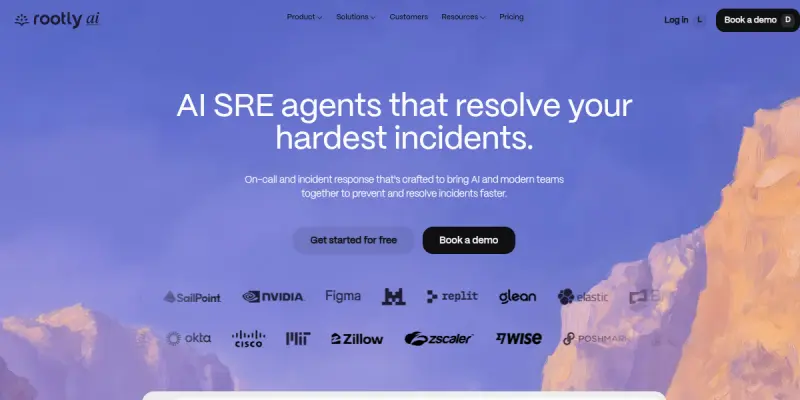
Screenshots & Interface
Pros
- ✓ Automates incident triage and routing based on runbooks
- ✓ Seamless integration with Slack and Teams for real-time communication
- ✓ AI-powered summaries simplify post-mortem documentation
Cons
- × Requires initial configuration of runbooks and escalation policies to function effectively
- × The learning curve for setting up complex automation rules can be steep
How to Use Rootly AI in Your Workflow
Integrating Rootly AI into your professional toolkit enhances efficiency by automating manual steps. By configuring it to suit your specific project requirements, you can optimize output quality and reduce project cycle times. Standard workflows involve testing the tool on simple tasks before scaling its use to complex operations.
Frequently Asked Questions
What is Rootly AI used for?
Rootly AI is an incident management platform for engineering teams that uses AI SRE agents to automate response and post-mortems. It helps teams detect, triage, and resolve incidents faster with integrated runbooks and communication tools.
What is the pricing model for Rootly AI?
Rootly AI uses a Freemium pricing model.
What are the main advantages of Rootly AI?
The key benefits of Rootly AI include: Automates incident triage and routing based on runbooks, Seamless integration with Slack and Teams for real-time communication, AI-powered summaries simplify post-mortem documentation.
What are the main limitations of Rootly AI?
Some limitations or cons of Rootly AI are: Requires initial configuration of runbooks and escalation policies to function effectively, The learning curve for setting up complex automation rules can be steep.
Alternative AI Tools

Appian AI
Appian AI combines artificial intelligence, low-code development, and process automation into a unified platform. It helps enterprises automate complex workflows and build intelligent applications. Its key differentiator is the seamless integration of AI with low-code for rapid deployment.

Dynatrace AI
Dynatrace AI is an observability and application security platform that uses AI to monitor, optimize, and secure cloud environments and applications. It helps DevOps and IT teams detect anomalies, automate responses, and improve system reliability through intelligent insights.

CodePal
CodePal is an AI-powered code assistant that helps developers write, review, and optimize code more efficiently. It offers a freemium model with a robust API for custom integrations. Suitable for both individual developers and teams.
Rating Details
Based on 0 ratings
Quick Comparisons
Related Tools
More AI tools from the same workflow, industry, or category.
AICode
AICode is a spec-driven AI coding copilot for developers using Visual Studio Code. It enforces a disciplined workflow to prevent AI-generated technical debt and ensures maintainable code. Its key differentiator is forcing line-by-line human review before changes are applied.
Opik
Opik is an open-source platform for LLM observability and evaluation. It helps developers trace, test, and monitor AI applications and autonomous agents throughout development and production.
PlanetScale AI
PlanetScale provides serverless cloud hosting for Vitess and PostgreSQL databases. It targets developers and engineering teams requiring high-performance, scalable database infrastructure. The platform enables instant scaling and branching workflows.
CodeReview AI
CodeReview AI is a tool that uses artificial intelligence to analyze code and suggest improvements. It helps developers identify bugs, security issues, and style inconsistencies automatically. The tool integrates with popular version control systems to fit into existing workflows.
Reviews
No reviews submitted yet. Be the first to share your experience.
Write a Review
Share Your Experience
Join the community to write reviews, submit ratings, and bookmark your favorite AI tools.