
Back to articles
Browse articles
Table of Contents Tap to expand
AI Productivity
Jul 12, 2026
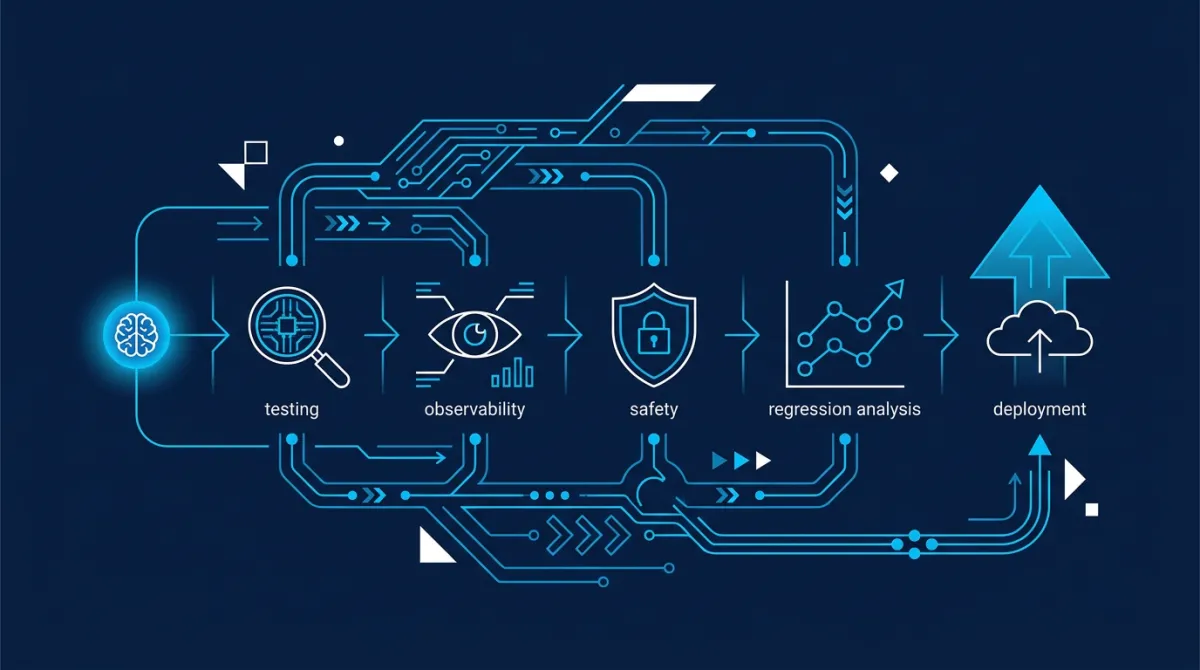
AI Agent Testing Tools 2026: A Practical Framework for Production Validation
D
Dave Dotio
Content Editor & AI Advocate
Quick Summary
ExtractableAI agents require a unique testing approach due to their probabilistic nature and potential for unexpected behavior. This guide provides a practical framework for evaluating AI agents before they reach production.
Category
AI Productivity
Published
Jul 12, 2026
Tags
None
Decision support
Compare this tool
Turn this guide into a shortlist decision.
TipJournal articles should lead back into product evaluation. Use the recommended compare pages or jump into a custom comparison from here.
Related Reading
More articles with the same topic or audience.
AI Productivity
•
Jul 28, 2026
AI Workload Scheduling: Building Cost-Aware LLM Pipelines for Production
The next competitive advantage in AI won't come from choosing a better model—it will come from using the right model at the right time. As inference costs continue to rise, engineering teams are beginning to treat AI workloads like cloud infrastructure: something to orchestrate, schedule, and optimize rather than simply execute. This guide explores how to build cost-aware AI pipelines that automatically route and schedule LLM workloads based on urgency, latency requirements, and pricing. Using emerging trends like DeepSeek V4's peak-valley API pricing as a catalyst, we'll show why AI workload scheduling is becoming a core architectural capability rather than an optimization reserved for hyperscalers.
AI Productivity
•
Jul 14, 2026
LLMO in Practice: A Practical Framework for AI Search Optimization
AI-powered search is changing how people discover information. Instead of scanning ten blue links, users increasingly receive synthesized answers generated from multiple sources. That shift creates a new optimization challenge: publishers must write content that language models can confidently retrieve, understand, and cite—not simply rank. This article introduces a practical framework for adapting editorial workflows to AI-native search experiences without abandoning proven SEO principles. Rather than chasing speculation or vendor-specific tactics, it focuses on durable content characteristics, technical trade-offs, and publishing practices that improve long-term discoverability while remaining resilient as search platforms evolve.
AI Productivity
•
Jul 13, 2026
AI Browser Automation Agents 2026: When They Beat Traditional Automation
Browser automation has traditionally meant brittle scripts, complex selectors, and endless maintenance. AI browser agents promise a different approach: understanding interfaces the way humans do and adapting when websites change. The question is whether that promise holds up in production. This guide examines where browser automation agents create genuine value, where conventional automation still wins, and how engineering teams should evaluate these tools before adopting them. Instead of comparing marketing claims, we'll focus on workflows, reliability, and operational tradeoffs.
AI Productivity
•
Jul 11, 2026
Best AI Coding Assistant 2026: How to Choose the Right One for Your Workflow
The era of AI coding assistants that simply autocomplete functions is over. Modern developer tools can understand entire repositories, plan multi-step changes, execute terminal commands, review pull requests, and even coordinate multiple coding tasks. Choosing the right assistant is no longer about benchmark scores—it's about matching capabilities to the way your team actually builds software. This guide compares today's leading approaches to AI-assisted development through a practitioner's lens. Instead of chasing feature checklists, we'll examine the workflows, tradeoffs, and decision criteria that matter when selecting the best AI coding assistant in 2026.
Discussion (0)
Please sign in with Google to join the conversation.
No discussions yet. Be the first to comment!