
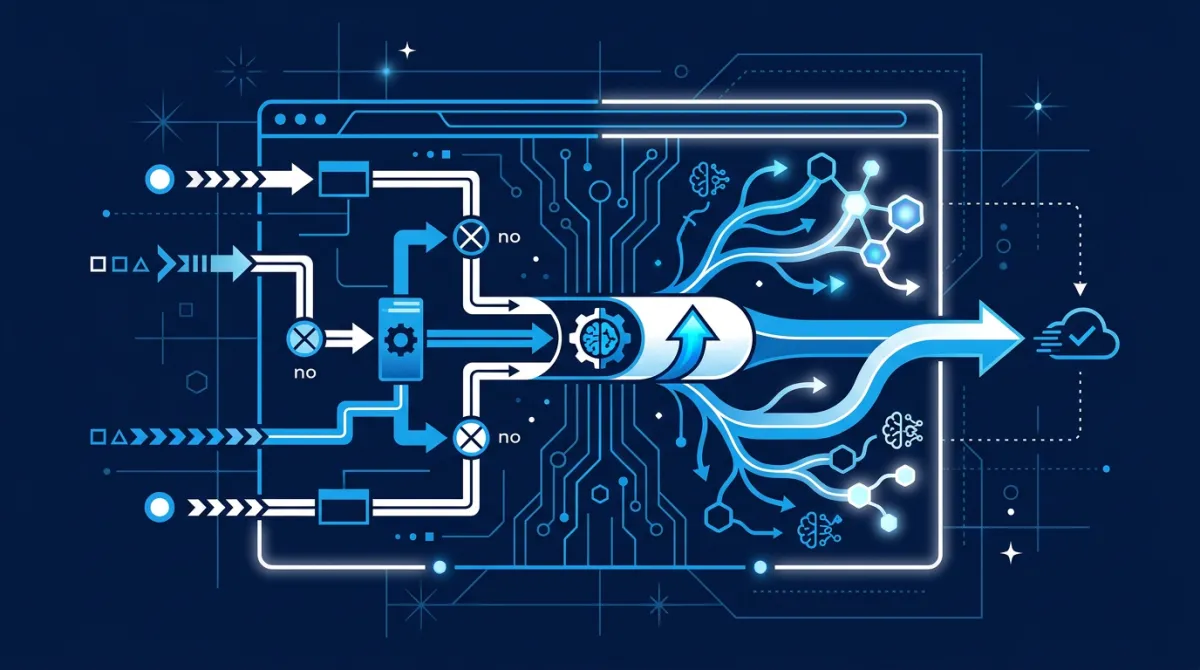
AI Browser Automation Agents 2026: When They Beat Traditional Automation
For years, browser automation has relied on deterministic scripts. Developers identified page elements, wrote selectors, and hoped websites wouldn't change before the next deployment.
That model is beginning to shift.
Modern browser agents combine large language models with browser control, allowing them to interpret interfaces, navigate unfamiliar websites, complete multi-step tasks, and recover from changes that would immediately break traditional automation.
The growing interest in AI browser automation agent 2026 reflects this shift. But replacing deterministic automation with autonomous agents isn't always the right decision. The real challenge is understanding which workflows benefit from AI reasoning and which remain better served by conventional automation.
This guide explores the practical tradeoffs that engineering teams should evaluate before introducing browser agents into production workflows.
Where AI Browser Automation Agent 2026 Delivers Real Value
The biggest advantage of browser agents isn't speed—it's adaptability.
Traditional automation platforms operate by following explicit instructions. If a button changes its identifier or a page layout shifts unexpectedly, the automation often fails until a developer updates the workflow.
Browser agents approach the problem differently.
Instead of depending exclusively on selectors, they interpret page structure, interface elements, and task objectives. That allows them to adapt to minor interface changes that would otherwise require manual maintenance.
Browser agents are particularly effective for workflows involving:
- repetitive research
- web-based data collection
- administrative tasks
- multi-step SaaS workflows
- customer support operations
- browser-based internal tools
In these situations, reducing maintenance effort can be more valuable than reducing execution time.
The greatest gains often come from automating workflows that previously resisted conventional scripting because interfaces changed too frequently.
Traditional Automation Still Wins More Often Than Marketing Suggests
Despite rapid advances, deterministic automation remains the better choice for many production systems.
Conventional browser automation frameworks provide:
- predictable execution
- reproducible results
- lower operational costs
- easier debugging
- mature testing ecosystems
- precise control
When workflows rarely change, AI reasoning may introduce unnecessary complexity.
Examples include:
- regression testing
- end-to-end application testing
- fixed administrative processes
- internal dashboards
- repetitive data entry
- scheduled reporting
These tasks benefit from deterministic execution rather than adaptive decision-making.
Engineering teams should avoid replacing reliable automation simply because AI agents appear more sophisticated.
Autonomy creates value only when adaptability solves a real operational problem.
Choosing Between Browser Agents and Automation Frameworks
Rather than asking which technology is "better," evaluate them according to workflow characteristics.
High interface volatility
Browser agents usually perform better when websites frequently change layouts or navigation.
Stable enterprise applications
Traditional automation often delivers greater reliability and lower maintenance.
Human-like interaction
Browser agents excel when workflows require interpreting instructions, making navigation decisions, or adapting to unexpected states.
Precision-driven execution
Deterministic frameworks remain superior when every action must be reproducible and auditable.
Maintenance burden
Organizations supporting dozens of frequently changing workflows may reduce long-term maintenance costs through AI-driven adaptability.
The decision should be based on operational requirements rather than technology trends.
What to Evaluate Before Deploying Browser Agents
Selecting a browser automation platform requires more than comparing supported features.
Engineering teams should evaluate several practical dimensions.
Reliability
Can the agent consistently complete representative workflows?
Recovery
How well does it respond when pages fail to load or expected elements disappear?
Observability
Can developers inspect every action taken by the agent?
Security
How are credentials, cookies, and sensitive user data handled?
Governance
Can organizations restrict which websites or actions agents may access?
Cost
Does adaptive automation reduce maintenance enough to justify increased inference costs?
A structured pilot using real production workflows will provide significantly more insight than feature comparisons or benchmark demonstrations.
Browser Agents Are Not Fully Autonomous Employees
Marketing narratives often portray browser agents as capable of replacing entire operational teams.
That expectation is unrealistic.
Current systems still encounter challenges such as:
- ambiguous instructions
- unexpected interface redesigns
- authentication failures
- CAPTCHA systems
- permission errors
- inconsistent reasoning
- external service outages
Human oversight remains essential for workflows involving financial transactions, customer communications, compliance, or sensitive business operations.
Rather than replacing employees, browser agents should be viewed as productivity multipliers that automate repetitive browser interactions while leaving judgment and accountability to humans.
Organizations adopting this mindset generally achieve better long-term outcomes than those pursuing full autonomy.
Final Recommendation
Adopting an AI browser automation agent 2026 should begin with workflow analysis, not technology enthusiasm.
If your automation frequently breaks because websites change, interfaces evolve, or workflows require contextual decision-making, browser agents can significantly reduce maintenance while expanding what can be automated.
However, deterministic automation remains the better choice for stable, repeatable, high-volume processes where predictability, auditability, and cost efficiency matter most.
The strongest automation strategies increasingly combine both approaches: conventional frameworks for structured workflows and AI browser agents for dynamic, human-like interactions. Teams that evaluate each workflow on its own merits—not on industry hype—will build automation systems that are both resilient and maintainable.