
AI Workload Scheduling: Building Cost-Aware LLM Pipelines for Production
Most AI applications still make the same architectural mistake.
Every request is treated as equally urgent.
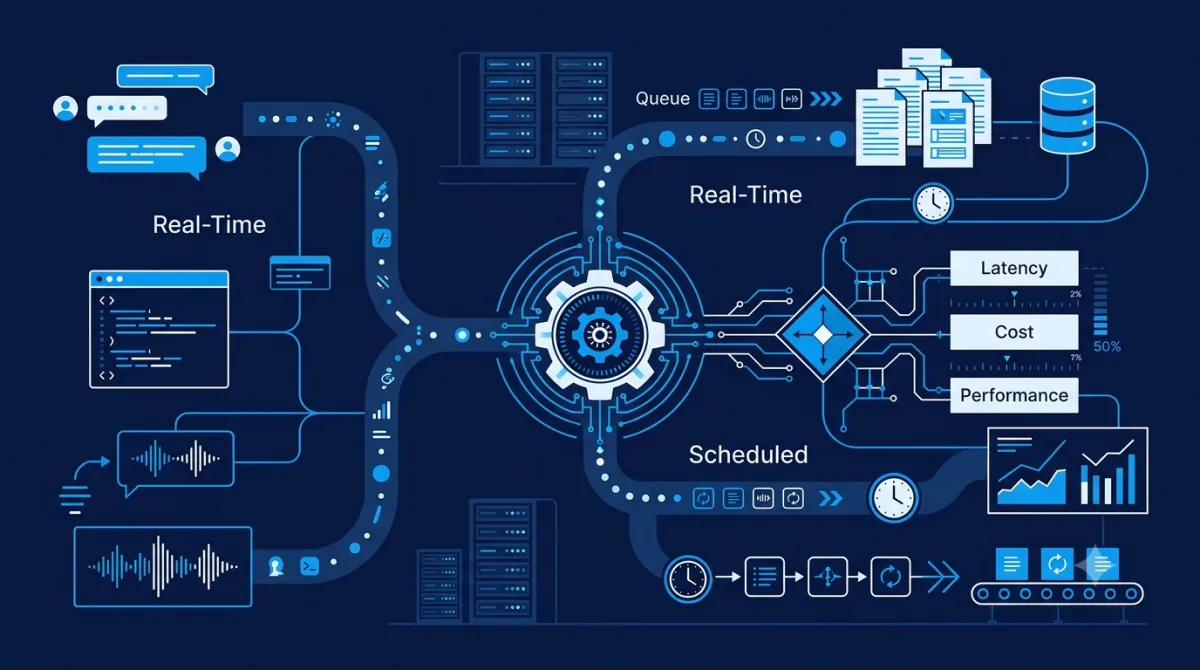
A chatbot reply, a nightly document classification job, an embedding pipeline, and a weekly analytics report are often sent through the same execution path—even though their latency requirements differ dramatically.
That approach was acceptable when AI adoption was small. At production scale, it becomes expensive.
As organizations move from prototypes to millions of API calls, infrastructure strategy matters just as much as model selection. The next generation of AI systems won't simply choose the best model—they'll decide when, where, and how each workload should execute.
The Problem: Not Every AI Request Needs an Instant Response
AI systems generally process requests in one of two ways:
Interactive workloads
These require immediate responses:
- AI chatbots
- coding assistants
- customer support
- voice agents
- search assistants
Latency directly affects user experience.
Asynchronous workloads
These can tolerate delays:
- document indexing
- embedding generation
- report creation
- content moderation
- large-scale summarization
- dataset labeling
- evaluation pipelines
Yet many organizations process both categories identically.
This leads to unnecessary infrastructure costs because resources are allocated for peak responsiveness even when the work could wait.
The first step toward cost-aware AI architecture is classifying workloads based on business urgency rather than technical simplicity.
AI Workload Scheduling Is More Than a Cost Optimization
Cloud computing solved a similar problem years ago.
Batch jobs run overnight.
Autoscaling responds to demand.
Reserved instances reduce long-term costs.
Priority queues protect critical services.
AI infrastructure is beginning to follow the same path.
Instead of immediately sending every request to the same model, orchestration layers can evaluate multiple factors:
- request priority
- acceptable latency
- model capability
- inference cost
- system utilization
- business impact
The result is an execution plan rather than a direct API call.
This architectural shift separates modern AI platforms from experimental prototypes.
A Practical Architecture for Cost-Aware LLM Pipelines
A production-ready scheduling system typically consists of four layers.
1. Workload Classification
Every incoming request should be tagged before execution.
For example:
Critical
Customer conversations, production support, authentication.
High
Developer copilots, executive reporting.
Medium
Internal search, documentation updates.
Low
Embedding generation, data enrichment, batch summarization.
This simple classification enables downstream optimization.
2. Intelligent Routing
Rather than hardcoding one model, the scheduler evaluates:
- response time requirements
- token limits
- expected complexity
- pricing
- availability
Different requests may be routed to different models without users noticing.
3. Queue Management
Instead of processing everything immediately, background tasks enter scheduled queues.
Examples include:
- nightly indexing
- weekly analytics
- large document processing
- evaluation benchmarks
This prevents expensive workloads from competing with customer-facing applications.
4. Continuous Monitoring
Scheduling decisions should be measured continuously.
Track metrics such as:
- average latency
- queue wait time
- inference cost
- token consumption
- completion success rate
- SLA compliance
Without measurement, optimization becomes guesswork.
Why DeepSeek V4 Signals a Broader Industry Shift
One reason DeepSeek V4 deserves attention is not simply its model capabilities.
According to TipJournal's Trend Intelligence Feed, the platform introduces a peak-valley API pricing structure that varies costs based on demand periods. While the exact pricing model should always be verified against official documentation before implementation, the broader implication is significant.
Pricing is becoming dynamic.
That changes how AI architects think about infrastructure.
Instead of optimizing only for latency and quality, scheduling systems may soon evaluate pricing conditions as another execution variable.
Today this concept appears in a single platform.
Tomorrow it could become common across the AI ecosystem.
The lesson is larger than any individual vendor: infrastructure-aware orchestration is becoming a competitive advantage.
Common Mistakes When Designing AI Pipelines
Many teams optimize too early—or optimize the wrong thing.
Three mistakes appear repeatedly.
Treating Every Request Equally
Not every task deserves premium infrastructure.
Categorizing workloads often delivers immediate savings without affecting users.
Optimizing for One Model
Production systems should optimize for outcomes, not vendor loyalty.
Architecture should make model replacement straightforward.
Ignoring Observability
Without detailed telemetry, teams cannot determine whether scheduling policies improve cost or degrade user experience.
Visibility is a prerequisite for optimization.
The Future of AI Infrastructure Is Policy-Driven
The next generation of AI platforms will likely resemble cloud orchestration systems more than traditional API integrations.
Instead of developers deciding where every request goes, organizations will define policies such as:
- customer-facing requests must respond within two seconds
- overnight batch jobs should prioritize lower-cost execution
- premium users receive higher-priority inference
- evaluation workloads pause during traffic spikes
The scheduler—not the application—will determine the optimal execution path.
This evolution moves AI architecture from static integrations toward adaptive infrastructure.
Final Thoughts
Choosing the right language model remains important, but it is no longer sufficient for production AI systems.
As inference demand grows, organizations need architectures that balance latency, capability, reliability, and cost automatically. Cost-aware scheduling enables engineering teams to make those tradeoffs systematically instead of treating every request as identical.
This guide to AI workload scheduling highlights an emerging pattern that extends beyond any single provider. DeepSeek V4's pricing model illustrates the direction of travel, but the larger opportunity is building orchestration layers that can adapt as pricing, models, and workloads evolve. The teams that master workload scheduling today will be better positioned to operate efficient, resilient AI platforms tomorrow.