
AI Control Plane Explained: The Missing Layer Between Models and Applications
Most organizations don't have an AI problem.
They have an AI coordination problem.
One team uses GPT for customer support.
Another deploys open-source models for internal search.
Developers build coding assistants.
Marketing experiments with image generation.
Security introduces governance policies.
Operations tracks AI costs.
Each initiative succeeds independently.
Together, they create an ecosystem that's increasingly difficult to manage.
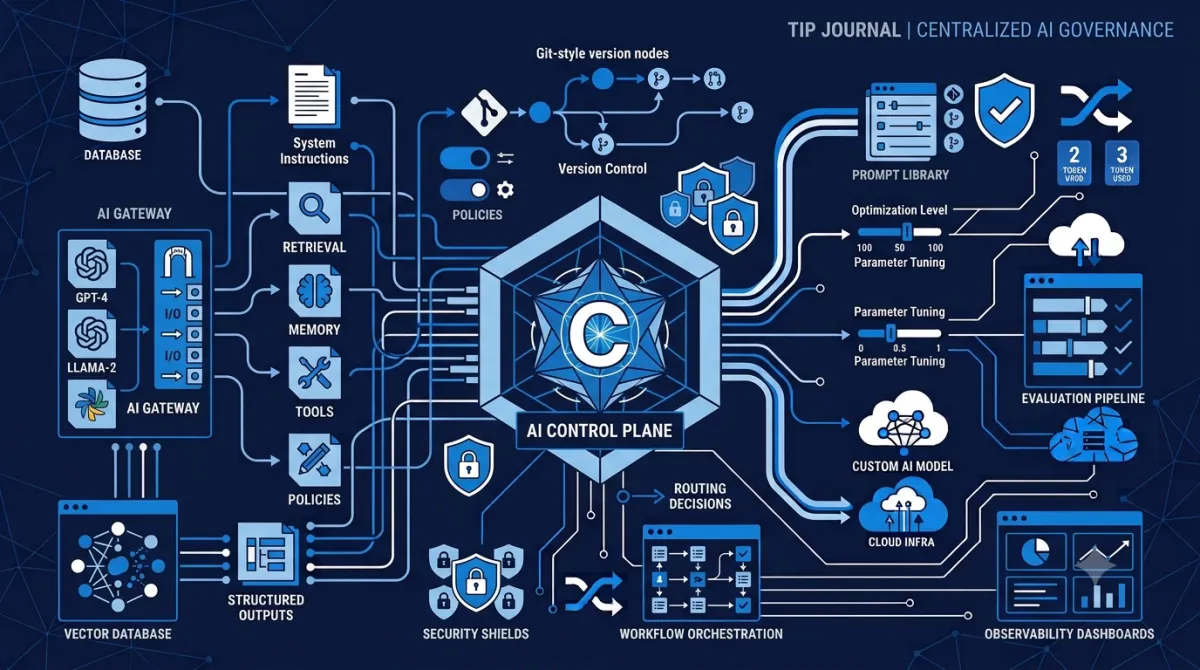
As AI adoption expands across the enterprise, companies need something beyond individual models and APIs. They need a centralized layer that coordinates the entire AI platform.
That layer is increasingly described as the AI Control Plane.
Enterprise AI Has Become a Distributed System
The first generation of AI applications was relatively simple.
One application.
One model.
One API key.
Today's architecture is very different.
A production AI platform often includes:
- multiple LLM providers
- embedding models
- vector databases
- retrieval pipelines
- prompt libraries
- evaluation systems
- AI gateways
- observability platforms
- security controls
- workflow automation
- AI agents
Each component introduces its own configuration, monitoring, permissions, and operational requirements.
Without coordination, complexity grows exponentially.
Organizations spend more time managing AI infrastructure than improving AI capabilities.
What Is an AI Control Plane?
An AI Control Plane is the centralized management layer responsible for governing how AI services operate across an organization.
Unlike application code—which focuses on business logic—the control plane manages platform-wide policies and operational decisions.
Instead of applications deciding everything independently, they rely on shared infrastructure to answer questions such as:
- Which models are approved?
- Which prompts are currently deployed?
- Which provider should handle this request?
- Which users may access premium models?
- Which workloads require evaluation?
- Which policies apply to regulated data?
- How should costs be allocated?
The control plane provides consistent answers across every AI application.
AI Control Plane vs. AI Gateway
These terms are sometimes used interchangeably, but they solve different problems.
AI Gateway
An AI Gateway primarily manages runtime traffic.
Typical responsibilities include:
- request routing
- authentication
- rate limiting
- provider abstraction
- logging
- failover
Its focus is operational execution.
AI Control Plane
An AI Control Plane manages platform governance.
Typical responsibilities include:
- model registry
- prompt management
- evaluation policies
- deployment approvals
- security rules
- cost governance
- usage analytics
- organizational standards
The gateway processes requests.
The control plane defines how those requests should be processed.
One operates in the data path.
The other defines the rules governing that path.
The Five Pillars of an AI Control Plane
1. Model Governance
Organizations increasingly use multiple AI providers.
A control plane maintains a centralized registry showing:
- approved models
- deprecated versions
- capability metadata
- pricing
- regional availability
Applications no longer need to hardcode provider information.
2. Prompt Lifecycle Management
Prompts become managed assets.
The platform handles:
- version history
- approvals
- rollback
- testing
- environment promotion
This mirrors modern software deployment practices.
3. Evaluation and Quality Assurance
Production AI requires continuous validation.
The control plane can automatically evaluate new prompts and models against benchmark datasets before deployment.
Instead of asking whether a model is newer, teams ask whether it performs better for their workloads.
4. Security and Policy Enforcement
Every enterprise has rules.
Some data cannot leave specific regions.
Some users cannot access premium models.
Certain prompts require human approval.
The control plane enforces these policies consistently across applications.
5. Cost and Resource Management
AI budgets are becoming infrastructure budgets.
A control plane enables organizations to monitor:
- token consumption
- departmental spending
- provider usage
- workload allocation
- model utilization
This creates financial visibility without requiring every team to build its own reporting tools.
Why AI Control Planes Will Become Standard Infrastructure
The evolution mirrors previous waves of enterprise software.
Cloud platforms introduced centralized infrastructure management.
Kubernetes introduced container orchestration.
API gateways standardized service communication.
Platform engineering centralized developer tooling.
AI is now entering a similar phase.
As organizations adopt dozens of AI services, decentralized management becomes unsustainable.
Instead of treating every application as a separate AI project, companies are beginning to manage AI as a shared organizational capability.
The control plane becomes the operational foundation supporting that transition.
Common Mistakes When Scaling Enterprise AI
Organizations often delay platform thinking until AI adoption is already widespread.
Three mistakes appear repeatedly.
Building Independent AI Silos
Every department creates its own prompts, integrations, and governance processes.
Knowledge becomes fragmented.
Operational costs increase.
Optimizing Individual Models Instead of the Platform
Choosing the best model matters less than ensuring consistent governance, monitoring, and deployment practices across all models.
Ignoring Operational Maturity
Many AI initiatives prioritize rapid experimentation while postponing lifecycle management.
Eventually, every successful AI project requires versioning, observability, security, evaluations, and policy enforcement.
Planning for these capabilities early reduces future migration costs.
The Future Is Platform Engineering for AI
Enterprise AI is becoming less about individual applications and more about shared infrastructure.
Over the next several years, organizations are likely to adopt centralized AI platforms where developers consume AI services through standardized internal interfaces rather than integrating directly with providers.
In this model:
- gateways handle traffic
- MCP standardizes tool connectivity
- observability monitors production
- evaluation systems measure quality
- workload schedulers optimize execution
- the AI Control Plane coordinates everything
This architecture enables flexibility without sacrificing governance.
Final Thoughts
The AI Control Plane represents the next stage in enterprise AI maturity. It shifts the focus from managing individual models to managing an entire AI ecosystem.
Organizations that invest in centralized governance, evaluation, security, and lifecycle management will be better positioned to adopt new models, control costs, and maintain operational consistency as AI systems grow in complexity.
Rather than becoming another tool in the stack, the AI control plane is emerging as the layer that connects—and governs—the entire stack. As enterprise AI evolves from experimentation to critical infrastructure, that coordination layer may become just as important as the models themselves.