
AI Gateway Explained: Why Every Company Needs One Before Scaling AI
The first AI application is easy.
The tenth is manageable.
The hundredth becomes an operational problem.
Many organizations begin by integrating a single LLM API into one application. Over time, new teams build their own AI features, each selecting different models, SDKs, authentication methods, prompt libraries, and monitoring tools. What starts as experimentation gradually evolves into a fragmented AI ecosystem that is expensive to operate and difficult to govern.
This is where the AI Gateway enters the picture.
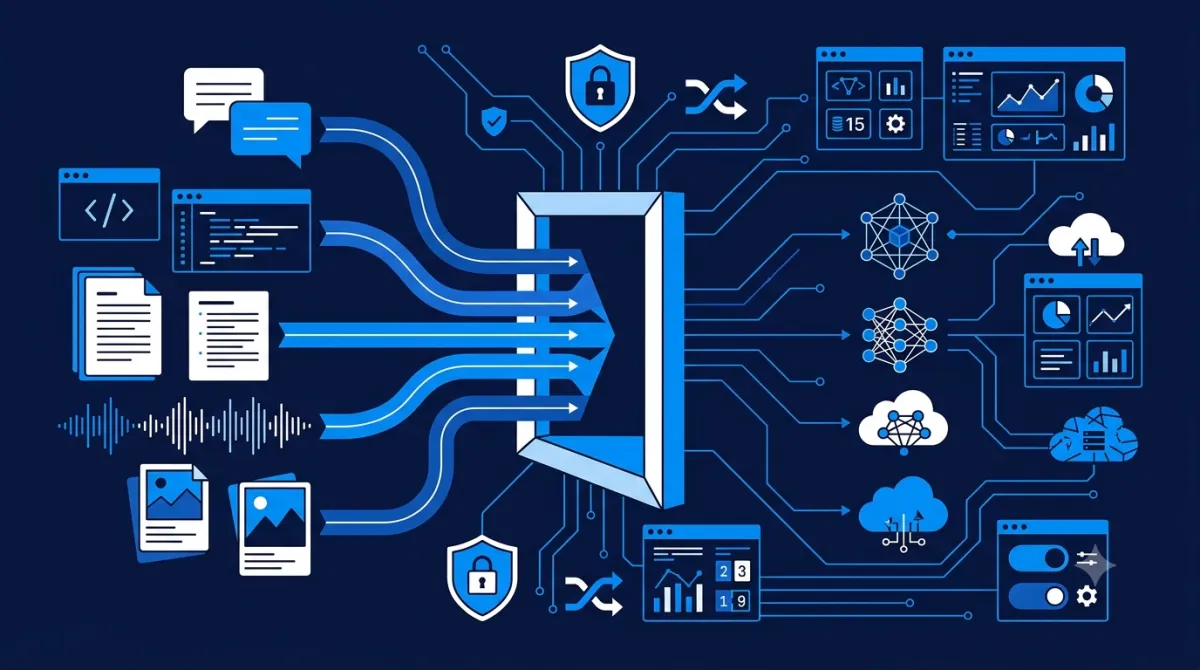
An AI Gateway is not another language model. It is an infrastructure layer that sits between your applications and AI providers, providing a unified interface for routing requests, enforcing security policies, monitoring usage, controlling costs, and simplifying model management.
As enterprises adopt multiple AI providers simultaneously, AI gateways are becoming as essential as API gateways became during the microservices era.
Why Direct Model Integrations Don't Scale
Connecting directly to an LLM API is straightforward for a single application.
Scaling that approach across dozens of services introduces operational complexity.
Consider a typical enterprise environment:
- Customer support uses one model.
- Developers rely on another coding model.
- Marketing experiments with image generation.
- Data teams generate embeddings.
- Internal assistants query private knowledge bases.
Without a centralized layer, each team independently manages:
- API authentication
- model selection
- retry logic
- rate limiting
- cost tracking
- logging
- prompt versioning
- security controls
The result is duplicated effort, inconsistent governance, and limited visibility into how AI resources are being used.
The problem is no longer model access—it's infrastructure management.
What an AI Gateway Actually Does
An AI Gateway functions as a centralized entry point for every AI request within an organization.
Instead of applications communicating directly with multiple providers, they communicate with the gateway.
The gateway then handles responsibilities such as:
Intelligent Model Routing
Requests can be directed to different models based on:
- workload type
- latency requirements
- pricing
- model capabilities
- geographic availability
Applications remain unchanged even if the underlying provider changes.
Authentication and Security
Rather than distributing provider API keys across multiple services, credentials are managed centrally.
This reduces operational risk while simplifying key rotation and access control.
Observability
Every request can be logged consistently.
Engineering teams gain visibility into:
- token usage
- latency
- failure rates
- model utilization
- response times
- cost trends
Without centralized telemetry, optimization becomes difficult.
Policy Enforcement
Organizations can define rules such as:
- approved models only
- maximum token limits
- department spending caps
- restricted prompts
- geographic routing requirements
This enables governance without slowing development.
The Business Benefits Extend Beyond Engineering
Although AI gateways are an infrastructure component, their impact reaches beyond engineering teams.
Lower Operational Costs
Centralized routing enables organizations to direct simple tasks toward lower-cost models while reserving premium models for more demanding workloads.
Faster Provider Adoption
When applications depend on the gateway rather than individual vendors, switching or adding providers becomes significantly easier.
This reduces vendor lock-in and encourages experimentation.
Stronger Governance
Security teams gain a single location to enforce compliance, audit usage, and monitor sensitive AI interactions.
Better Developer Experience
Application teams integrate once with the gateway rather than learning the unique APIs of multiple providers.
This simplifies development while improving consistency.
Choosing an AI Gateway: Five Questions to Ask
Not every gateway solves the same problems.
Before adopting one, engineering leaders should evaluate the platform against five practical questions.
1. Can It Support Multiple Providers?
Avoid architectures tied to a single model vendor.
A gateway should abstract provider-specific APIs while allowing teams to adopt new models as they emerge.
2. Does It Provide Deep Observability?
Basic request logs aren't enough.
Look for dashboards covering:
- latency
- token consumption
- model performance
- error rates
- cost allocation
These metrics are essential for operating AI at scale.
3. Are Governance Policies Flexible?
Large organizations often require different rules for different business units.
The gateway should support granular policy management without requiring application changes.
4. How Easy Is Integration?
Developer adoption depends on simplicity.
The best gateways minimize changes required in existing applications and provide mature SDKs, documentation, and APIs.
5. Can It Scale Operationally?
Consider:
- throughput
- high availability
- failover mechanisms
- regional deployment
- monitoring integrations
Infrastructure that performs well in testing may behave differently under production traffic.
AI Gateways Will Become the Control Plane for Enterprise AI
The evolution mirrors what happened with cloud computing.
Early applications communicated directly with databases.
Eventually, API gateways centralized authentication, routing, rate limiting, and observability.
AI infrastructure is following a similar trajectory.
Organizations increasingly use multiple language models, embedding services, image generators, and speech systems simultaneously.
Managing those services independently becomes unsustainable.
The AI gateway provides a unified control plane that separates applications from providers, enabling greater flexibility, stronger governance, and improved operational efficiency.
As enterprise AI matures, this architectural layer is likely to become a standard component rather than an optional enhancement.
Final Thoughts
The conversation around enterprise AI often focuses on choosing the best language model. In practice, long-term success depends just as much on the infrastructure surrounding those models.
An AI Gateway enables organizations to standardize access, improve observability, enforce governance, and reduce operational complexity without constraining developer productivity.
For companies moving beyond isolated AI experiments, investing in a centralized gateway is less about adopting another tool and more about establishing the foundation required to scale AI responsibly. The organizations that treat AI as infrastructure—not just a collection of APIs—will be better prepared as the AI ecosystem continues to evolve.