
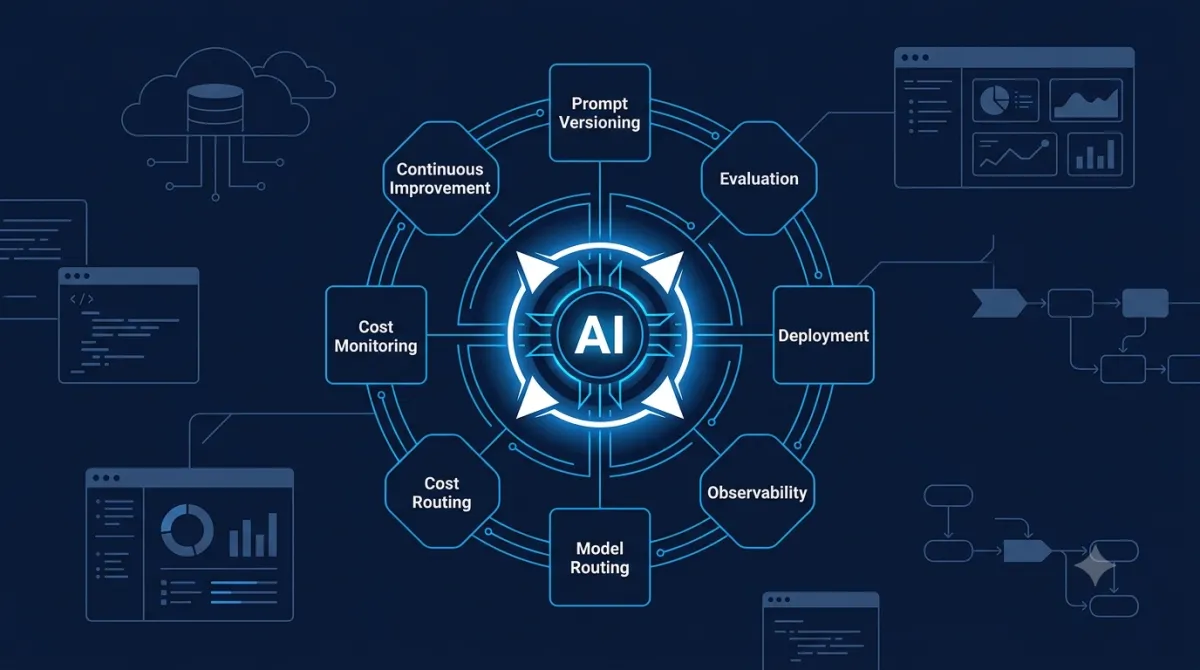
LLMOps Explained: The Operational Framework Behind Production AI
The hardest part of building an AI application isn't writing the first prompt.
It's operating the thousandth request.
Early AI projects often succeed because they're small. One model, one prompt, one developer, and a handful of users.
Production changes everything.
Prompts evolve.
Models are updated.
Providers introduce new APIs.
Costs fluctuate.
Users discover edge cases.
Without operational discipline, today's successful AI application can become tomorrow's maintenance burden.
That's why engineering teams are increasingly adopting LLMOps—the practices, tooling, and workflows that keep large language model applications reliable after they leave the prototype stage.
What Is LLMOps?
LLMOps (Large Language Model Operations) is the discipline of managing the lifecycle of LLM-powered applications in production.
It combines practices from:
- DevOps
- MLOps
- Platform Engineering
- Site Reliability Engineering (SRE)
Its objective is straightforward:
Deliver AI applications that remain reliable, observable, secure, and cost-effective as they evolve.
LLMOps focuses less on training models and more on operating applications built with them.
Why MLOps Isn't Enough
MLOps emerged to solve challenges around training, deploying, and monitoring machine learning models.
LLM-powered applications introduce additional operational concerns.
Instead of managing datasets and model weights alone, teams must also manage:
- prompts
- retrieval pipelines
- AI agents
- tool integrations
- conversation memory
- structured outputs
- provider routing
- token usage
- model versions
The operational surface is much larger.
Many organizations discover that existing MLOps workflows don't fully address these challenges.
The Core Pillars of LLMOps
Successful LLMOps platforms combine several operational capabilities.
Prompt Management
Prompts are production assets.
Engineering teams increasingly:
- version prompts
- review changes
- test updates
- promote prompts across environments
- roll back failed deployments
Managing prompts like source code reduces risk and improves collaboration.
Model Management
Organizations rarely rely on one provider.
LLMOps platforms help teams:
- compare models
- route workloads
- manage versions
- monitor provider performance
- migrate between vendors
Applications become less dependent on individual model APIs.
Evaluation Pipelines
Benchmark scores rarely predict production quality.
Instead, organizations continuously evaluate applications against representative workloads.
Typical evaluation metrics include:
- task success
- factual accuracy
- hallucination rate
- tool execution quality
- user satisfaction
- response consistency
Evaluation becomes part of every deployment cycle.
Observability
Traditional application monitoring isn't sufficient for AI.
Teams need visibility into:
- prompts
- model versions
- retrieval quality
- tool usage
- latency
- token consumption
- costs
- reasoning failures
Without observability, debugging AI systems becomes significantly harder.
Governance and Security
Enterprise AI requires consistent controls.
LLMOps platforms enforce:
- approved models
- access permissions
- data handling policies
- audit logs
- compliance requirements
- prompt validation
Governance becomes a shared platform capability rather than an application-specific responsibility.
A Typical LLMOps Workflow
A production deployment often follows a lifecycle like this:
- Update a prompt or workflow.
- Run automated evaluations.
- Compare results against previous versions.
- Deploy to staging.
- Monitor production metrics.
- Detect regressions.
- Roll back if quality declines.
This process mirrors mature software deployment practices.
The difference is that AI quality must also be measured continuously.
Common Mistakes Teams Make
Organizations often underestimate the operational complexity of AI.
Three patterns appear repeatedly.
Treating Prompts as Static Text
Prompts evolve just like application code.
Without version control and testing, changes become difficult to track.
Ignoring Cost Until Production
A workflow that performs well technically may become financially unsustainable under real traffic.
Cost monitoring should be integrated from the beginning.
Measuring Only Model Performance
A language model can perform well while the overall application performs poorly because retrieval, tool execution, or workflow logic fails.
LLMOps evaluates the entire system—not just the model.
LLMOps Is More Than Tooling
It's tempting to think of LLMOps as a collection of platforms.
In reality, it's an engineering mindset.
Tools support practices such as:
- continuous evaluation
- controlled deployments
- operational monitoring
- incident response
- governance
- documentation
- collaboration
Buying a platform doesn't automatically create mature operations.
Processes matter just as much as software.
The Future of LLMOps
As AI systems become more autonomous and more deeply integrated into business operations, LLMOps is likely to evolve beyond prompt and model management.
Future platforms may coordinate:
- AI gateways
- control planes
- evaluation services
- observability systems
- policy engines
- memory platforms
- agent orchestration
- workload scheduling
Rather than managing isolated AI applications, organizations will manage entire AI ecosystems through unified operational platforms.
LLMOps is becoming the bridge between experimentation and enterprise-scale reliability.
Final Thoughts
The success of production AI depends on much more than selecting the best language model. It requires operational discipline across prompts, evaluations, observability, governance, deployments, and cost management.
LLMOps provides the framework for treating AI applications as living systems that evolve continuously after launch. By adopting practices such as prompt versioning, automated evaluations, centralized monitoring, and structured deployment workflows, engineering teams can improve reliability while reducing operational risk.
As enterprise AI matures, the distinction between companies that experiment with AI and those that build dependable AI platforms will increasingly come down to one capability: operational excellence. LLMOps is how that excellence is achieved.