
The Fragmentation of Creative AI: Why Multi-Model Hubs Are Replacing Single-Tool Workflows in 2026
Two years ago, designing an AI-driven creative pipeline was straightforward. The market was a straightforward race with a few dominant players, and choice boiled down to an ecosystem commitment: you were either a Midjourney house, an OpenAI team, or a niche indie dev experimenting on the fringes. Each platform possessed a distinct structural signature, and creators adapted their workflows around those specific quirks.
In 2026, that consolidated paradigm is officially dead.
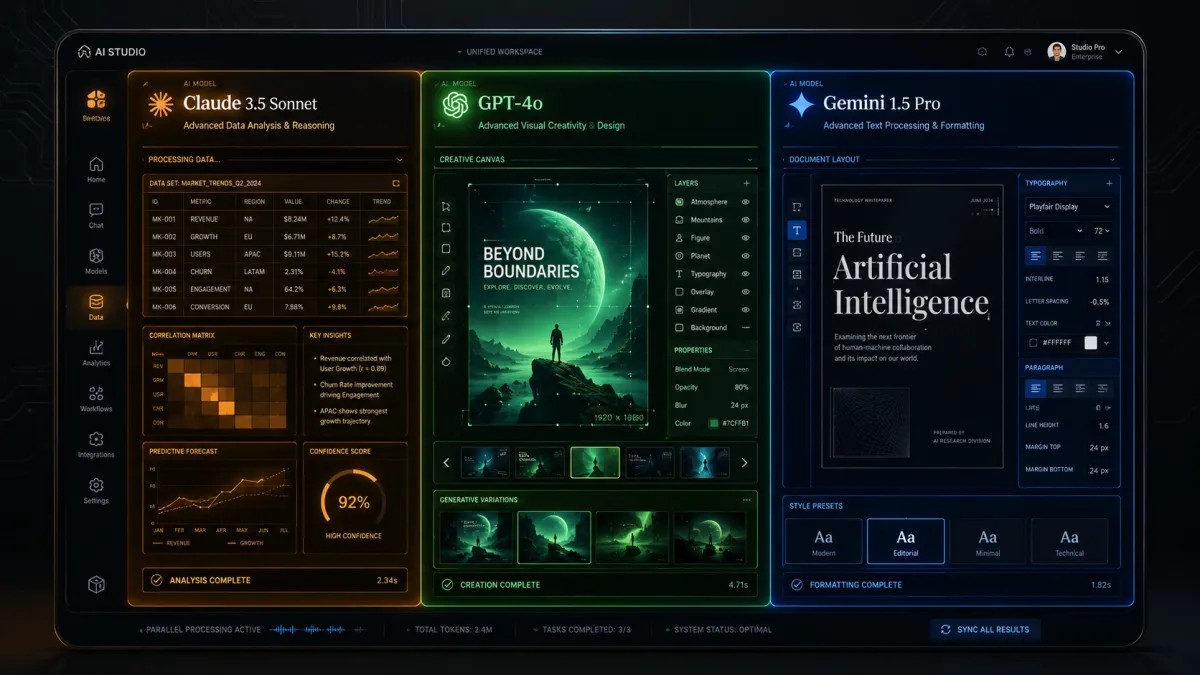
The market for generative assets has fractured into a deeply specialized ecosystem. The sheer volume of competitive, specialized models has roughly tripled over the past twenty-four months, creating an unprecedented wave of fragmentation. Today, the strategy isn't about finding the single "best" platform; it's about realizing that one size fits absolutely no one. As a result, forward-thinking creative directors and enterprise engineering teams are abandoning single-tool loyalty altogether, shifting to unified multi-model hubs that aggregate dozens of distinct engines under a single interface.
The Specialization Explosion: How Models Actually Differ Now
The legacy assumption that all foundational creative engines produce roughly equivalent output—differing only in subscription costs or generation speeds—has been thoroughly debunked by real-world production environments. Modern architectures have diverged across highly specific performance vectors, making model selection a critical architectural choice.
- Photorealism vs. Complex Composition: Open-weights architectures like Flux.1 (and its specialized fine-tunes) have captured the market for flawless, ultra-realistic textures, skin grain, and complex hand anatomy. Conversely, frontier closed models like DALL-E 3 remain the gold standard for dense, multi-subject scene composition and complex spatial prompt fidelity, keeping text rendering legible within complex layouts.
- Speed vs. Precision Trade-offs: Distilled, lightning-fast models like SD3 Medium or specialized Turbo and Lightning variants are optimized purely for rapid iteration. For rapid concept generation—where an art director needs twenty structural variations in seconds before greenlighting a project—these high-velocity systems compound efficiency gains exponentially.
- The Rise of Long-Tail Experts: We are seeing an explosion of hyper-focused models that do not aim for general knowledge. Instead, they are meticulously fine-tuned for granular design verticals: architectural rendering, industrial fashion photography, medical illustration, or specific vector line art patterns.
The Single-Tool Bottleneck: Creative Compromise and Vendor Lock-In
Relying on a single creative application has evolved from a safe default into a severe operational bottleneck. When an enterprise restricts its team to a lone interface, it forces creators into a cycle of continuous creative compromise.
The structural differences between these workflows illustrate the inherent limitations of legacy setups:
| Workflow Dimension | Legacy Single-Tool Pipeline | Modern Multi-Model Hub Pipeline |
|---|---|---|
| Initial Input | Monolithic Prompt | Unified System Prompt + Intent Parsing |
| Orchestration Layer | Direct Manual Execution | Intelligent Semantic Routing Layer |
| Execution Engine | Single General-Purpose Model | Chain of Highly Specialized Models |
| Post-Processing | Heavy Manual Masking / Fixing | Automated Multi-Model Compositing |
| Final Output | Compromised Asset | Premium, Production-Ready Asset |
If a project requires hyper-realistic environmental design alongside intricate typographic text placement, a single general-purpose model will inevitably drop the ball on one or both requirements. Creators are left spending hours manually masking, fixing text glitches, or heavily touching up assets in external editing suites like Photoshop.
Furthermore, single-tool setups breed severe vendor lock-in. When a disruptive new model launches on the open-source market, an organization shackled to a closed ecosystem cannot adopt it without completely rewriting its internal training documentation, establishing new procurement pipelines, and forcing staff to jump between conflicting browser windows.
Deconstructing the Hub Architecture: Dynamic Routing and Unified Billing
Multi-model platforms solve the fragmentation problem by abstracting the underlying infrastructure complexity. Whether leveraging public aggregators like OpenRouter for raw API routing, utilizing developer platforms like Poe for rapid model configuration, or building proprietary internal routing layers via LangChain and Semantic Kernel, the core mechanism remains the same. They host, manage, and deliver access to a massive matrix of independent image and asset generators through a centralized interface.
This model-agnostic architecture changes the creative math across three core dimensions:
1. Granular Workflow Matching
Instead of compromising, teams can dynamically map specific sub-tasks to the exact model structurally built to handle them. A concept artist can use an ultra-fast distilled model to block out a scene layout, switch to a high-precision reasoning model to inject complex character elements, and pass the final layout to a photorealism specialist for the final render.
2. Direct Cross-Model Comparison
Testing a single complex prompt across disparate environments used to require maintaining multiple expensive corporate accounts, managed across completely separate tabs and billing structures. Multi-model hubs allow creators to run a single prompt concurrently across several models, visualizing side-by-side variations instantly to pick the absolute best output for the current campaign.
3. Lowered Barriers for Niche Innovators
The shift toward hubs reshapes the economics for independent model developers. A developer who trains a flawless, world-class model tailored strictly for children's book illustrations no longer needs a multi-million dollar marketing budget or an aggressive customer acquisition funnel to survive. By listing their specialized architecture directly inside a multi-model hub, they instantly gain access to a global pool of active enterprise users who pay strictly for inference compute.
The Next Milestone: Intelligent Orchestration and Automation
The multi-model ecosystem is moving rapidly past basic manual selection tools. The industry is currently building toward two major technical shifts that will define the next generation of creative asset pipelines:
Automatic Model Routing
Rather than requiring an art director to manually decide which model fits a prompt, next-generation hubs utilize semantic analysis layers. The platform reads an incoming prompt, evaluates the core requirements (e.g., assessing the need for high-fidelity text vs. cinematic lighting), and automatically routes different segments of the execution to the optimal combination of engines. It can even split a single complex generation request across multiple models simultaneously, compositing the final image on the fly.
Cross-Model Visual Consistency
Maintaining persistent characters, style parameters, and branding details across different foundational models remains a critical industry friction point. To resolve this, platform engineers are prioritizing the development of advanced style-extraction filters, reference-guided generation anchors, and automated output harmonization layers. These tools ensure that an asset generated by an ultra-fast model matches the exact stylistic DNA of a final high-precision render.
The Strategic Bottom Line
In 2026, building a resilient creative asset pipeline is no longer about picking the right vendor; it’s about building a flexible, model-agnostic infrastructure.
Forward-looking engineering teams are replacing rigid application structures with versatile multi-model hubs. By removing platform silos and treating generative models as specialized, plug-and-play components, creative operations can eliminate vendor lock-in, slash production times, and ensure they are always using the absolute sharpest tool available on the market.