

Dgraph AI
Use Dgraph AI as the anchor for a real shortlist.
Instead of returning to a broad directory, jump straight into the strongest adjacent matchups for pricing, workflow fit, and differentiation.
Overview
Overview
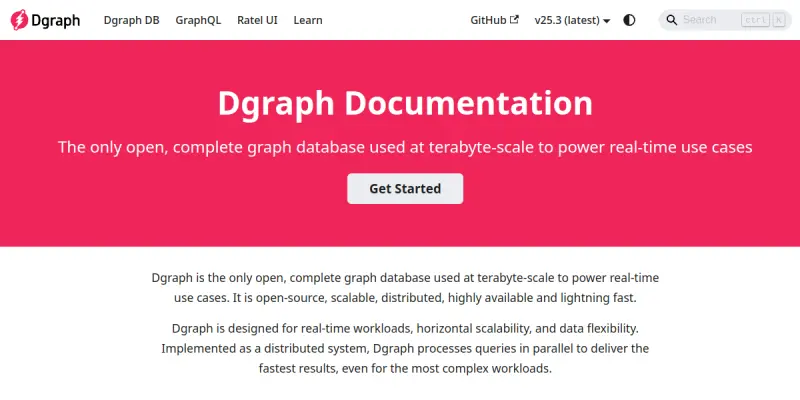
Dgraph is an open-source, distributed graph database built for handling large-scale, real-time queries. Originally developed by Dgraph Labs, it is designed to offer high performance and horizontal scalability for graph workloads. Unlike many graph databases that cache or batch-process data, Dgraph is built from the ground up for low-latency, online query processing, making it suitable for applications such as recommendation engines, social networks, and knowledge graphs.
Key Features
- Distributed Architecture: Dgraph automatically shards and replicates data across multiple nodes for fault tolerance and high throughput.
- GraphQL Support: Native support for the GraphQL query language, enabling flexible data querying and mutation.
- Real-time Graph Traversals: Optimized for deep, real-time graph traversals with low latency.
- ACID Transactions: Supports multi-key, distributed ACID transactions for data consistency.
- Built-in Visualization: Provides a UI (called Ratel) for exploring and managing graph data.
- Open Source: Fully open-source under the Apache 2.0 license, allowing self-hosting and community contributions.
- Terabyte-Scale Capabilities: Proven to handle datasets in the terabyte range with efficient indexing and compression.
- GraphQL+QL: Offers a custom query language (GraphQL+-) for advanced graph patterns not expressible in standard GraphQL.
Use Cases
Recommendation Engines
Dgraph can power real-time recommendations by traversing user-item interactions, social graphs, and content metadata. For example, an e-commerce site can use Dgraph to recommend products based on a user's purchase history and friend preferences.
Knowledge Graphs
Enterprises can build interactive knowledge graphs from structured and semi-structured data. Dgraph allows querying relationships between entities, such as people, places, and events, with low latency.
Social Networks
Dgraph is well-suited for social applications that require fetching feeds, friends-of-friends, and content in real-time. Its distributed nature supports growing user bases without degrading performance.
Fraud Detection
By analyzing connectivity patterns in financial transactions, Dgraph can help identify suspicious activities. Real-time graph traversal enables quick detection of loops, multi-hop anomalies, and hidden relationships.
Enterprise Data Catalog
Organizations can use Dgraph to create an interactive catalog of data assets, metadata, and lineage, enabling data scientists and analysts to discover and understand data relationships.
Pricing & Plans
Dgraph is free and open-source. For users who prefer a managed experience, Dgraph Labs offers Dgraph Cloud, a hosted platform with different tiers:
- Free Tier: Includes limited resources suitable for small experiments and development.
- Growth Plans: Paid tiers with increased compute, storage, and support for production workloads.
- Enterprise: Custom pricing for large-scale, dedicated clusters with premium support.
Exact pricing details are available on the Dgraph Cloud website.
Integrations & Compatibility
- GraphQL: Native support for GraphQL endpoints.
- gRPC/REST: Can be accessed via gRPC or REST APIs.
- Client Libraries: Official clients for Go, Java, JavaScript, and Python.
- Kubernetes: Helm charts available for deployment on Kubernetes.
- OpenTelemetry: Supports tracing and monitoring.
Who Is It For?
- Backend Developers: Building applications that require complex relationship queries.
- Data Engineers: Designing data pipelines and storage for graph-like data.
- Data Scientists: Exploring connected datasets for analytics and machine learning.
- Startups and Enterprises: Needing a scalable, open-source graph database for production use.
Limitations
- Learning Curve: Understanding graph modeling and Dgraph's specific query language (GraphQL+-) may take time for teams new to graph databases.
- Limited Ecosystem: Compared to relational databases or Neo4j, Dgraph has a smaller community and fewer third-party integrations.
- No Built-in Security: Dgraph does not include built-in authentication or authorization; these must be handled separately.
- In-memory Constraints: Performance can degrade if the working dataset exceeds available memory due to disk-based operations.
Final Verdict
Dgraph is a powerful, open-source graph database that excels at real-time, terabyte-scale graph workloads. Its native GraphQL support and distributed architecture make it a strong choice for applications like recommendation engines, knowledge graphs, and social networks. However, teams should be prepared to invest in learning graph modeling and managing security externally. For organizations seeking a scalable, community-backed graph database with a generous free tier, Dgraph is a compelling option.
Tool Facts
Screenshots & Interface
Pros
- ✓ Open-source and free to self-host, reducing licensing costs.
- ✓ Native GraphQL support simplifies API integration.
- ✓ Distributed architecture scales horizontally to handle terabytes of data.
- ✓ Real-time graph traversal delivers low-latency queries even on deep relationships.
- ✓ Active community and official client libraries for major programming languages.
Cons
- × Steep learning curve for teams unfamiliar with graph databases.
- × Smaller ecosystem and community compared to established graph databases like Neo4j.
- × No built-in authentication or authorization, requiring additional security layers.
- × Performance can degrade if the working dataset exceeds available memory.
How to Use Dgraph AI in Your Workflow
Integrating Dgraph AI into your professional toolkit enhances efficiency by automating manual steps. By configuring it to suit your specific project requirements, you can optimize output quality and reduce project cycle times. Standard workflows involve testing the tool on simple tasks before scaling its use to complex operations.
Frequently Asked Questions
What is Dgraph AI used for?
Dgraph is a graph database designed for high-scale, real-time queries. It targets developers and data engineers building applications that require efficient graph traversal and low-latency data retrieval. Its key differentiator is being fully open-source while handling terabyte-scale workloads.
What is the pricing model for Dgraph AI?
Dgraph AI uses a Freemium pricing model.
What are the main advantages of Dgraph AI?
The key benefits of Dgraph AI include: Open-source and free to self-host, reducing licensing costs., Native GraphQL support simplifies API integration., Distributed architecture scales horizontally to handle terabytes of data., Real-time graph traversal delivers low-latency queries even on deep relationships., Active community and official client libraries for major programming languages..
What are the main limitations of Dgraph AI?
Some limitations or cons of Dgraph AI are: Steep learning curve for teams unfamiliar with graph databases., Smaller ecosystem and community compared to established graph databases like Neo4j., No built-in authentication or authorization, requiring additional security layers., Performance can degrade if the working dataset exceeds available memory..
Alternative AI Tools

Codacy AI
Codacy AI automates code quality and security checks for development teams, offering AI-powered suggestions to streamline engineering workflows.

Softr AI
Softr AI is a no-code platform for building AI-powered portals and internal tools. It connects directly to data sources like Airtable and Google Sheets. Users can build custom interfaces using a drag-and-drop editor.

GitHub Copilot
GitHub Copilot is an AI pair programmer that provides real-time code suggestions and autocompletion. It enhances developer productivity by learning from the codebase.
Rating Details
Based on 0 ratings
Quick Comparisons
Related Tools
More AI tools from the same workflow, industry, or category.
AICode
AICode is a spec-driven AI coding copilot for developers using Visual Studio Code. It enforces a disciplined workflow to prevent AI-generated technical debt and ensures maintainable code. Its key differentiator is forcing line-by-line human review before changes are applied.
Opik
Opik is an open-source platform for LLM observability and evaluation. It helps developers trace, test, and monitor AI applications and autonomous agents throughout development and production.
PlanetScale AI
PlanetScale provides serverless cloud hosting for Vitess and PostgreSQL databases. It targets developers and engineering teams requiring high-performance, scalable database infrastructure. The platform enables instant scaling and branching workflows.
CodeReview AI
CodeReview AI is a tool that uses artificial intelligence to analyze code and suggest improvements. It helps developers identify bugs, security issues, and style inconsistencies automatically. The tool integrates with popular version control systems to fit into existing workflows.
Reviews
No reviews submitted yet. Be the first to share your experience.
Write a Review
Share Your Experience
Join the community to write reviews, submit ratings, and bookmark your favorite AI tools.