

PagerDuty AI
Use PagerDuty AI as the anchor for a real shortlist.
Instead of returning to a broad directory, jump straight into the strongest adjacent matchups for pricing, workflow fit, and differentiation.
Overview
Overview
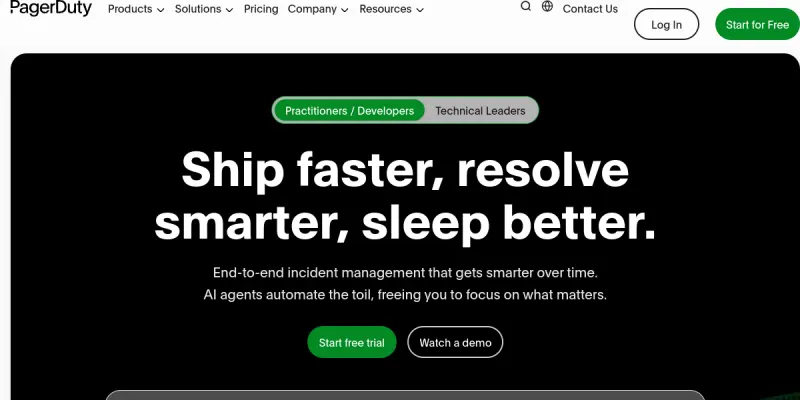
PagerDuty AI is a cloud-based AI operations platform designed to help DevOps, IT operations, and site reliability engineering (SRE) teams manage and automate incident response. By leveraging machine learning and intelligent automation, it reduces noise, surfaces actionable insights, and streamlines the entire incident lifecycle from detection to post-mortem.
Key Features
- AI-Driven Incident Detection: Analyzes alerts and metrics to identify critical incidents early, reducing false positives.
- Automated Response Actions: Triggers predefined workflows, such as auto-remediation scripts, to resolve common issues without human intervention.
- Intelligent Alert Grouping: Correlates related alerts into a single incident, minimizing alert fatigue.
- Root Cause Analysis (RCA): Uses AI to suggest probable causes and supporting evidence for faster troubleshooting.
- Incident Timeline & Collaboration: Provides a consolidated timeline of events and integrates with Slack, Teams, and Jira for seamless team coordination.
- Analytics & Reporting: Offers dashboards and reports to track incident trends, mean time to acknowledge (MTTA), and mean time to resolve (MTTR).
- Bidirectional Integrations: Connects with major monitoring tools (Datadog, Prometheus, Grafana), ticketing systems (ServiceNow, Jira), and communication platforms.
- Post-Incident Reviews: Automates creation of post-mortem documentation and action item tracking.
Use Cases
DevOps Incident Management
DevOps teams use PagerDuty AI to automate the incident lifecycle. When a critical alert comes in, the platform automatically pages the right engineer, provides context, and can execute remediation playbooks, significantly reducing response times.
SRE Operations
SRE teams leverage PagerDuty AI's root cause analysis and alert grouping to maintain high service reliability. By minimizing manual triage, engineers can focus on improving system resilience rather than firefighting.
IT Service Desk Automation
IT help desks can integrate PagerDuty AI to handle common infrastructure issues automatically. For example, if a disk usage threshold is breached, the platform can run a cleanup script and notify the team only if the issue persists.
Multi-Cloud Monitoring
Organizations running workloads across AWS, Azure, and GCP can use PagerDuty AI to centralize incident management. The platform correlates events from disparate sources, providing a unified view of health across environments.
Pricing & Plans
PagerDuty offers a freemium pricing model. The Free plan includes limited incident management and team collaboration. Paid tiers — Pro, Business, and Enterprise — provide advanced features such as custom workflows, analytics, AI-driven insights, and dedicated support. Exact pricing is available on the PagerDuty website.
Integrations & Compatibility
PagerDuty AI integrates with over 700 tools, including monitoring (Datadog, New Relic, Dynatrace), ticketing (ServiceNow, Jira, Zendesk), collaboration (Slack, Microsoft Teams), and cloud platforms (AWS, Azure, GCP). It offers a REST API for custom integrations and supports webhook-based event ingestion.
Who Is It For?
PagerDuty AI is built for DevOps engineers, SRE teams, IT operations managers, and platform engineers who need to automate incident response and reduce manual toil. It is also suitable for organizations of all sizes that require reliable on-call management and proactive incident prevention.
Limitations
- Advanced AI features (e.g., intelligent alert grouping, root cause analysis) are only available on paid tiers.
- The platform relies heavily on stable internet connectivity; offline functionality is limited.
- Initial setup and configuration of custom workflows may require a learning curve for non-expert users.
- Integration with some legacy or niche tools may require custom development via the API.
Final Verdict
PagerDuty AI is a robust, AI-enhanced incident management platform that can significantly improve operational efficiency for DevOps and SRE teams. Its breadth of integrations and automation capabilities make it a compelling choice, though full value is unlocked with a paid subscription. It is best suited for organizations already invested in a modern observability stack.
Tool Facts
Screenshots & Interface
Pros
- ✓ AI-driven alert grouping reduces noise and helps engineers focus on critical incidents.
- ✓ Over 700 pre-built integrations accelerate adoption and improve workflow connectivity.
- ✓ Automated response playbooks cut mean time to resolve (MTTR) for common issues.
- ✓ Built-in analytics provide actionable insights into incident trends and team performance.
- ✓ Freemium tier allows small teams to test core features without upfront cost.
Cons
- × Advanced AI features like automated RCA are locked behind paid plans, limiting free-tier value.
- × Platform requires reliable internet connectivity; no offline mode is available.
- × Initial setup of custom automation rules and integrations can be time-consuming for teams without prior experience.
- × Pricing for higher tiers is not publicly transparent and requires contacting sales.
How to Use PagerDuty AI in Your Workflow
Integrating PagerDuty AI into your professional toolkit enhances efficiency by automating manual steps. By configuring it to suit your specific project requirements, you can optimize output quality and reduce project cycle times. Standard workflows involve testing the tool on simple tasks before scaling its use to complex operations.
Frequently Asked Questions
What is PagerDuty AI used for?
PagerDuty AI is an AI-enhanced operations platform that helps DevOps and IT teams automate incident response. It uses machine learning to detect, diagnose, and resolve critical issues faster, reducing manual toil.
What is the pricing model for PagerDuty AI?
PagerDuty AI uses a Freemium pricing model.
What are the main advantages of PagerDuty AI?
The key benefits of PagerDuty AI include: AI-driven alert grouping reduces noise and helps engineers focus on critical incidents., Over 700 pre-built integrations accelerate adoption and improve workflow connectivity., Automated response playbooks cut mean time to resolve (MTTR) for common issues., Built-in analytics provide actionable insights into incident trends and team performance., Freemium tier allows small teams to test core features without upfront cost..
What are the main limitations of PagerDuty AI?
Some limitations or cons of PagerDuty AI are: Advanced AI features like automated RCA are locked behind paid plans, limiting free-tier value., Platform requires reliable internet connectivity; no offline mode is available., Initial setup of custom automation rules and integrations can be time-consuming for teams without prior experience., Pricing for higher tiers is not publicly transparent and requires contacting sales..
Alternative AI Tools

DeepSource
DeepSource automates code reviews to catch security issues and improve code quality. It analyzes your codebase to suggest fixes, helping development teams ship safer software faster.

AskCodi
AskCodi is an AI-powered code assistant that helps developers generate code snippets and debug issues across multiple programming languages.

Kodem AI
Kodem AI is a runtime-powered application security platform that merges dynamic runtime intelligence with static analysis (SAST, SCA, container and IaC scanning). It helps developers and security teams identify and fix vulnerabilities with high accuracy and low false positives.
Rating Details
Based on 0 ratings
Quick Comparisons
Related Tools
More AI tools from the same workflow, industry, or category.
AICode
AICode is a spec-driven AI coding copilot for developers using Visual Studio Code. It enforces a disciplined workflow to prevent AI-generated technical debt and ensures maintainable code. Its key differentiator is forcing line-by-line human review before changes are applied.
Opik
Opik is an open-source platform for LLM observability and evaluation. It helps developers trace, test, and monitor AI applications and autonomous agents throughout development and production.
PlanetScale AI
PlanetScale provides serverless cloud hosting for Vitess and PostgreSQL databases. It targets developers and engineering teams requiring high-performance, scalable database infrastructure. The platform enables instant scaling and branching workflows.
CodeReview AI
CodeReview AI is a tool that uses artificial intelligence to analyze code and suggest improvements. It helps developers identify bugs, security issues, and style inconsistencies automatically. The tool integrates with popular version control systems to fit into existing workflows.
Reviews
No reviews submitted yet. Be the first to share your experience.
Write a Review
Share Your Experience
Join the community to write reviews, submit ratings, and bookmark your favorite AI tools.