
Agent Skills Could Become the Package Manager for AI Capabilities
AI agents can share more than tools. They can share the procedures, expertise, and workflows that make those tools useful. But turning that knowledge into dependable infrastructure requires solving the same hard problems that software package managers faced.
A coding agent can write a function, inspect a repository, and run tests. Yet it may still struggle with a team's specific code-review process, its deployment checklist, or the rules for handling a production incident.
The missing piece is often not another model. It is procedural knowledge.
Agent Skills offer one way to package that knowledge so it can be reused across compatible AI systems. Instead of rebuilding the same workflow for every agent, developers can provide a reusable unit containing instructions, reference material, and, when necessary, scripts or other supporting resources.
That sounds simple. But it raises a bigger question: Could skills become to AI capabilities what software packages became to application development?
The analogy is useful, provided we understand where it holds—and where it breaks.
From prompts to reusable capabilities
Most people have experimented with long prompts that tell an AI how to perform a task. A prompt might define a code-review checklist, explain a company's writing style, or describe the steps for analyzing a spreadsheet.
The problem appears when that prompt becomes part of a recurring workflow.
It gets copied between projects, modified by different people, and eventually becomes difficult to maintain. One agent uses the latest instructions; another uses an older version. A developer fixes an error in one copy but forgets to update the others.
A skill changes the packaging model.
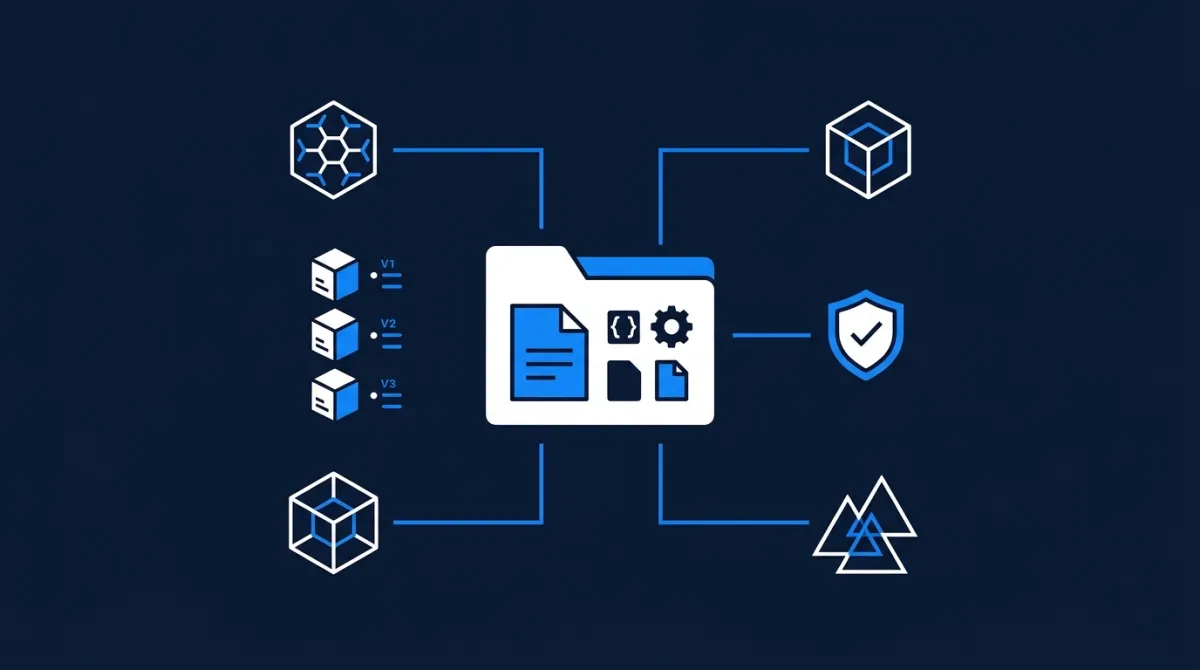
In the Agent Skills format, a skill is a directory containing a SKILL.md file, with optional supporting resources such as scripts, templates, and reference documents. The file describes the capability and provides instructions for using it.
A simplified structure looks like this:
csv-quality-check/
├── SKILL.md
├── references/
│   └── data-quality-rules.md
├── scripts/
│   └── validate_columns.py
└── assets/
    └── report-template.md
The skill might teach an agent how to inspect a CSV, identify missing values, validate column names, and produce a structured report.
The instructions explain the procedure. The reference file provides domain-specific rules. The script handles deterministic checks. The template standardizes the output.
Each component has a different job.
This distinction matters because a skill is not necessarily a new model, a standalone application, or an autonomous agent. It is a reusable capability that an agent can draw on when the task calls for it.
Anthropic's documentation describes a progressive-loading approach: an agent can discover a skill from its metadata, load its main instructions when relevant, and consult supporting resources as needed. That helps avoid placing every instruction into every interaction. See the Agent Skills documentation.
Why the package-manager analogy matters
Software package managers solved a familiar problem: developers needed to reuse existing code without manually copying it into every project.
They created conventions for distributing packages, identifying versions, resolving dependencies, and updating software. Registries made packages easier to discover, while metadata helped developers understand what they were installing.
Agent Skills create an opportunity to apply similar ideas to procedural knowledge.
Consider a team building several AI agents for software delivery. One agent prepares pull requests. Another reviews code. A third drafts release notes. A fourth checks deployment readiness.
Some capabilities are specific to each workflow. Others are shared.
The team could maintain separate implementations of the same coding conventions, testing procedure, or documentation rules. Or it could maintain reusable skills and provide them to compatible agents.
The second approach can reduce duplicated work and make improvements easier to distribute.
The potential benefits are straightforward:
- Reuse: Build a workflow once instead of recreating its instructions for every agent.
- Consistency: Share the same documented procedure across compatible environments.
- Maintainability: Improve a common capability in one place instead of tracking multiple copies.
- Composability: Combine smaller capabilities into larger workflows when their instructions and assumptions are compatible.
- Portability: Reduce dependence on a single agent product when multiple platforms support the same format.
These benefits are possibilities, not guarantees. A shared file format does not ensure that every agent will interpret the instructions identically, have access to the same tools, or produce equivalent results.
That is where the package-manager comparison becomes more interesting.
A shared format is only the beginning
A package manager is useful because it does much more than store files. It helps answer practical questions about how software is identified, installed, updated, and combined.
A skill ecosystem faces a similar set of challenges.
1. Discovery: How does an agent find the right skill?
Imagine searching for a skill that reviews a Laravel pull request. A registry could return dozens of candidates: some general-purpose, some designed for particular frameworks, and others tailored to a company's internal standards.
A useful discovery system would need more than names and descriptions. It could expose supported environments, required tools, input expectations, examples, test results, maintenance status, and known limitations.
Descriptions are especially important because agents may use them to decide when a skill is relevant. A vague description can prevent a useful skill from being selected—or cause an unsuitable one to be selected too often.
The objective should not be to maximize the number of available skills. It should be to make the right capability identifiable for the task at hand.
2. Versioning: Which version did the agent use?
Suppose a team updates a skill to enforce a new security requirement. The updated version catches a vulnerability that the previous version missed.
That sounds like progress, until an automated workflow starts producing different results after an unreviewed update.
Versioning makes the change explicit. Teams need to know which revision was tested, which one is deployed, and what changed between releases.
Where reproducibility matters, workflows should be able to pin a skill to a specific version rather than silently following the latest release.
This is not just a convenience for developers. It is part of understanding why an agent behaved differently on two separate runs.
3. Dependencies: What does a skill require?
A skill might assume that Python is available, that a particular command-line tool is installed, or that the agent can access a specific directory.
Another skill might require a different version of the same dependency. Two instructions might also conflict even when their software dependencies do not.
Software package managers can resolve many technical dependency problems because packages expose structured metadata and interfaces. Natural-language procedures are less predictable. Two skills may overlap, contradict one another, or rely on unstated assumptions.
A mature ecosystem will need clearer ways to describe requirements and compatibility, as well as mechanisms for detecting conflicts before they affect a workflow.
4. Verification: Does the skill actually work?
A skill can be well written and still fail in practice.
Its instructions may be ambiguous. Its examples may be outdated. A script may work on one operating system but fail on another. An agent may ignore a step or misunderstand the conditions under which it should run.
That makes evaluation essential.
A credible skill should ideally include test cases, expected outputs, known failure modes, and a clear statement of the environments in which it has been tested.
For example, a data-validation skill could be evaluated against CSV files containing missing values, duplicate records, malformed dates, and unexpected columns. The evaluation should measure whether the skill detects the relevant problems—not merely whether the agent produces a convincing explanation.
A download count is evidence of adoption, not evidence of correctness.
The security problem: installing instructions is not like installing harmless text
Skills also create a distinct security challenge.
A skill's instructions can influence how an agent uses its tools. Supporting scripts may execute code. Reference documents may contain untrusted content. Depending on the agent's permissions and execution environment, a malicious or compromised skill could attempt to expose sensitive data, trigger unauthorized actions, or redirect a workflow away from its intended purpose.
This is why source trust and execution boundaries matter.
A skill that formats a Markdown document does not necessarily need access to production credentials. A skill that analyzes a repository should not automatically receive permission to modify deployment infrastructure.
A safer ecosystem would make it easier to answer questions such as:
- Who created and maintains this skill?
- What files, tools, network resources, and permissions does it require?
- Does it execute code, and if so, what does that code do?
- Has its content changed since the version was reviewed?
- Can it be tested in an isolated environment before being used on sensitive data?
Not every skill needs a complex security review. The level of scrutiny should match its potential impact. But skills that can influence consequential actions deserve more than a quick inspection of their descriptions.
The important distinction is that portability should not mean automatic trust.
Anthropic explicitly warns that skills can contain instructions and code that affect agent behavior, and recommends using skills from trusted sources. Its donation of the format to the Agentic AI Foundation also identified security guidance as an area for future work.
Sources: Anthropic's announcement and Agent Skills documentation.
Open standards can reduce lock-in—but cannot eliminate it
The portability question is central to the future of skills.
A shared format lets developers express a capability in a form that multiple compatible platforms can recognize. That is a meaningful step toward interoperability.
On October 22, 2026, Anthropic donated Agent Skills to the Agentic AI Foundation (AAIF), a Linux Foundation project intended to provide neutral governance for open agent infrastructure. Anthropic reported that more than 70 agent platforms had integrated the format by the time of the announcement.
The donation creates an opportunity for the specification to evolve through a broader community rather than remaining under the control of a single company.
But a common format is not the same as identical runtime behavior.
One agent may have filesystem access while another cannot. One may support script execution; another may accept only instructions and reference material. Tool availability, context limits, permission systems, and model behavior can all change how a skill performs.
In practice, portability has several layers:
- Format compatibility: Can the platform read the skill's structure?
- Capability compatibility: Does the platform provide the tools and execution environment the skill expects?
- Behavioral compatibility: Does the skill perform reliably on that platform?
- Operational compatibility: Can the team manage versions, permissions, evaluations, and updates consistently?
A standard can help with the first layer and contribute to the others. It cannot solve them automatically.
This is also why skills should not be confused with tool protocols. A skill describes how an agent should approach a task; a tool interface or protocol makes particular operations available. A well-designed workflow may need both.
What a practical skill ecosystem could look like
The next step is not necessarily a single universal store containing every capability.
Different use cases require different distribution models. A public skill for formatting documents can be shared broadly. A skill that encodes internal financial controls may need to remain inside an organization's private registry.
A useful ecosystem could support both.
For an individual developer, the workflow might be simple: find a skill, inspect its contents, install it, and test it on a representative task.
For an engineering team, the process could be more controlled:
- Discover a candidate skill from a trusted source.
- Review its instructions, supporting files, and permissions.
- Evaluate it against representative tasks.
- Pin a tested version in the project configuration.
- Track updates and changes.
- Monitor failures and replace or roll back versions when needed.
The key is to treat skills as maintained engineering assets rather than disposable prompt snippets.
That also changes how teams should build them. A good skill should have a narrow, clearly defined purpose. It should explain when it applies, state assumptions, describe failure handling, and avoid requesting permissions it does not need.
If a workflow can be implemented more reliably through a deterministic script, the skill should use that script where appropriate rather than asking the model to improvise every step.
The strongest capabilities will likely combine instructions for judgment with code for operations that require predictable behavior.
The open question: What exactly are we standardizing?
There is an important limit to the package-manager analogy.
A conventional software package usually exposes code and interfaces whose behavior can be tested under defined conditions. A skill contains natural-language instructions interpreted by a model. Its execution can vary with the model, context, tools, and surrounding instructions.
Consequently, two platforms loading the same skill may not produce identical results.
This does not make the format unhelpful. It means that skill compatibility should be measured in terms of demonstrated behavior, not merely successful installation.
The ecosystem also needs to distinguish between different kinds of capability. A procedural guide, a collection of reference documents, a script-driven workflow, and a skill that directs an agent to take external actions do not carry the same operational risks.
Treating all of them as interchangeable packages would hide meaningful differences.
A useful standard should make these differences easier to understand rather than pretending they do not exist.
Conclusion: Package the expertise, engineer the trust
Agent Skills address a practical problem: capable models still need the right procedures, domain knowledge, and supporting resources to complete specialized tasks reliably.
Packaging that expertise makes it easier to reuse and maintain. An open standard can make it more portable. But neither solves discovery, dependency conflicts, verification, security, or runtime differences by itself.
Software package managers became essential because they turned code reuse into a manageable engineering process. An equivalent ecosystem for agent capabilities will need to do the same for instructions and workflows—while accounting for the unpredictability of model-driven execution.
The most valuable skill libraries will not necessarily be the largest. They will be the ones that teams can understand, test, trust, version, and maintain.
The real opportunity is not to collect more prompts. It is to make useful expertise a dependable part of the AI software stack.