
From Chatbots to Delegation: What Changes When AI Starts Owning a Task?
Subtitle: The next shift in AI isn't just better answers. It's software that accepts an assignment, works across applications, and returns when it needs a decision. That changes the engineering problem from generating useful output to managing delegated work.
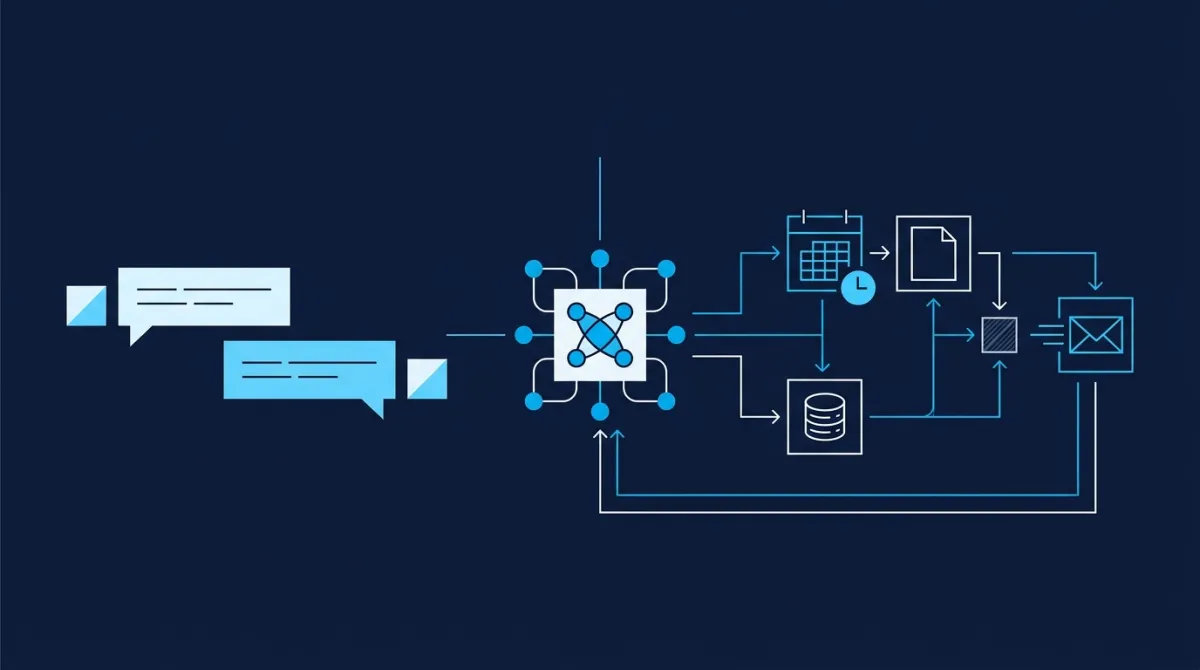
A chatbot waits for your next message. A task-oriented agent may already be checking your calendar, assembling information from connected applications, or preparing work you assigned earlier.
That difference sounds small until the agent can send an email, update a customer record, issue a refund, or make a purchase.
On October 21, 2026, Anthropic introduced Claude Duet, a research-preview application built around this more proactive model. It can surface items that need attention, carry out delegated tasks in the background, and ask for approval before certain consequential actions. The initial preview targets professionals and small-business owners in the United States. Anthropic's announcement describes the product as an agent that works proactively rather than simply waiting for prompts.
The important development isn't one new application. It's the changing relationship between people and software.
When an AI system starts owning a task, even temporarily, the challenge is no longer just whether its answer is correct. The system must understand what it has been asked to accomplish, know which actions it is allowed to take, maintain context as the work progresses, and recognize when it should stop and ask a human.
1. A response is not the same as a completed task
Consider two ways to handle an overdue customer invoice.
With a conventional chatbot, a user might ask for a reminder email. The model drafts the message, and the user copies it into an email client, checks the recipient, sends it, and updates whatever internal system tracks the follow-up.
The model helps with one step. The person remains responsible for coordinating the entire process.
A delegated agent could instead be asked to identify overdue invoices, check the relevant customer history, prepare reminders, and return a summary of what it found. Depending on its permissions and safeguards, it might then send approved messages or update the relevant records.
The difference is the unit of work.
- Chatbot: Produce a response to a request.
- Copilot: Help a person perform a task.
- Delegated agent: Pursue an agreed outcome across multiple steps, potentially without continuous human direction.
These categories overlap. A chatbot can call tools, and a delegated agent can still need frequent guidance. The distinction is about how much responsibility the system takes for coordinating the work between the initial instruction and the final result.
A good answer can be delivered in seconds. A completed task may require dozens of decisions, several applications, retries, and a final verification step.
That is why improvements in conversational quality do not automatically translate into reliable task completion.
2. The interface is becoming less important than the workflow
The familiar chatbot interface organizes work around turns: a user asks, a model responds, and the user decides what to do next.
Delegation changes that sequence.
A user can describe an outcome once, leave the system to work, and return when the agent has completed the assignment or reached a decision it cannot safely make alone.
Claude Duet illustrates this direction. Anthropic says it can produce a morning briefing, monitor connected applications periodically, prepare work in the background, and notify users when an assignment is complete or requires review. It runs in a cloud-based environment, so the user's own device does not need to remain active for the work to continue.
This changes the product's central question from:
How do we help users interact with the model?
to:
How do we help users define, delegate, supervise, and verify work?
The implications extend beyond the chat interface. A task-oriented agent needs a way to retain the relevant context, access the right tools, track progress, communicate blockers, and present its results in a form that a person can evaluate.
A conversation history alone is not a complete task-management system.
3. Delegation requires a contract, not just a prompt
People routinely give colleagues instructions that leave room for judgment. They also rely on shared expectations about what a colleague may decide independently.
Software needs those expectations to be made more explicit.
An instruction such as "handle the overdue invoices" leaves several questions unanswered:
- Which invoices count as overdue?
- Should disputed invoices be excluded?
- Is the agent allowed to contact customers?
- Can it offer discounts or change payment terms?
- Should it update the accounting system?
- What should happen if customer records conflict?
- What evidence must be returned when the work is complete?
If those questions remain unresolved, the agent must either guess, stop repeatedly for clarification, or risk doing something the user did not intend.
A useful delegation contract defines five things:
Outcome. What must be true when the task is finished?
Scope. Which records, systems, people, and time periods are included?
Permissions. Which actions may the agent take, and which require approval?
Constraints. What must never happen, even if it appears to help achieve the goal?
Completion evidence. What should the agent return so the user can verify the result?
This does not mean every task needs a lengthy specification. A low-risk task may need only a short instruction. But the more consequential the actions, the less reasonable it is to rely on vague intent.
The goal is to make autonomy proportional to the clarity of the assignment and the cost of getting it wrong.
4. The difficult part is managing the work between steps
An agent that works across several applications is not simply generating a longer answer. It is operating a workflow that can fail at multiple points.
Imagine an agent preparing a sales forecast. It retrieves sales records, joins them with product information, applies assumptions, builds a spreadsheet, and prepares a summary.
Any of those steps could fail. A data source may be unavailable. Two systems may disagree. A spreadsheet formula may be wrong. The model may misunderstand an unusual transaction. A later step may proceed using an earlier mistake.
A reliable system needs more than the ability to retry a failed tool call.
It needs state: a record of what has been completed, what remains, what assumptions were made, and which results have been verified.
It also needs checkpoints. If a long task fails halfway through, the system should be able to determine what can safely continue rather than blindly repeating every action.
Finally, it needs recovery behavior. When a source is missing or an operation fails, the agent should know when to retry, when to use an approved alternative, and when to stop and report the problem.
These requirements are not unique to AI. They are familiar problems in distributed systems, workflow engines, and job-processing infrastructure. What makes AI agents different is that parts of the workflow may be planned dynamically by a model whose next decision is not fully predictable in advance.
The engineering challenge is to combine flexible reasoning with deterministic boundaries around important operations.
5. Permissions must follow the consequences of an action
Not every agent action deserves the same level of scrutiny.
Reading a document is different from editing it. Drafting an email is different from sending it. Preparing a payment is different from executing it.
A practical permission model should distinguish between at least three classes of work:
Low-impact, reversible actions: searching approved data, organizing information, preparing a draft, or creating a private report.
Actions that change shared state: editing a customer record, updating a project, or changing a published document.
High-impact or difficult-to-reverse actions: sending external communications, making payments, deleting important data, or changing access permissions.
The appropriate boundary depends on the context. Updating an internal field may be routine in one organization and tightly controlled in another.
Anthropic says Claude Duet asks users to approve consequential actions such as sending messages, making payments, signing documents, or deleting information. Its announcement also describes restrictions on certain financial operations. These are product-specific safeguards, not proof that every agent has an equivalent approval model.
Approval itself is only one part of the design.
A useful approval request should show what the agent intends to do, the target and relevant context, the expected consequence, and enough information for the user to make an informed decision. The system should then ensure that the approved action is the action actually executed.
Permissions should also be limited to what the task requires. Connecting an agent to an application should not automatically grant unrestricted authority over every record and operation in that application.
6. Trust depends on observability, not confidence
An agent can sound certain and still be wrong. A polished completion message does not prove that the underlying work was performed correctly.
For delegated systems, trust requires a record of what happened.
At minimum, an operationally useful agent should be able to report:
- What information it consulted.
- Which tools and actions it used.
- Which steps succeeded or failed.
- What assumptions it made.
- Which decisions require human input.
- What remains incomplete.
- What evidence supports its claim of completion.
This does not mean users need to inspect every internal reasoning step. They need actionable evidence about the workflow and its outcomes.
For example, "I followed up on all overdue invoices" is less useful than a report listing the invoices reviewed, the exclusions applied, the messages drafted or sent, the actions awaiting approval, and any records that could not be reconciled.
Observability matters after failure, too. If a customer receives a duplicate message or an accounting record changes unexpectedly, the organization needs to reconstruct what happened and determine whether the action can be reversed.
This is where agent design intersects with familiar operational practices: audit logs, monitoring, access control, incident response, and change management.
The more authority an agent receives, the more important these mechanisms become.
7. Measuring agents means measuring outcomes
A model can perform well on question-answering benchmarks and still be unreliable at delegated work.
Task completion introduces several dimensions that ordinary response evaluation may miss:
Completion rate: Did the agent achieve the requested outcome, rather than merely produce a plausible report?
Correctness: Were the results accurate, including the intermediate changes made along the way?
Human intervention: How often did a person need to correct, redirect, or rescue the task?
Recovery: Could the agent handle missing data, failed tools, and unexpected conditions safely?
Time and cost: How long did the workflow take, and how much inference, tool usage, and human review did it require?
Safety: Did the agent respect its permissions and avoid unintended external effects?
These measures should be evaluated together. A system that completes more tasks by taking risky shortcuts may be worse than one that stops and asks for help. An agent that reports a high success rate but requires extensive manual verification may also provide less value than its headline performance suggests.
A useful evaluation should include realistic end-to-end workflows, not just isolated tool calls. It should also test failure cases: ambiguous instructions, conflicting records, unavailable applications, prompt injection, expired credentials, and actions that require approval.
The relevant question is not simply whether an agent can complete a task in a demonstration. It is whether it completes the task reliably under the conditions in which people will actually use it.
8. Where businesses should begin
The arrival of more proactive agents does not mean every workflow should be handed over immediately.
A sensible starting point is a task that is frequent, bounded, easy to inspect, and relatively inexpensive to reverse.
Examples include preparing daily summaries, collecting information for a report, identifying records that need attention, or drafting routine follow-up messages.
Before granting broader permissions, an organization should:
- Define the outcome. Write down what successful completion means.
- Limit access. Connect only the applications and data needed for the task.
- Set approval thresholds. Decide which actions can happen automatically and which need a person.
- Keep a traceable record. Log important decisions, tool calls, changes, and failures.
- Test against real cases. Include incomplete data, conflicting instructions, and failure scenarios.
- Measure the whole workflow. Count review time, corrections, operational cost, and unintended actions—not just tasks marked complete.
- Expand gradually. Increase the agent's authority only when evidence supports doing so.
This approach may look less impressive than giving an agent broad access and asking it to run a department. It is also a more credible path toward using automation in real operations.
The shift is from generating content to accepting responsibility
AI products are beginning to compete on more than model quality or the usefulness of a single answer. They are also competing on their ability to carry work across applications, maintain context, decide when to act, and know when to involve a person.
Claude Duet is one example of that direction. Its significance lies in the product model: an agent that can initiate relevant interactions, continue delegated work in the background, and return when it needs a decision.
But delegation is not the same as unrestricted autonomy.
The most useful agent will not necessarily be the one that performs the most actions without asking. It may be the one that understands the task's boundaries, completes routine work independently, exposes uncertainty early, and leaves a clear record of what it changed.
For developers, that means building systems around the model: task state, permissions, checkpoints, verification, and recovery.
For businesses, it means treating an agent less like a clever chat window and more like a new kind of worker whose access, responsibilities, and results must be managed.
The real test of an AI agent is not whether it can say, "I'll take care of it."
It's whether you can verify what "taken care of" actually means.
Further reading
- Introducing Claude Duet — Anthropic
- Claude Duet product overview — Anthropic
- Stripe and Anthropic help entrepreneurs run their business inside Claude Duet — Stripe
- Anthropic unveils Claude Duet AI agent app — Reuters
TipJournal covers the engineering decisions behind AI tools and systems—not just the announcements.