
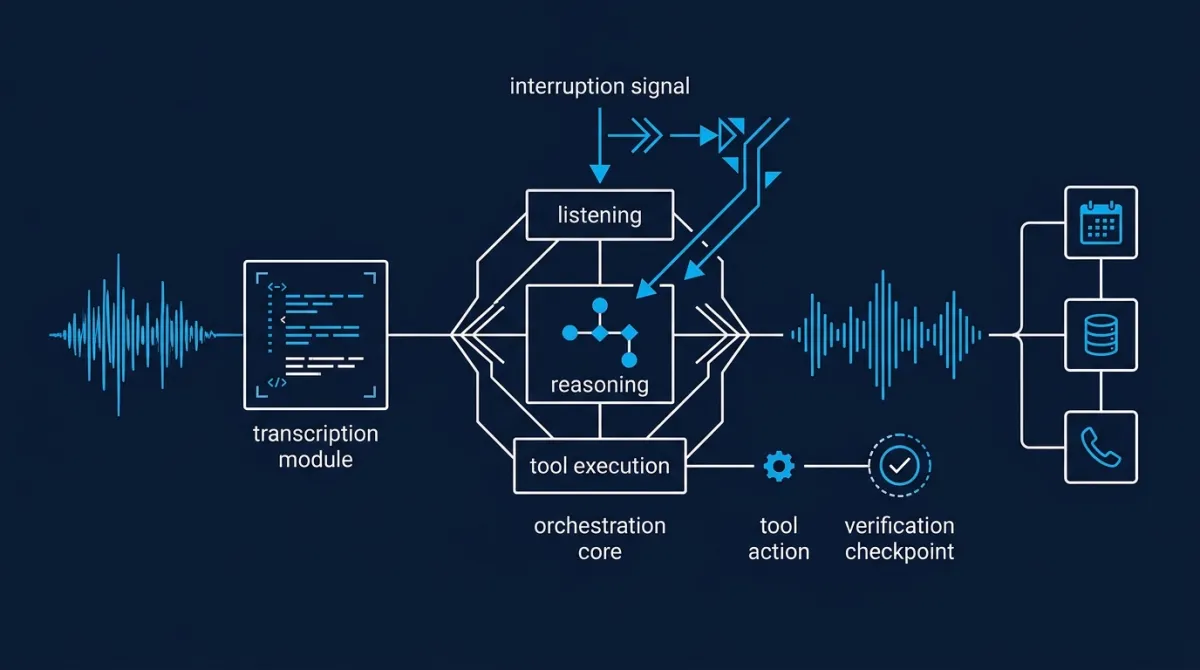
Voice Agents Need More Than Speech Recognition
Subtitle: Accurate transcription is only the first step. Useful voice agents must manage interruptions, latency, context, tool execution, and the difference between saying something happened and proving it happened.
A voice agent can recognize every word in a sentence and still have a terrible conversation.
Imagine calling a clinic to book an appointment. You explain that you need a consultation next week, mention your availability, and pause briefly to remember a date. The agent interprets the pause as the end of your sentence and starts responding. You interrupt to correct the date, but it continues talking. Eventually, it confirms a booking—without successfully creating one in the clinic's system.
The transcription might be accurate. The voice might sound natural. The experience is still a failure.
This is the problem facing the next generation of voice agents: speech recognition and speech synthesis are necessary components, but neither is enough to make a system reliable in a real conversation.
On October 20, 2026, Mistral introduced Voxtral 3, a family of speech models alongside a Voice Agents SDK designed to combine listening, reasoning, tool calling, and speaking in a real-time pipeline. The release includes multilingual transcription, expressive speech generation, and mechanisms for detecting when a speaker has finished talking. Mistral says the system can support multi-step workflows through connected business systems. These are the company's stated capabilities; their practical value still depends on how the complete application performs. Read the announcement.
The more interesting story isn't simply that speech models are improving. It's that voice is becoming an interface for software that can take action.
1. Transcription is only one part of the problem
Traditional speech-to-text systems solve a relatively narrow task: convert audio into text.
That task has its own difficult cases—accents, background noise, overlapping speakers, unfamiliar names, and spoken numbers. But even a perfect transcript doesn't tell an application what to do next.
Consider this request:
"Book a table for two on Friday at seven—actually, make that Saturday."
A transcription system might correctly capture every word. The application must still understand that Saturday replaces Friday, determine the intended date, check availability, submit the reservation, and verify the result.
A production voice agent therefore needs several capabilities working together:
- Perception: Recognize speech, speakers, relevant sounds, and spoken corrections.
- Conversation management: Decide when to listen, respond, wait, or yield to the user.
- Reasoning: Interpret intent, identify missing information, and determine the next step.
- Action execution: Call tools and interact with external systems.
- Verification: Confirm what actually happened before reporting success.
These capabilities can fail independently. A model may understand the request but choose the wrong tool. A tool may execute correctly while the spoken response misrepresents the result. A technically correct answer may arrive so late that the conversation feels broken.
Treating all these failures as transcription errors makes debugging harder, not easier.
2. Latency changes the meaning of a conversation
In a text interface, waiting an extra second is often tolerable. In a voice conversation, delays are much more noticeable because silence becomes part of the interaction.
But total response time is not the only useful measurement. The first audible response matters too.
Suppose a customer asks, "Can you check whether my payment arrived?"
The agent may need to authenticate the customer, query an account system, retrieve a transaction, and interpret the result. Some of that work may take time.
A well-designed system can acknowledge the request promptly, continue the operation, and explain the result when it becomes available. It must not confuse an acknowledgment with a completed action.
For example:
- Good: "I'll check that for you." The system queries the account.
- Bad: "Your payment has arrived." The system has not yet received a verified result.
This distinction becomes important when a voice agent operates through a phone line, where users may assume that a confident spoken answer reflects an actual system operation.
Latency also accumulates across a pipeline. Audio capture, speech recognition, model inference, network requests, tool execution, and speech generation can all add delay. Optimizing just one component may have little effect if another stage dominates the wait.
There are two broad architectural approaches:
Cascaded pipeline: Separate speech recognition, language-model reasoning, and speech generation components. This can offer flexibility and control, but introduces boundaries and potential delays between stages.
Native speech-to-speech model: A model processes audio and generates audio more directly. This can simplify some interactions, though tool integration, external actions, and application-level safeguards are still necessary.
Neither architecture automatically wins in every setting. The appropriate choice depends on language coverage, latency targets, observability, customization needs, cost, and the reliability requirements of the application.
Microsoft's voice-agent best practices similarly emphasize measuring time to first audio and examining latency across the pipeline rather than treating responsiveness as a single model metric.
3. Turn-taking is a technical problem
People don't communicate in perfectly separated blocks of speech.
They hesitate, restart sentences, correct themselves, speak over one another, and pause while thinking. A useful voice agent needs to distinguish these behaviors from the end of a conversational turn.
This is harder than detecting silence.
Someone might pause after saying, "I'd like to book an appointment for..." while checking a calendar. Another person might stop speaking because they expect the agent to respond. Both situations can produce a similar acoustic signal, but they require different behavior.
A system that responds too early interrupts users. A system that waits too long feels sluggish.
Turn detection therefore needs to account for both acoustic signals and the meaning or structure of the conversation. Different applications also need different trade-offs. A fast-paced voice assistant may benefit from short response delays, while a healthcare or customer-service assistant may need to tolerate longer pauses and carefully collect information.
Interruption handling matters just as much
In ordinary conversation, people can interrupt to correct a mistake or change direction. Voice agents need to support the same basic interaction.
When a caller says, "No, I meant Tuesday," the system must do more than stop producing audio. It must update its understanding of the request and ensure that any subsequent action reflects the correction.
A reliable interruption mechanism needs to coordinate at least three things:
- Stop or appropriately yield the current speech output.
- Capture and interpret the user's new input.
- Reconcile the correction with any work already underway.
That third step is especially important. If the agent has already submitted a booking or initiated a payment, stopping its speech does not undo the external action.
Mistral says Voxtral 3 includes end-of-turn detection that uses acoustic and semantic information, and its Voice Agents SDK is designed to stop speaking when a user cuts in. Those are useful capabilities, but they must be tested in complete application workflows, including situations where an external operation has already started. Voxtral 3 technical announcement.
4. A natural voice can hide an unreliable system
Modern speech generation can make an agent sound expressive, patient, and conversational. That improves usability, but it introduces a subtle risk: people may interpret natural delivery as evidence of competence.
A fluent voice can say the wrong thing just as fluently.
Imagine an agent handling a return request. It checks an order, initiates a refund, and receives a timeout from the payment service. The operation may have failed—or it may have succeeded while the confirmation was lost.
If the agent immediately says, "Your refund has been processed," it has turned an uncertain technical state into a confident claim.
The correct behavior is to inspect the transaction state or follow a safe recovery procedure before confirming the result.
This is why voice quality and task correctness should be evaluated separately.
A voice agent needs to communicate naturally, but it also needs to distinguish between:
- What the user requested.
- What the agent intends to do.
- What action it actually attempted.
- What the external system confirmed.
- What remains uncertain or incomplete.
The spoken response should reflect the last verified state, not the agent's intention.
This principle applies beyond financial operations. It matters whenever a voice agent books an appointment, changes a delivery address, updates a customer record, or sends a message.
5. Tool use makes voice agents useful—and harder to trust
The value of a voice agent increases when it can do something with the conversation.
A customer-service agent might look up an order, retrieve a delivery status, submit a replacement request, and explain the result. A hands-free workplace assistant might search internal documents, update a task, or schedule a meeting.
But tool integration introduces a new class of failure.
The system may understand the request yet call the wrong function. It may pass an incorrect identifier. It may lack permission to perform the action. Or it may receive an ambiguous response from the external application.
A voice agent therefore needs explicit boundaries around its tools.
Read operations retrieve information and usually have fewer external consequences.
Write operations modify records or trigger workflows and require stronger controls.
High-impact operations—such as payments, cancellations, or changes to sensitive records—may require authentication, explicit confirmation, or additional authorization.
The precise safeguards depend on the task and business context. A user saying "yes" should not automatically authorize every action if the user has not been shown what they are approving.
The agent must also be able to recover from failures without repeating an action that already succeeded. For operations that can create duplicate effects, the application may need idempotency keys, transaction-status checks, or other safeguards at the system level.
These are established software-engineering problems, but conversational interfaces make them more challenging because the user cannot see every internal step.
6. Evaluate the whole conversation, not just the transcript
A voice agent can pass a speech-recognition benchmark and still fail at its job.
Word error rate measures transcription errors. It does not tell you whether the agent understood a correction, respected an authorization boundary, completed a booking, or communicated the final result accurately.
A meaningful evaluation should cover several layers.
Speech quality
- Was the user's speech recognized correctly?
- Were names, dates, addresses, and numbers preserved?
- Did background noise or overlapping speech cause errors?
Conversation quality
- Did the agent wait for the user to finish?
- Did it respond at an appropriate time?
- Could the user interrupt or correct it naturally?
- Did it ask for clarification when required?
Task correctness
- Did it interpret the user's latest intent?
- Did it select the right tool and parameters?
- Did the external system reach the expected final state?
- Did the agent avoid duplicate or unauthorized actions?
Operational performance
- How long did it take to begin responding?
- How much time did the entire task require?
- How often did tools fail?
- How much did each conversation cost?
Safety and recovery
- Did the agent follow access restrictions?
- Did it avoid claiming unverified success?
- Could it recover safely from timeouts and ambiguous results?
- Did it transfer the interaction to a human when appropriate?
OpenAI's September 2026 voice-agent evaluation guide provides a useful example of this end-to-end approach. It evaluates the spoken intent, conversational behavior, delegated work, actual tool execution, resulting application state, and the final message communicated to the user.
The key lesson is straightforward: a successful conversation is not merely one that sounds good. The system must complete the intended task and communicate its result correctly.
7. How to test a voice agent before deploying it
A practical test suite should contain ordinary requests, but also the messy interactions that real users produce.
Consider a voice agent that books appointments. A useful initial evaluation set could include the following cases:
| Test case | What to verify |
|---|---|
| Clear request | Correct intent, tool call, and completed booking |
| Mid-sentence correction | The latest date or time replaces the earlier value |
| Missing information | The agent asks for the required detail instead of guessing |
| Long thinking pause | The agent does not interrupt prematurely |
| User interruption | Speech stops appropriately and the request is updated |
| Tool timeout | The agent checks the operation's state before retrying |
| Unauthorized request | The restricted action does not occur |
| Failed booking | The agent reports failure rather than inventing a confirmation |
| Background noise | Critical information is captured or clarified |
| Human handoff | Context is preserved when a person takes over |
For every scenario, define the expected behavior and the forbidden behavior. Then inspect the actual tool calls and final application state, not just the transcript.
For example, a booking correction should result in exactly one reservation for the corrected date—not two reservations and a convincing apology.
Run important scenarios repeatedly. Speech systems can behave differently across runs, and average latency alone may hide the slow interactions that frustrate users. Track latency distributions, completion rates, failure categories, and the amount of human intervention required.
Finally, test the system on the channel where it will actually operate. A browser microphone, a mobile device, and a telephone connection can have very different acoustic conditions and network characteristics.
A voice agent that works in a quiet demonstration environment has not yet demonstrated production reliability.
8. What Voxtral 3 changes—and what it doesn't
Mistral's Voxtral 3 release reflects a broader effort to treat voice as an integrated agent interface rather than a transcription service followed by a separate response generator.
The announced family includes transcription models, a real-time transcription model, a text-to-speech model, and a Voice Agents SDK. Mistral describes support for more than 50 languages for transcription, expressive speech across more than 35 languages and 50 dialects, and integrations for tools, telephony, browsers, and business systems. The components can also be combined with a separate reasoning model. See the official announcement and Mistral documentation changelog.
The architecture matters because developers can assemble the speech, reasoning, and action layers into one application while retaining some flexibility to change components.
Mistral also emphasizes deployment options through its hosted APIs and self-deployment. For organizations handling sensitive conversations, where audio is processed and how long data is retained are important design and procurement questions. A deployment option alone, however, does not establish that an application satisfies every privacy, security, or regulatory requirement.
The release does not eliminate the need for application engineering. Teams still have to design authorization, manage external state, handle failures, evaluate latency, and decide when a human should take over.
Nor should vendor-reported capabilities be treated as independent proof that every voice workflow is reliable. Real-world performance depends on the complete stack, the deployment environment, the connected tools, and the quality of testing.
The opportunity is to build more capable voice interfaces. The work is to make those interfaces dependable.
The real product is the conversation, not the voice
Voice agents are moving from answering spoken questions toward completing tasks through conversation. That makes the interface more natural, but it also raises the standard for correctness.
Users should be able to interrupt an agent, correct a detail, ask what happened, and trust that its confirmation reflects a verified result. Developers need to measure the complete path from spoken intent to external action—not just transcription accuracy or how human the voice sounds.
Voxtral 3 is a timely example of this architectural direction. Its significance is less about making machines sound more human and more about coordinating speech, reasoning, and action in real time.
The best voice agent won't necessarily be the one with the most convincing voice.
It will be the one that listens carefully, knows when to wait, handles corrections, executes the right action, and never confuses a good-sounding answer with a job successfully completed.
Further reading
- Voxtral 3 — Mistral AI
- Mistral documentation changelog
- Voice-agent evaluation guide — OpenAI
- Voice-agent best practices — Microsoft Learn
TipJournal covers the engineering decisions behind AI tools and systems—not just the announcements.