
The AI Agent Shift Is Here: 5 Releases Changing How AI Gets Work Done
From cloud agents that run for hours to open standards for interoperability and safer code execution, the latest AI releases point toward a different kind of software: systems built to carry work through, not just respond to requests.
For the past few years, the AI product cycle has been easy to recognize. A new model arrives, benchmark scores improve, and developers discover another set of tasks they can delegate to a chatbot.
The latest wave of releases is different.
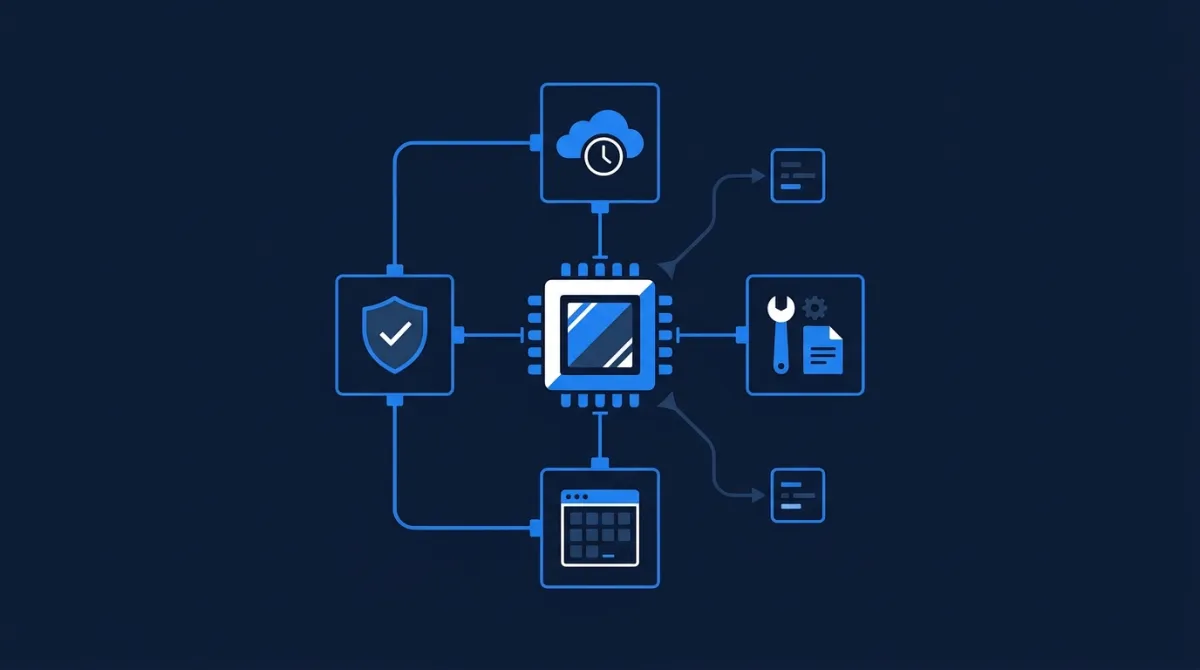
The focus is shifting from the model alone to everything required to make an agent useful in practice: persistent execution, access to real tools, shared context, multi-agent coordination, and controlled environments in which software can be changed safely.
Several announcements from September and October 2026 illustrate this shift. They come from competing companies, serve different audiences, and are not interchangeable products. But together, they reveal where the AI software stack is heading.
Here are five developments worth watching—and what actually matters about each one.
1. OpenAI Agents API: Agent infrastructure becomes a managed service
Released: September 10, 2026
Best suited for: Developers building cloud-based AI workflows
Official announcement: Introducing the Agents API
Building an agent that can answer a question is relatively straightforward. Building one that works through a complex task, uses tools, maintains context, handles failures, and returns a usable artifact is a different engineering problem.
Developers have traditionally had to assemble much of that infrastructure themselves.
OpenAI's Agents API, announced in public beta, aims to reduce that burden by exposing the agent harness and infrastructure behind Codex through an API. Developers can configure a task, model, tools, and execution environment without implementing every part of the orchestration layer from scratch.
The announcement highlights several capabilities:
- Long-running sessions: Context management helps agents continue working across extended sessions.
- Tool discovery: Relevant tool definitions can be loaded when needed instead of always consuming context.
- Programmatic tool calling: Related operations can be chained, filtered, or executed in parallel.
- Subagents: Work can be divided among specialized agents.
- Execution environments: Agents can work with files, run code, and produce artifacts in managed or supported external environments.
Why does this matter?
The difficult part of building a useful agent is often not writing the initial prompt. It is managing everything that happens after the first model response.
A coding agent might need to inspect a repository, run tests, diagnose a failure, edit a file, and verify the result. A research agent might gather information from multiple sources, compare findings, and assemble a report.
A managed harness can reduce the amount of custom infrastructure developers need to maintain.
The trade-off is that developers become more dependent on the platform's APIs, execution model, and operational constraints. A managed agent harness also does not automatically make every workflow reliable or safe; teams still need to define permissions, success criteria, and failure handling.
The important shift: Agent orchestration is becoming a productized infrastructure layer rather than something every team must build independently.
2. Google Gemini agent: From asking questions to delegating outcomes
Announced: October 8, 2026
Best suited for: Businesses that want agents connected to their existing work systems
Official announcement: Welcome to Gemini at Work 2026
Google introduced a unified Gemini agent designed to handle knowledge work, content creation, coding, and other tasks through a common interface.
The significant part is not simply that Gemini can generate more kinds of content. It is the combination of persistent execution, organizational context, connected tools, and delegation.
According to Google, the agent can work with systems such as Gmail, Drive, Docs, Sheets, Calendar, development tools, and enterprise platforms. It can also coordinate specialized subagents and continue work that takes hours or days.
Google describes a model in which users specify an objective and the agent plans and carries out the work, rather than requiring a detailed instruction for every step.
This changes the interaction pattern.
Instead of asking an assistant to summarize several documents and then manually assemble the result, a user could delegate the broader outcome: analyze the documents, compare the findings, prepare a report, and place it in the appropriate workspace.
The promise is fewer handoffs between the user and the software.
Google also describes flexible model selection, allowing the agent to choose among supported models for different jobs. In principle, that separates the agent's identity and context from the specific model used for each task.
That is an important architectural idea: the model can change without forcing the user to rebuild the entire workflow.
But there are practical questions. How accurately does the agent understand organizational context? What happens when two systems contain conflicting information? Which actions require approval? Can users inspect and reverse consequential changes?
The value of a workplace agent will depend on those operational details as much as on its ability to plan.
The important shift: The interface is moving from a place where users ask questions toward a place where they delegate work and review the result.
3. Claude Duet: The standalone agent moves toward proactive work
Reported: October 21, 2026
Best suited for: Professionals and small-business owners exploring more autonomous assistance
Coverage: Reuters report on Claude Duet
Anthropic's reported launch of Claude Duet adds another direction to the agent race: a standalone application designed to help professionals manage and complete work more autonomously.
The broader product trend is important. Rather than treating agentic capabilities as features hidden inside a chat interface, companies are experimenting with dedicated experiences for delegating and managing tasks.
This matters because autonomous work needs a different user experience from ordinary chat.
A conversation is organized around turns: the user asks, the model answers, and the user decides what to do next.
A task-oriented agent needs to communicate other things:
- What work is currently running?
- What has already been completed?
- What information or permissions are missing?
- Which decisions need human approval?
- What evidence supports the claimed result?
- How can the user intervene or recover if something goes wrong?
These are not cosmetic interface questions. They are part of making delegation usable.
A proactive assistant can save time when it handles the coordination surrounding a task. But autonomy can also make mistakes harder to notice if the user cannot see what the agent is doing.
The useful measure is therefore not how many actions an agent can take without interruption. It is how much meaningful work it completes while preserving visibility and appropriate human control.
Because the available reporting is more limited than the detailed developer documentation for the Agents API, Duet should be treated here as evidence of the product direction—not proof that autonomous professional work is already solved.
The important shift: AI agents are becoming dedicated work products, not merely features attached to existing chatbots.
4. Agentic AI Foundation: Four projects target the missing infrastructure
Announced: October 22, 2026
Best suited for: Developers and organizations building interoperable agent systems
Official announcement: Agentic AI Foundation announces four new projects
This may be the most consequential announcement for developers interested in the long-term architecture of AI agents.
The Agentic AI Foundation (AAIF), hosted by the Linux Foundation, announced four projects contributed by different companies:
Agent Skills — Anthropic
An open format for packaging instructions, scripts, and supporting resources into reusable capabilities that compatible agents can load when needed.
The opportunity is to make specialized workflows more portable. Instead of rebuilding the same procedures for every agent, developers can distribute and maintain reusable skills.
Open Responses — OpenAI
An open specification for interoperable interfaces between applications and language models from different providers.
The aim is to reduce the translation work required when supporting multiple model backends through a common interface.
OpenEnv — Hugging Face
An open framework for creating interoperable reinforcement-learning environments.
Standardized environments can make it easier for researchers and developers to build, share, and scale environments used to train and evaluate agents.
OpenSandbox — Alibaba
A general-purpose sandbox platform for AI applications, with support for different programming languages and execution environments.
Sandboxing matters because agents may execute code, modify files, or interact with tools. They need boundaries that limit the damage a mistake or malicious instruction could cause.
These projects address different layers of the stack, but their shared direction is clear: agents need common formats, interfaces, environments, and security infrastructure.
The foundation's announcement brought its portfolio to ten projects in its first year, including established efforts such as the Model Context Protocol (MCP) and Agent2Agent (A2A).
Open governance does not guarantee that every platform will implement these projects identically, nor that every project will become widely adopted. Standards still need active contributors, working implementations, clear specifications, and practical reasons for developers to use them.
Nevertheless, neutral governance can help reduce the risk that essential infrastructure remains controlled by a single vendor.
The important shift: The industry is beginning to standardize the infrastructure around agents, not just compete over the models powering them.
5. GitHub Copilot local sandboxing: Safer execution becomes part of the developer workflow
Generally available: October 7, 2026
Best suited for: Developers using AI coding agents on their own machines
Official release: Local sandboxing for GitHub Copilot
As coding agents gain the ability to run commands, edit files, and interact with development environments, one question becomes increasingly important: what exactly is the agent allowed to touch?
An agent that can execute arbitrary commands with unrestricted access to a developer's machine creates a different risk from an assistant that only suggests code.
GitHub's local sandboxing release introduces a controlled execution boundary for Copilot workflows across supported local environments.
The announced controls can restrict access to areas such as:
- Files and directories the agent can read or modify.
- Internet and local network access.
- Git and GitHub CLI credentials.
- Commands and tools running within the sandboxed workflow.
The feature uses Microsoft Execution Containers to translate a common sandbox policy into operating-system controls across Windows, macOS, and Linux.
The distinction is important: sandboxing applies to tool execution, regardless of which model is generating the commands.
This is a useful architectural principle. A model can be changed, upgraded, or routed to another provider, while the execution boundary continues to enforce the permissions configured by the developer or organization.
Sandboxing is not a complete security solution. Teams still need to review permissions, protect secrets, validate code changes, and consider what happens when an agent is granted access to external services. But it creates a meaningful layer of defense.
The important shift: More autonomous coding requires enforceable execution boundaries, not just better prompts asking the model to behave safely.
What connects these releases?
At first glance, these products solve different problems. One provides developer infrastructure, another targets workplace productivity, another explores a standalone agent experience, and the others address standards and security.
Together, they point to a common architecture.
An increasingly capable agent needs several layers to work well:
- A model to interpret requests, reason, and select actions.
- A harness to manage context, orchestration, retries, and execution.
- Tools and integrations to interact with real systems.
- Skills and memory to supply reusable procedures and relevant context.
- An execution environment to run code and manipulate resources.
- Security and governance to control what the agent is allowed to do.
- Evaluation and observability to determine whether it actually completed the task.
A weakness in any one of these layers can undermine the result.
A powerful model without access to the right tools may be unable to complete the task. A well-integrated agent without adequate permissions may be ineffective. An agent with extensive permissions but weak safeguards may create unacceptable risks.
This is why the agent race is becoming an infrastructure race as well as a model race.
The competitive advantage may increasingly come from how effectively these layers work together.
Which developments should developers pay attention to first?
The answer depends on what you are building.
| If you are building… | Start by exploring… | Why |
|---|---|---|
| A custom cloud agent | OpenAI Agents API | Managed orchestration, tools, subagents, and execution environments |
| A workplace automation workflow | Gemini agent | Integration with organizational systems and persistent work |
| A dedicated assistant product | Claude Duet | A useful example of the shift toward task-oriented agent experiences |
| An interoperable agent stack | AAIF projects | Open formats and shared infrastructure |
| An AI coding workflow | Copilot local sandboxing | More controlled command and file execution |
These are starting points, not universal recommendations. Availability, pricing, platform requirements, data policies, and the actual maturity of each product should be checked before choosing a production dependency.
For an independent developer, the most practical approach is to start with one narrow workflow, define a measurable outcome, and give the agent only the tools and permissions required to complete it.
For a team building agent infrastructure, interoperability, observability, and security deserve attention early. They become harder to retrofit after an application accumulates many tools, workflows, and external dependencies.
The part of the agent story that still needs proof
The announcements are significant, but product capabilities should not be confused with demonstrated business outcomes.
A platform may support long-running tasks without completing every long-running task successfully. A multi-agent system may divide work among subagents without outperforming a simpler design. An open standard may promise portability while implementations still differ in important ways.
The real test is whether these systems can deliver repeatable value in production.
That means measuring task completion, error rates, latency, cost, recovery behavior, and the amount of human intervention required. It also means evaluating how they behave when tools fail, context is incomplete, or a task falls outside their permissions.
The next stage of agent development will be defined not simply by how much autonomy a product advertises, but by how reliably that autonomy can be managed.
Conclusion: The agent is becoming a system, not a prompt
The latest AI releases suggest that the industry is moving beyond the idea that a better model alone will solve the problem of useful automation.
The next generation of agents needs persistent execution, reliable tool access, reusable capabilities, secure environments, and infrastructure that developers can operate and inspect.
OpenAI is productizing parts of the agent runtime. Google is pushing toward persistent, connected workplace delegation. Anthropic is exploring a dedicated professional agent experience. The Agentic AI Foundation is bringing more infrastructure under open governance, while GitHub is strengthening the execution boundaries around coding agents.
These are different bets, and their long-term success remains to be established.
But they share one direction: AI is moving from generating responses toward operating software systems on our behalf.
For developers, the opportunity is to build workflows that were previously too expensive or cumbersome to automate. The responsibility is to make those workflows observable, secure, and testable.
The most useful agent will not be the one that claims the most autonomy. It will be the one that can be trusted with a clearly defined job—and can provide evidence that the job was done correctly.
Sources and further reading
- OpenAI — Introducing the Agents API — September 10, 2026.
- Google Cloud — Welcome to Gemini at Work 2026: Introducing the Gemini agent — October 8, 2026.
- Reuters — Anthropic unveils Claude Duet AI agent app — October 21, 2026.
- Linux Foundation — Agentic AI Foundation announces four new projects — October 22, 2026.
- GitHub Changelog — Local sandboxing for GitHub Copilot now generally available — October 7, 2026.