
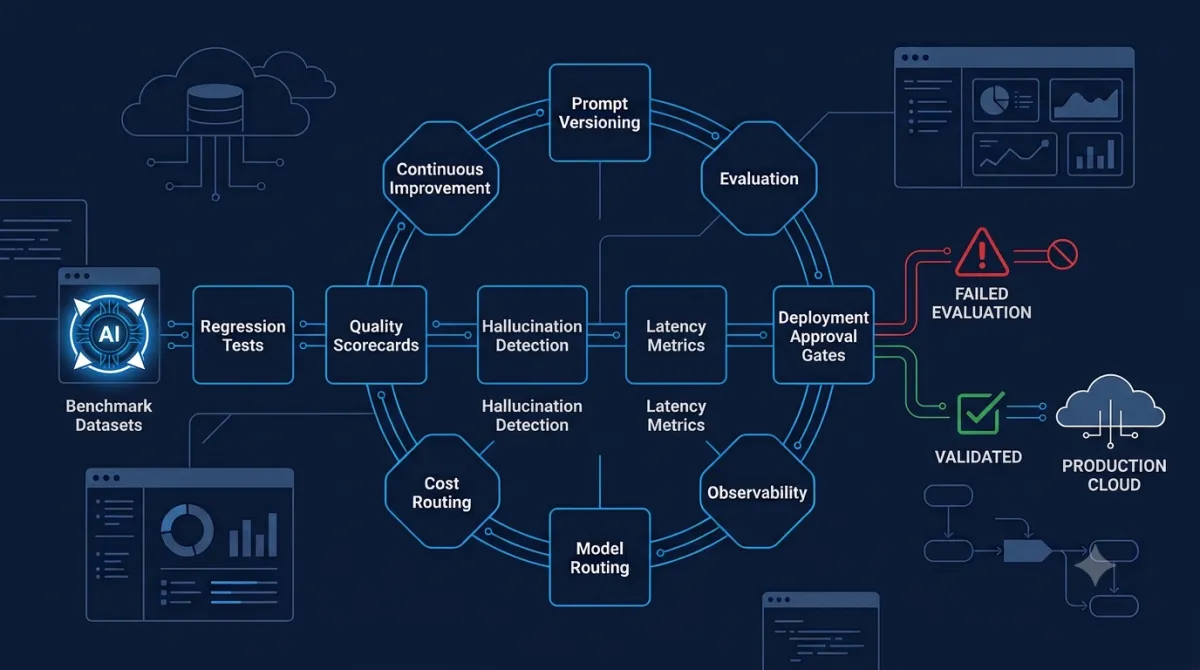
AI Evaluation Pipelines Explained: Why Testing Beats Prompt Guesswork
Changing a prompt is easy.
Knowing whether it actually improved your AI system is much harder.
Many teams still evaluate prompts by opening a chat window, asking a few familiar questions, and deciding which answer "looks better."
That might work for a prototype.
It doesn't work for production.
A customer support assistant may answer thousands of different questions every day. A coding agent must handle countless programming scenarios. An internal knowledge assistant needs to retrieve information accurately across thousands of documents.
Human intuition can't reliably evaluate systems operating at that scale.
That's why mature AI teams are building evaluation pipelines—automated workflows that continuously measure quality before changes reach users.
Why Manual Prompt Testing Doesn't Scale
Imagine updating a customer support prompt.
You test five questions.
Everything looks good.
The update is deployed.
A week later, support tickets increase because the assistant now performs worse on refund requests, multilingual conversations, and edge cases you never tested.
Nothing was technically broken.
The testing process simply wasn't representative.
AI systems require evaluation across hundreds—or sometimes thousands—of realistic scenarios.
Small samples create false confidence.
What Is an AI Evaluation Pipeline?
An AI evaluation pipeline is an automated process that measures the quality of an AI application whenever prompts, models, retrieval systems, or workflows change.
Rather than relying on subjective opinions, it compares outputs against predefined expectations and performance metrics.
A typical pipeline includes:
- benchmark datasets
- automated test cases
- quality metrics
- regression detection
- deployment gates
- production monitoring
The goal isn't to find the perfect prompt.
It's to ensure every change improves—or at least preserves—the quality of the system.
What Should You Evaluate?
Successful AI teams rarely measure only one metric.
Instead, they evaluate multiple dimensions depending on the application.
Accuracy
Did the system produce the correct answer?
Groundedness
Did the response rely on retrieved evidence rather than inventing unsupported information?
Hallucination Rate
How often does the model generate inaccurate or unverifiable claims?
Tool Execution
Did the agent choose the correct tools and use them successfully?
Structured Output
Does the response match the required schema or format?
Latency
How long did the workflow take to complete?
Cost
How many tokens were consumed?
Did quality improvements justify the additional expense?
Quality isn't a single score.
It's a balance between multiple operational objectives.
Benchmark Datasets Become Your AI Test Suite
Traditional software relies on automated tests.
AI systems increasingly rely on benchmark datasets.
Instead of checking whether a function returns the expected value, evaluation datasets contain representative tasks such as:
- customer support questions
- coding challenges
- document summarization
- retrieval scenarios
- classification tasks
- multilingual conversations
Every deployment runs against the same benchmark.
If quality declines, the deployment can be blocked automatically.
This introduces repeatability into AI development.
Regression Testing for AI
One of the biggest advantages of evaluation pipelines is regression detection.
Suppose a new prompt improves coding accuracy by 8%.
That's good news.
But what if it also reduces retrieval accuracy by 15%?
Without automated evaluation, the regression might remain unnoticed until users report problems.
Evaluation pipelines compare new versions against previous baselines across every important metric.
Improvement in one area should never come at the hidden expense of another.
Evaluation Should Extend Beyond Prompts
Many organizations evaluate prompts while ignoring the rest of the AI system.
Production quality also depends on:
- retrieval pipelines
- memory systems
- tool integrations
- model routing
- output validation
- workflow orchestration
Changing any of these components can affect user experience.
Evaluation should measure the application as a complete system rather than focusing solely on language models.
Closing the Loop With Production Data
Offline benchmarks are essential.
Production feedback is equally important.
Leading AI teams continuously compare evaluation results with real-world signals such as:
- user satisfaction
- task completion rates
- escalation frequency
- retry rates
- support tickets
- workflow success
These metrics help identify gaps between laboratory performance and production reality.
The strongest evaluation strategies combine controlled testing with operational monitoring.
Evaluation Is Becoming a Deployment Requirement
As AI applications move deeper into business operations, evaluation is shifting from a best practice to a deployment requirement.
Modern AI release pipelines increasingly follow a sequence like this:
- Update prompt, model, or workflow.
- Run automated evaluations.
- Compare against historical baselines.
- Review quality reports.
- Approve deployment.
- Monitor production metrics.
- Trigger rollback if quality declines.
This process resembles continuous integration and continuous deployment (CI/CD), but with AI-specific quality gates.
Evaluation becomes the checkpoint between experimentation and production.
The Future of AI Development Is Evidence-Based
For years, prompt engineering was driven by experimentation and intuition.
That culture is changing.
Engineering teams are adopting the same principles that transformed software development:
- automated testing
- measurable quality
- repeatable experiments
- continuous monitoring
- data-driven releases
Prompt improvements are no longer accepted because they seem better.
They're accepted because evaluation demonstrates they perform better.
As AI systems become more complex, evidence will replace instinct.
Final Thoughts
Building AI applications is becoming less about finding clever prompts and more about proving that every change delivers measurable value.
AI evaluation pipelines provide the structure needed to test prompts, retrieval systems, agents, and workflows against consistent benchmarks before they reach production. They reduce regressions, improve reliability, and create confidence that updates are based on evidence rather than intuition.
Organizations that invest in evaluation early will iterate faster, deploy with greater confidence, and spend less time reacting to unexpected failures. In production AI, the most successful teams won't be the ones making the most changes—they'll be the ones measuring the impact of every change they make.