
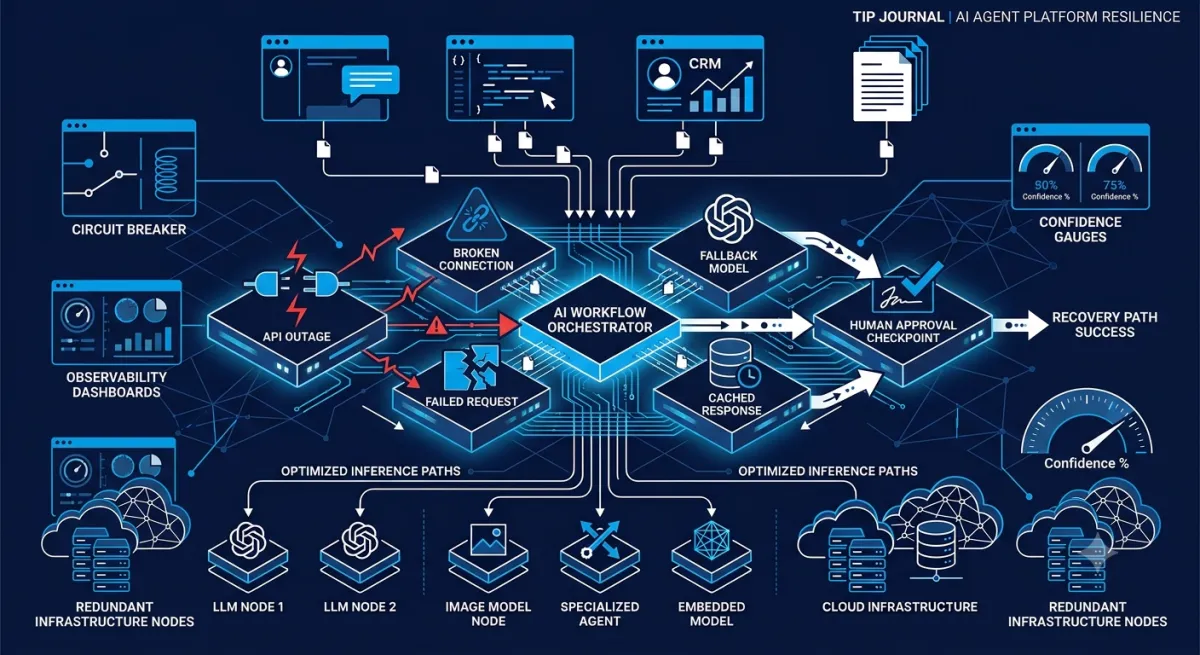
Designing AI Systems That Fail Gracefully: A Practical Guide to Resilient AI Architecture
Every AI system fails.
The difference between a prototype and a production platform isn't whether failures occur.
It's what happens next.
A chatbot that returns an error message during a model outage is unreliable.
A customer support agent that silently invents an answer when retrieval fails is even worse.
The strongest AI platforms aren't built around perfect models.
They're built around imperfect systems that continue operating when individual components fail.
This philosophy—known as graceful degradation—has been part of distributed systems engineering for years. As AI becomes another layer of enterprise infrastructure, the same principles are becoming essential.
Failure Is a Feature of Distributed AI
Modern AI applications depend on far more than a language model.
A single request may involve:
- identity providers
- AI gateways
- retrieval systems
- vector databases
- external APIs
- workflow engines
- memory stores
- moderation services
- evaluation pipelines
Every dependency can fail independently.
Designing for perfect conditions is unrealistic.
Designing for recovery is practical.
Graceful Failure Starts With Understanding Failure Modes
Before building recovery strategies, teams need to understand how AI systems actually fail.
Common failure modes include:
Provider Outages
The language model becomes temporarily unavailable.
Retrieval Failures
Relevant documents aren't found or are incomplete.
Tool Errors
External services return timeouts, permission errors, or invalid responses.
Hallucinations
The model produces confident but incorrect information.
Budget Limits
Token or spending limits are reached during execution.
Latency Spikes
Response times exceed acceptable service-level objectives.
Each scenario requires a different recovery strategy.
Treating all failures the same often creates unnecessary user disruption.
Pattern 1: Fallback Models
A production application shouldn't depend on a single provider.
If a premium reasoning model becomes unavailable, requests may automatically route to:
- another commercial model
- a smaller model
- a local model
- cached responses
Users may notice reduced capability.
They shouldn't lose access entirely.
Graceful degradation prioritizes availability over perfection.
Pattern 2: Progressive Response Strategies
Not every task requires the same level of intelligence.
Instead of returning an error immediately, systems can reduce functionality in stages.
For example:
- Attempt the preferred reasoning model.
- Retry using an alternative provider.
- Use retrieval without reasoning.
- Return cached information.
- Escalate to a human operator.
Every successful fallback improves the user experience.
Pattern 3: Human-in-the-Loop Recovery
Some failures shouldn't be solved automatically.
Examples include:
- financial approvals
- healthcare recommendations
- legal advice
- account changes
- production deployments
When confidence drops below a defined threshold, the system should pause and request human review.
Graceful failure sometimes means knowing when not to automate.
Pattern 4: Circuit Breakers for AI
Repeated failures can overwhelm downstream services.
Borrowing from distributed systems, circuit breakers temporarily stop requests to failing dependencies.
Instead of repeatedly calling an unavailable provider, the application:
- detects repeated failures
- pauses requests
- retries after a cooldown period
- restores traffic gradually
This prevents cascading failures across the platform.
Pattern 5: Confidence-Based Decision Making
Language models often produce fluent answers regardless of certainty.
Production systems should supplement model outputs with confidence signals.
Examples include:
- retrieval coverage
- tool execution success
- validation results
- evaluation scores
- policy checks
Applications can then choose between:
- automatic completion
- additional verification
- alternative workflows
- human escalation
Confidence becomes an operational input rather than a user-facing metric.
Pattern 6: Observability Before Recovery
You can't recover from failures you don't detect.
Production AI systems should monitor:
- model latency
- provider availability
- retrieval quality
- tool success rates
- token consumption
- prompt versions
- workflow completion
- user satisfaction
Observability transforms failures into measurable engineering problems.
Without telemetry, graceful recovery becomes impossible.
Designing for Resilience Instead of Perfection
Successful engineering teams don't ask:
"How do we eliminate every failure?"
They ask:
"How do we make failures predictable, observable, and recoverable?"
That shift changes architectural priorities.
Instead of maximizing benchmark performance alone, teams invest in:
- redundancy
- validation
- retry logic
- automated testing
- fallback workflows
- operational playbooks
Reliability becomes a platform capability rather than a property of a single model.
The Future of AI Will Be Measured by Reliability
As AI moves deeper into enterprise operations, expectations will change.
Users won't compare benchmark scores.
They'll judge whether systems remain dependable during real-world conditions.
Organizations that treat AI like cloud infrastructure—not experimental software—will increasingly adopt engineering disciplines such as:
- incident response
- disaster recovery
- service-level objectives
- chaos testing
- redundancy planning
- resilience engineering
These practices have long defined reliable distributed systems.
They're now becoming equally important for AI.
Final Thoughts
Every production AI system eventually encounters failures. Models become unavailable, tools stop responding, retrieval pipelines break, and unexpected edge cases emerge. These events aren't exceptional—they're part of operating complex software.
Designing AI systems that fail gracefully means accepting this reality and building architectures that continue delivering value even when individual components don't. Fallback models, confidence-based routing, circuit breakers, human oversight, and strong observability all contribute to resilient AI platforms.
In the years ahead, the organizations that earn user trust won't necessarily have the smartest AI. They'll have the AI that remains dependable when everything else goes wrong.