
Why Every Coding Agent Needs a Sandbox
Subtitle: AI coding agents can write, execute, and debug code without waiting for a developer at every step. But giving an agent a terminal is also giving model-directed operations access to a real computing environment. Sandboxing makes that capability safer to deploy.
A coding agent receives a task, inspects a repository, modifies a few files, installs a dependency, and runs the test suite. The tests fail, so it changes the implementation and tries again.
This is exactly the workflow that makes coding agents useful: they can execute code, observe the results, and iterate.
Now imagine that one of the commands deletes an important directory. Or that a package installation runs a malicious script. Or that the repository contains instructions designed to trick the agent into exposing an environment variable.
The problem is not necessarily that the model is malicious. The problem is that the agent executes instructions and code whose effects may not be fully predictable.
A prompt saying "never delete important files" is not a security boundary. Neither is asking the model to inspect a command before running it.
The more useful an agent becomes at executing code, the more important it becomes to control where that code runs and what it can access.
That is the role of a sandbox.
1. Why coding agents change the security model
Traditional development tools usually operate under a human-controlled workflow. A developer writes or reviews code, executes commands, examines their effects, and decides what to do next.
Coding agents compress that loop.
An agent may generate a script and execute it seconds later. It may install packages, modify files, launch processes, inspect test failures, and make further changes without a person reviewing every intermediate step.
The execution environment must therefore account for code that has not been reviewed before it runs.
That code can originate from several places:
- The model's own generated commands or scripts.
- A repository or dependency the agent has been asked to inspect.
- Instructions embedded in an issue, document, or web page.
- Test fixtures and build scripts.
- Packages installed during the task.
These sources can influence the agent's decisions in unexpected ways. A malicious repository instruction, for example, might persuade an agent to run a command that attempts to read local credentials.
This is why the security question is not simply whether the model follows its instructions. It is whether the system limits the consequences when the model, its inputs, or an executed program behaves unexpectedly.
A sandbox creates a separate environment in which the agent can perform its work under defined restrictions.
2. What a sandbox actually provides
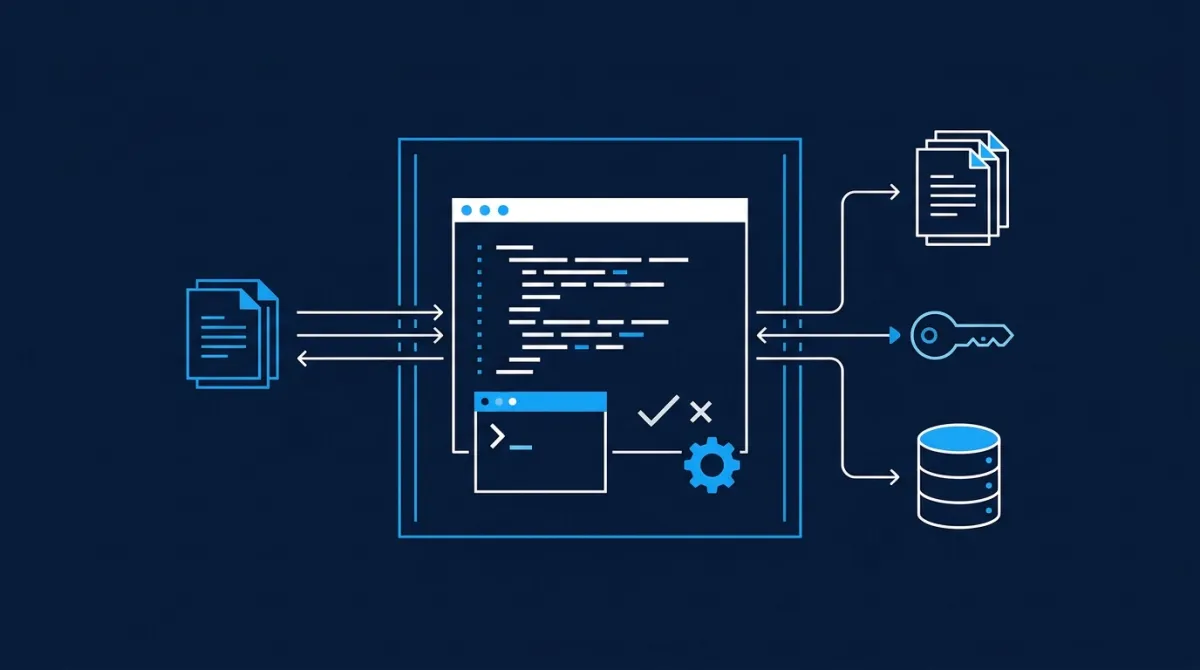
A coding sandbox is an isolated execution environment with the resources needed to perform a task: a filesystem, shell, installed tools, and often network access and persistent workspace state.
The agent can use that environment to inspect files, execute commands, install dependencies, run tests, and produce artifacts. The surrounding application determines what the environment is allowed to access and what happens to its results.
A typical workflow looks like this:
- Create a sandbox for a task.
- Prepare a workspace containing the repository and required files.
- Give the agent narrowly scoped tools and permissions.
- Let it execute commands and inspect their results.
- Collect the proposed changes and test evidence.
- Review or validate the output.
- Preserve the required artifacts and dispose of the environment when appropriate.
The important distinction is between execution and control.
The sandbox executes model-directed commands. A trusted orchestration layer should manage access, credentials, approval requirements, logging, and the overall task lifecycle.
This separation reduces the need to give the agent direct access to the developer's machine or production infrastructure.
OpenAI's Sandbox Agents documentation describes this architecture as a separation between the agent harness—which manages model calls, tool routing, approvals, and recovery—and the sandbox environment where commands run and files change.
The exact protections depend on the implementation. A sandbox is not automatically secure simply because it has a separate directory or runs inside a container.
3. A container is not the whole security strategy
Containers are a common way to create isolated workspaces. They package a process with a filesystem view, dependencies, and resource settings, making it easier to create repeatable environments.
For many development tasks, a properly configured container is useful. But containerization and security isolation are not interchangeable terms.
Containers commonly share the host operating-system kernel. Their protection depends on kernel security, namespaces, capabilities, filesystem mounts, runtime configuration, and other controls.
A container that runs with excessive privileges, mounts sensitive host directories, exposes the Docker socket, or receives unrestricted credentials can undermine the intended boundary.
Other approaches include virtual machines and microVMs, which can provide a separate guest kernel. They introduce different startup, resource, and operational trade-offs.
The right choice depends on the threat model.
| Approach | Typical advantage | Important limitation |
|---|---|---|
| Separate process or workspace | Lightweight and easy to set up | May provide little security isolation |
| Container | Fast startup and familiar tooling | Shares the host kernel; configuration matters |
| VM or microVM | Stronger separation through a guest kernel | Additional infrastructure and resource overhead |
| Managed sandbox service | Outsources much of the lifecycle and runtime management | Depends on provider guarantees, configuration, and data-handling requirements |
No row is universally best. A local development experiment, an online code-execution service, and a platform executing thousands of untrusted agent tasks have different requirements.
The key is to select an isolation boundary appropriate to the potential damage—not simply the easiest runtime to launch.
4. Filesystem access: what can the agent change?
A coding agent needs to modify files. But it rarely needs unrestricted access to every file available to the machine running it.
Consider an agent asked to fix a bug in one repository. Its workspace may require:
- The project source code.
- Tests and fixtures.
- Project-specific configuration.
- A temporary directory for build artifacts.
- A dependency cache, if permitted.
It should not automatically receive access to unrelated repositories, SSH keys, browser profiles, personal documents, or production configuration files.
A useful design gives the sandbox a dedicated workspace and explicitly controls which files and directories are mounted into it.
Read-only mounts can protect inputs that should not change. Writable mounts can be restricted to the task's working directory. Sensitive directories should remain outside the sandbox unless the task genuinely requires them.
There is a subtle but important point: mounting a host repository into a sandbox as writable means the agent may still modify the host's files through that mount. Destroying the sandbox does not undo those changes.
For stronger separation, create a temporary checkout, worktree, or copy inside the isolated environment. Review the resulting diff before applying it to the main repository.
This makes rollback easier and limits the damage from a bad command.
5. Network access is another permission boundary
Code execution often requires network access.
An agent may need to download dependencies, clone a repository, access package registries, or communicate with an approved API. Blocking all outbound traffic can break legitimate tasks.
But unrestricted network access creates a different problem.
Suppose the agent executes a package installation script that attempts to upload local files to an external server. Or a malicious repository instruction persuades it to contact an attacker-controlled endpoint.
If the sandbox can reach arbitrary destinations and has access to sensitive files, the environment may provide a route for data exfiltration.
A safer network policy can include:
- Denying outbound access by default where practical.
- Allowing only required package registries and approved services.
- Routing authenticated requests through a trusted proxy.
- Preventing the sandbox from accessing internal control-plane services.
- Logging network activity where the environment supports it.
Credentials deserve special attention.
An API key placed directly in an environment variable inside the sandbox may be readable by any process with sufficient access in that environment. If the agent runs untrusted commands, the key may be exposed.
A stronger architecture keeps long-lived credentials in trusted infrastructure and provides narrowly scoped access through a proxy or broker. The broker can enforce destination and permission policies without revealing the underlying secret to the agent.
Cloudflare's coding-agent sandbox guide describes a pattern in which the orchestration layer retains credentials and injects authorization into approved model requests, while the sandbox's network access is controlled separately.
The principle is simple: give the agent the ability to perform an authorized operation without giving it unrestricted access to the credentials that make the operation possible.
6. Resource limits prevent runaway execution
Not every dangerous command is malicious.
A generated script might enter an infinite loop. A build could consume excessive memory. A dependency installation might fill the available disk. A test suite could run much longer than expected.
Without limits, a single task can affect other workloads or exhaust the machine's resources.
A production sandbox should enforce appropriate limits for:
- CPU usage.
- Memory consumption.
- Disk space.
- Execution time.
- Process counts.
- Network traffic, where supported.
Limits should be applied by the execution platform rather than relying on the model to recognize when it is consuming too many resources.
This matters especially when many agents run concurrently. An environment that is acceptable for one developer may behave very differently when hundreds of tasks execute in parallel.
Resource management is therefore both a reliability measure and a security control.
7. A fresh environment for every task
One attractive property of a sandbox is that it can be disposable.
When a task begins, the platform creates a known environment with a defined starting state. When the task ends, the environment can be destroyed or reset.
This reduces the risk that one task leaves behind unexpected files, running processes, modified tools, or other state that affects the next task.
But complete disposability is not always practical. Coding agents often need to resume work after a model call, an approval step, or a temporary infrastructure failure.
A useful design separates the workspace lifecycle from the task's durable artifacts.
The environment may be temporary while the system preserves:
- The proposed patch or Git diff.
- Test results and execution logs.
- Required generated files.
- A snapshot needed to resume work.
- Task metadata and approval history.
Snapshots can also help create multiple isolated branches of an experiment from the same prepared starting point.
The critical rule is that persistence should be intentional. A resumed environment must not silently inherit credentials, untrusted processes, or access permissions that are no longer appropriate.
8. Isolation does not replace code review or testing
A sandbox limits the environment in which code executes. It does not prove that the generated code is correct.
An agent can produce a logically incorrect patch, introduce a subtle security vulnerability, or modify a file in a way that passes the existing tests but breaks a different workflow.
A secure execution environment is one layer in a larger development process.
A practical pipeline might include:
- Execute the agent's work in an isolated workspace.
- Run unit tests, integration tests, and relevant static checks.
- Inspect the diff for unexpected files or changes.
- Scan dependencies and generated code where appropriate.
- Require review for sensitive changes.
- Run independent CI checks before merging or deploying.
These controls serve different purposes.
The sandbox limits the effects of execution. Tests check expected behavior. Static analysis can identify certain defect patterns. Human review evaluates intent, architecture, and changes that automated checks may miss.
An agent reporting "all tests passed" should also provide the commands executed and the actual results. The surrounding system should verify those results rather than treating the model's summary as proof.
And even if a patch passes every test, that does not justify giving the agent unrestricted access to production systems.
9. Why sandbox infrastructure is becoming its own product category
As agents become capable of handling complete development tasks, sandbox management becomes more than a way to launch a container.
A production platform may need to create environments on demand, allocate resources, preserve state, enforce network rules, expose files and tools through APIs, and terminate environments reliably.
It may also need to support different kinds of work: code execution, browser automation, data analysis, application previews, and automated testing.
OpenSandbox is one example of this infrastructure direction. Its official project site describes an open-source platform for running AI agents in isolated environments, with support for code execution, commands, files, browsers, and desktop workflows. The project supports local Docker-based development and deployment through Kubernetes.
Its significance is architectural: rather than making every agent implementation responsible for building and managing its own execution environment, a shared sandbox layer can provide a consistent interface for creating and controlling isolated workspaces.
That separation can make it easier to change the model or agent framework without rebuilding the entire execution infrastructure.
It does not mean every application needs a dedicated sandbox platform. A small internal tool may work perfectly well with a simpler, well-configured execution environment. The need for a separate platform grows with concurrency, workload diversity, isolation requirements, and operational complexity.
10. A practical checklist before deploying a coding agent
Before allowing an agent to execute commands against a real repository, answer these questions.
Isolation
- Does the agent run outside the developer's normal working environment?
- Is the chosen boundary appropriate for untrusted code?
- Can one task access another task's workspace?
Permissions
- Are filesystem mounts limited to the required files?
- Does the agent run without unnecessary administrative privileges?
- Are production credentials and host secrets kept outside its reach?
Networking
- Which outbound destinations are allowed?
- Can the agent reach internal services that it does not need?
- Are authenticated requests mediated through a trusted layer?
Resource control
- Are CPU, memory, disk, and execution-time limits enforced?
- Can a runaway process exhaust shared capacity?
- Is there a mechanism to terminate stalled tasks?
Recovery and evidence
- Can the task be stopped and resumed safely?
- Are important commands, outputs, and changes recorded?
- Can the platform produce a reviewable diff and test report?
- Are persistent artifacts separated from temporary execution state?
Deployment
- Does independent CI validate the resulting changes?
- Are sensitive operations subject to human approval?
- Is there a clear rollback path if the agent's changes cause problems?
If these questions have no clear answers, improving the model's prompt is not the next priority. The execution environment needs attention first.
The agent can be autonomous without being unrestricted
Coding agents become more useful when they can execute code, inspect real results, and iterate without constant human supervision. Those same capabilities make their execution environment part of the application's security model.
A sandbox does not make every action safe. Its protections depend on the isolation mechanism, filesystem configuration, network policy, credentials, resource limits, and how the surrounding application handles results.
But it establishes an essential principle: the agent should have enough access to complete the task, not enough access to damage everything around it.
As agentic development scales from individual experiments to shared platforms, this boundary becomes infrastructure that developers must design, measure, and maintain.
The objective is not to stop coding agents from taking action.
It is to let them take action in a place where mistakes are contained, results are verifiable, and the rest of the system remains protected.
Further reading
- Sandbox Agents — OpenAI API
- Run coding agents in a sandbox — Cloudflare
- OpenSandbox — Official project site
- OpenSandbox — GitHub repository
- Agent Sandbox — Kubernetes SIGs
TipJournal covers the engineering decisions behind AI tools and systems—not just the announcements.