
Prompt Engineering Best Practices: Why It's Becoming Configuration, Not Programming
The most valuable prompt in your company probably isn't written by one person anymore.
It's assembled.
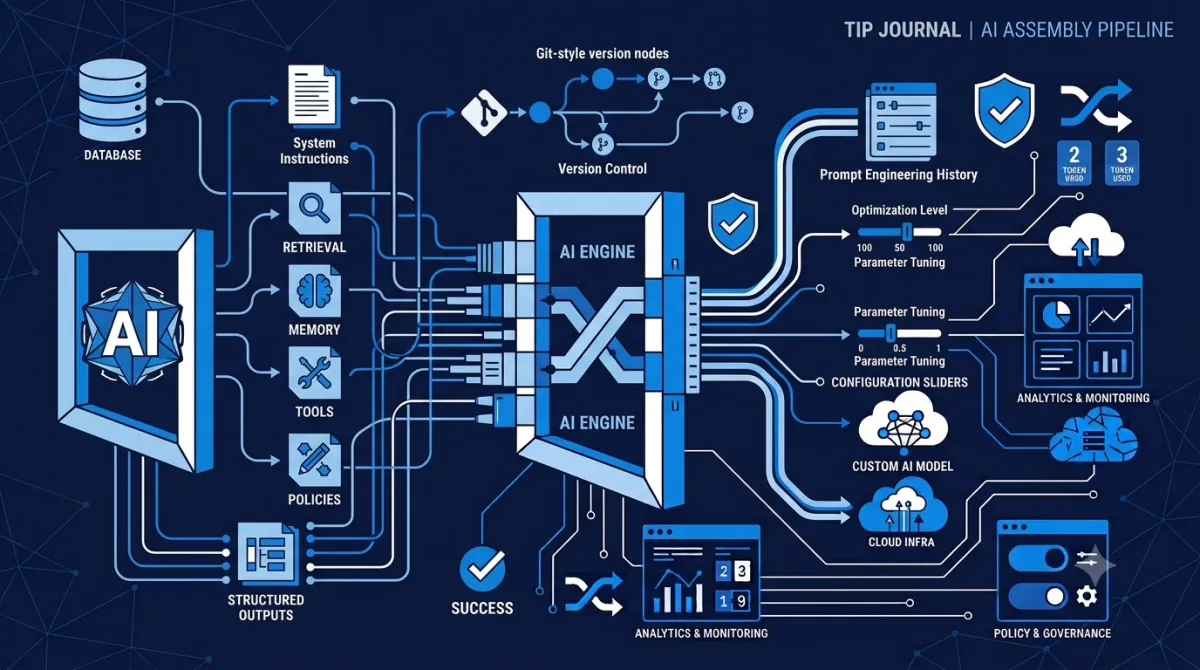
A production AI application might combine a system prompt, user context, retrieved documents, organizational policies, tool descriptions, memory, and structured output requirements before a model generates a single token.
In other words, modern prompting is becoming less about writing clever instructions and more about configuring reliable AI systems.
This represents one of the biggest shifts in enterprise AI. The organizations building successful AI products are spending less time discovering "magic prompts" and more time building repeatable prompt architectures that can be versioned, tested, monitored, and improved.
The Era of the Master Prompt Is Ending
Early LLM applications depended heavily on handcrafted prompts.
Teams experimented endlessly with wording:
- "Act as an expert..."
- "Think step by step..."
- "Answer in JSON..."
- "Never hallucinate..."
Small wording changes sometimes produced dramatic improvements.
That environment encouraged a perception that prompt engineering was primarily a writing exercise.
As AI systems matured, however, developers discovered a limitation:
Large prompts don't scale.
A 2,000-word prompt copied across dozens of applications quickly becomes difficult to maintain, audit, and improve.
Every product update creates inconsistencies.
Every copied prompt introduces technical debt.
The problem is no longer writing prompts.
It's managing them.
Prompt Engineering Best Practices Have Shifted Toward System Design
Modern AI applications rarely rely on static prompts.
Instead, prompts are assembled dynamically from multiple components.
A typical production request may include:
- a system instruction
- user input
- retrieved documentation
- company policies
- tool definitions
- conversation memory
- formatting rules
- output schemas
Each component serves a different purpose.
Rather than editing one massive prompt, engineering teams configure these building blocks independently.
This modular approach improves maintainability while reducing unintended side effects when updates are required.
Prompt engineering increasingly resembles application configuration rather than creative writing.
Why Configuration Beats Customization
Configuration introduces several operational advantages.
Reusability
A prompt module describing company tone can be reused across customer support, documentation, and marketing applications.
Version Control
Prompt components can evolve independently.
Teams can review changes through Git, compare versions, and roll back problematic updates.
Testing
Instead of manually reading outputs, organizations can evaluate prompt changes using benchmark datasets and automated regression tests.
Governance
Sensitive instructions—such as compliance requirements or security policies—can be managed centrally instead of duplicated across dozens of applications.
The result is greater consistency and significantly lower maintenance costs.
Prompt Libraries Are Replacing Individual Prompt Files
Many engineering teams now organize prompts similarly to software components.
Instead of storing prompts inside application code, they maintain structured libraries containing:
- reusable system prompts
- task templates
- response schemas
- persona definitions
- policy modules
- localization variants
Applications assemble these components based on the task being performed.
For example, a customer support assistant and a technical documentation generator may share compliance rules while using different tone modules and retrieval pipelines.
This modularity makes prompt changes easier to test and deploy.
Retrieval and Tools Reduce Prompt Complexity
Another reason prompt engineering is changing is that modern models no longer rely exclusively on instructions.
They increasingly depend on external context.
Retrieval-Augmented Generation (RAG) allows models to access relevant documents instead of embedding extensive knowledge inside prompts.
Tool calling enables models to retrieve live information rather than guessing.
Memory systems preserve context across conversations without continuously expanding prompt length.
As these capabilities improve, prompts become orchestration instructions rather than repositories of information.
The prompt tells the model how to use knowledge, not what knowledge to memorize.
Measuring Prompt Quality Like Software
Perhaps the biggest cultural shift is how prompts are evaluated.
Successful AI teams no longer ask:
"Does this prompt sound better?"
They ask:
- Does accuracy improve?
- Does hallucination decrease?
- Does latency increase?
- Does token usage remain acceptable?
- Does customer satisfaction improve?
- Does the new version outperform the previous one?
Prompt changes become measurable engineering decisions instead of subjective opinions.
This enables continuous improvement through experimentation rather than intuition.
The Future Is Prompt Operations, Not Prompt Engineering
The next stage of enterprise AI is unlikely to revolve around individual prompt specialists.
Instead, organizations will build operational systems around prompts.
Expect to see practices such as:
- prompt versioning
- automated evaluations
- deployment pipelines
- approval workflows
- rollback mechanisms
- policy validation
- performance monitoring
Collectively, these practices resemble DevOps far more than traditional copywriting.
Some teams have already begun referring to this broader discipline as PromptOps, emphasizing lifecycle management over prompt creation.
Regardless of the terminology, the direction is clear: prompts are becoming managed infrastructure.
Final Thoughts
Prompt engineering is not disappearing—it is evolving.
Writing effective instructions remains important, but long-term success increasingly depends on how those instructions are organized, tested, governed, and integrated into larger AI systems.
These prompt engineering best practices reflect a broader transition from isolated prompt writing to configuration-driven AI development. Teams that adopt modular prompt architectures, reusable components, and systematic evaluation processes will be better equipped to maintain reliable AI applications as models, tools, and business requirements continue to evolve.
The future of prompting belongs less to individual prompt authors and more to engineering teams that treat prompts as versioned, testable, and configurable assets.