
Context Engineering Is Replacing Prompt Engineering as the New AI Discipline
For the past few years, AI developers have been obsessed with prompts.
Make the instructions clearer.
Add examples.
Change the system message.
Tell the model to reason step by step.
Try another prompt template.
This approach worked when AI applications were mostly chat interfaces.
It becomes much less effective when AI systems start performing complex tasks.
An agent investigating a customer issue may need access to account history, internal documentation, recent transactions, API responses, organizational policies, and previous interactions—all within the same workflow.
No single prompt can contain everything.
The problem is no longer simply what should we tell the model?
It's what should the model know right now?
That shift is driving the rise of context engineering.
Prompt Engineering Was Only the Beginning
Prompt engineering focuses on instructions.
It answers questions like:
- What should the model do?
- How should it respond?
- What format should it use?
- What rules should it follow?
Context engineering addresses a broader problem.
It determines:
- What information should be included?
- Which information is relevant?
- Where should it come from?
- How should it be structured?
- When should it be retrieved?
- What should be removed?
- How should the context change as the task evolves?
The prompt is part of the system.
The context is the environment in which the model makes decisions.
Why Bigger Context Windows Don't Solve the Problem
The arrival of increasingly large context windows might suggest that context engineering is becoming unnecessary.
The opposite is true.
More available context doesn't automatically mean better context.
Consider an AI agent working with thousands of documents.
Giving the model access to every document creates several problems:
- higher inference costs
- increased latency
- irrelevant information
- conflicting information
- reduced attention to important details
The challenge isn't simply fitting more information into the context window.
It's selecting the right information at the right time.
Context engineering is fundamentally an information selection problem.
The Context Stack
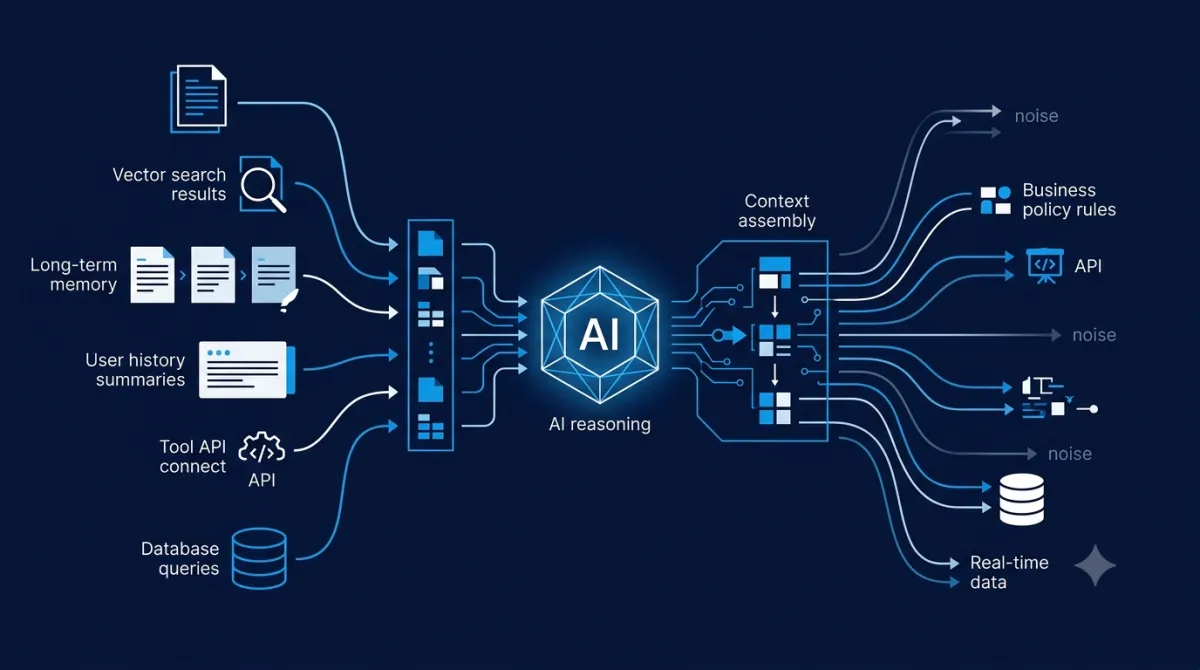
Modern AI systems assemble context from multiple sources.
A typical request may combine:
System Instructions
Rules that define the model's role and behavior.
User Input
The immediate request from the person interacting with the system.
Retrieved Knowledge
Documents and information retrieved from external data sources.
Conversation History
Recent interactions that provide continuity.
Long-Term Memory
Persistent information about users, projects, or previous events.
Tool Results
Real-time information returned by APIs, databases, browsers, or other software.
Business Policies
Rules governing what the AI is allowed to do.
Environmental State
Information about the current workflow, application, or execution state.
The model receives a unified context.
Behind the scenes, multiple systems are responsible for assembling it.
This is where context engineering becomes an architectural discipline.
Retrieval Is Only One Part of Context Engineering
Context engineering is often confused with Retrieval-Augmented Generation (RAG).
RAG is important.
It is not the whole picture.
Retrieval answers one question:
Which external information should be added to the context?
Context engineering asks additional questions:
- Which memories should be included?
- Which tools should be available?
- Which instructions have priority?
- Which information is outdated?
- Which context should be removed?
- How should conflicting sources be resolved?
A production AI system may use retrieval, memory, tools, and policies simultaneously.
Context engineering coordinates all of them.
The Context Budget Is a Real Engineering Constraint
Every AI application operates within a context budget.
That budget isn't limited to tokens.
It also includes:
- latency
- inference cost
- retrieval time
- model attention
- system complexity
More context can increase costs while reducing relevance.
The goal is therefore not to maximize context.
It's to maximize useful context.
This introduces new optimization problems.
Engineering teams must decide:
- What information deserves priority?
- What can be summarized?
- What can be discarded?
- What should be retrieved dynamically?
- What should remain permanently available?
The best AI systems treat context as a scarce resource.
Context Compression Becomes Important
Long-running AI agents can accumulate enormous amounts of information.
A multi-hour research task might generate:
- dozens of tool calls
- hundreds of search results
- multiple intermediate conclusions
- large documents
- previous reasoning steps
Passing everything back to the model is inefficient.
Context engineering systems increasingly compress information into more useful representations.
Examples include:
- conversation summaries
- task state
- extracted facts
- structured memory
- intermediate results
Instead of carrying the entire history forward, the system preserves the information that matters.
The objective is simple:
Keep the signal. Remove the noise.
Context Changes During Execution
Traditional prompts are static.
Agentic systems are dynamic.
An agent might begin with:
"Investigate why this customer's order was delayed."
After the first tool call, the context changes.
The agent discovers:
- the order was shipped
- the carrier reported a delay
- the customer contacted support twice
The next action should now be based on this new information.
Context engineering therefore becomes a continuous process.
The system must repeatedly:
- Observe the current state.
- Retrieve relevant information.
- Update the context.
- Select available tools.
- Execute the next action.
This is fundamentally different from sending one large prompt to a model.
Context Engineering Changes Agent Architecture
The rise of AI agents makes context engineering increasingly important.
Agents don't simply answer questions.
They operate within environments.
They need to know:
- what has already happened
- what remains to be done
- what tools are available
- what constraints apply
- what information is trustworthy
A well-designed agent therefore requires a context architecture.
That architecture may include:
- memory systems
- retrieval pipelines
- state management
- tool registries
- policy engines
- context filters
- summarization systems
- model routing
The agent becomes the decision-making layer.
Context engineering becomes the information infrastructure around it.
From Prompt Engineering to Context Engineering
The evolution can be summarized simply.
Prompt Engineering
"How do I ask the model the right question?"
Context Engineering
"How do I give the model the right information to make the right decision?"
The second question is much broader.
It includes prompt design but extends into software architecture, data engineering, information retrieval, memory systems, and AI infrastructure.
This is why context engineering is emerging as a distinct engineering discipline.
The New AI Engineering Skillset
The AI engineers building production systems will increasingly need skills beyond prompt writing.
They will need to understand:
- information retrieval
- vector search
- knowledge graphs
- databases
- memory architectures
- agent workflows
- API integration
- context optimization
- evaluation
- observability
The most valuable AI engineer may not be the person who writes the cleverest prompt.
It may be the person who designs the system that consistently provides the model with exactly what it needs.
Final Thoughts
Prompt engineering isn't disappearing.
It's becoming one component of something larger.
As AI systems become more autonomous, the quality of their outputs increasingly depends on the quality of the information surrounding them. The model can only reason effectively about the context it receives.
That makes context selection, retrieval, memory, state, tools, and policies first-class engineering problems.
The next generation of AI applications won't be built by endlessly adding instructions to larger prompts. They'll be built by engineering dynamic information environments that give models the right context at the right moment.
The future of AI engineering may therefore be less about teaching models what to say—and more about designing what they should know before they act.